
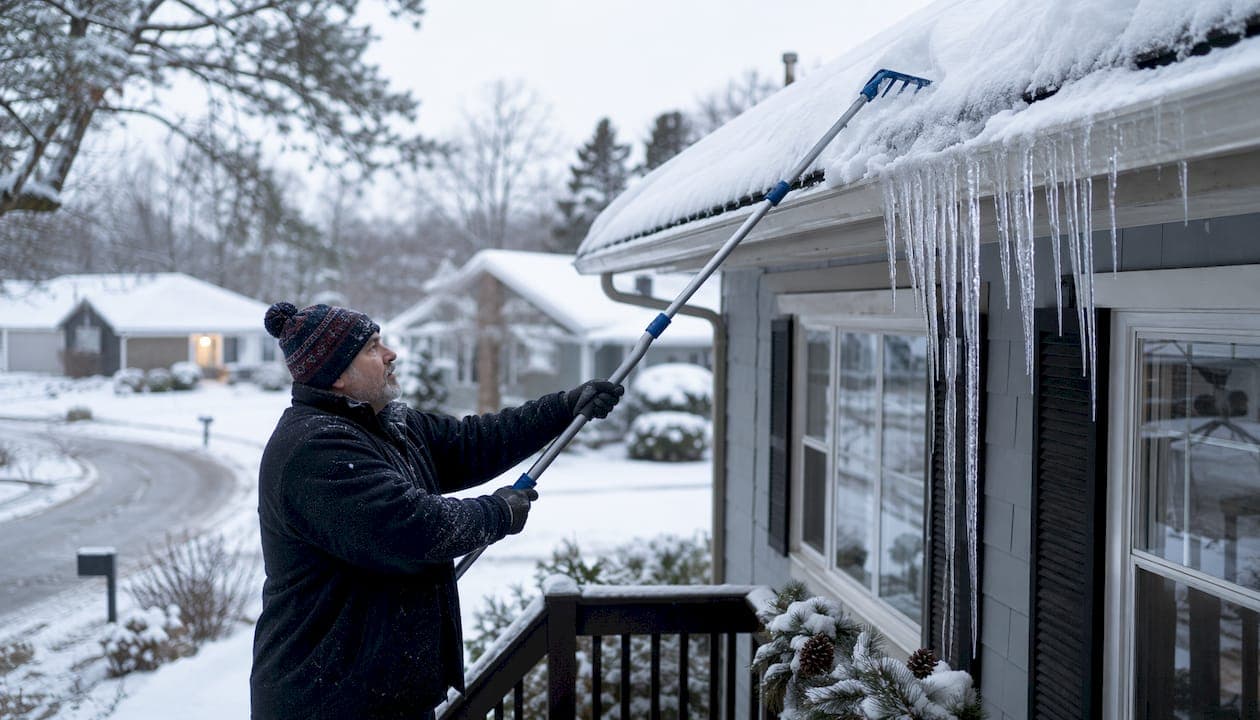
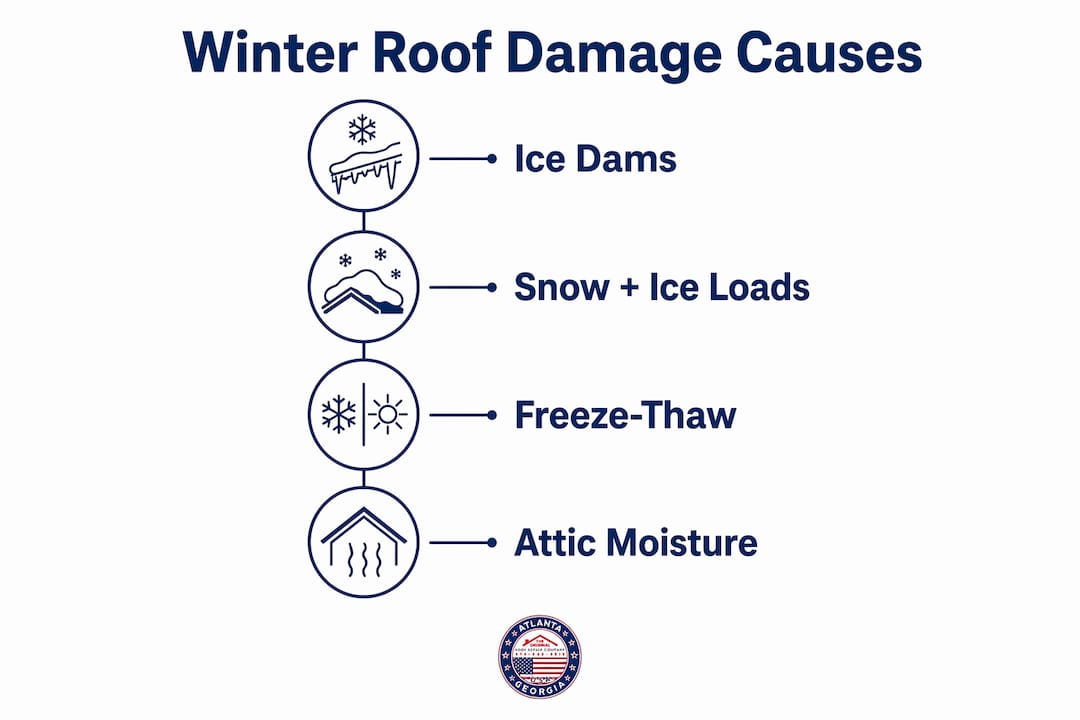
Winter damages roofs through four overlapping mechanisms: snow and ice loads that stress framing, ice dams that force meltwater under shingles, freeze–thaw cycles that crack and separate materials, and attic moisture from air leakage that rots decking from the inside out. If you suspect damage right now, take these steps first:
- Inspect from the ground. Use binoculars or a phone camera to scan for missing shingles, ice ridges, or sagging sections. Do not climb onto an icy roof.
- Document everything. Photograph and timestamp any visible damage for your insurance claim before conditions change.
- Protect entryways and HVAC units. Clear snow and ice from paths near doors, vents, and outdoor equipment where falling ice or shedding snow can cause injury.
Safety first: Falling icicles and sliding snow are genuine hazards, not just property concerns. FEMA and the National Weather Service specifically warn homeowners to plan roof-shedding paths to protect people and equipment below. If you see sagging, active leaking, or heavy concentrated snow, call a professional before going near the roof.
Table of Contents
- Why winter causes roof damage: the four core mechanisms
- What does winter roof damage actually look like?
- How winter roof risk varies by U.S. region
- How to prevent winter roof damage before and after a storm
- When should you call a roofer after winter weather?
- Safe tools and methods for post-storm roof checks
- Will insurance cover your winter roof damage?
- How much snow or ice actually puts your roof at risk?
- Local expertise: The Original Roof Repair Company in Cherokee County and the Atlanta area
- Key Takeaways
- What most homeowners get wrong about winter roof damage
- Roof inspections and emergency repairs for Atlanta-area homeowners
- Useful sources
- FAQ
Why winter causes roof damage: the four core mechanisms
Cold weather does not damage roofs uniformly. The failures follow predictable physics, and understanding them helps you spot problems before they become expensive.
Ice dams: the most misunderstood culprit
An ice dam is a ridge of ice that builds at the roof's edge, blocking meltwater from draining. According to UMass Amherst building research, ice dams can form with as little as 1–2 inches of snow when a warm roof deck and cold eaves exist simultaneously. Heat escaping from the living space warms the upper roof deck, melting the snow above. That water runs down the slope, hits the cold overhang, and refreezes. The dam grows, and the pooled water behind it wicks back under shingles and into the attic.
The root cause is almost always an energy problem, not a weather problem. Air leakage through ceiling penetrations — around recessed lights, plumbing stacks, chimneys, and ductwork — lets warm, moist interior air into the attic. That air condenses on the cold roof deck, accelerating both ice dam formation and hidden rot long before any visible leak appears.
Snow and ice loads
Fresh snow is relatively light, but packed or wet snow is significantly heavier, and one inch of ice weighs roughly the same as a foot of fresh snow. Structural risk rises sharply when loads concentrate in one area. Drifting and sliding from higher roof sections create local depths far greater than the average roof depth, which is where framing failures typically begin.
Freeze–thaw cycles
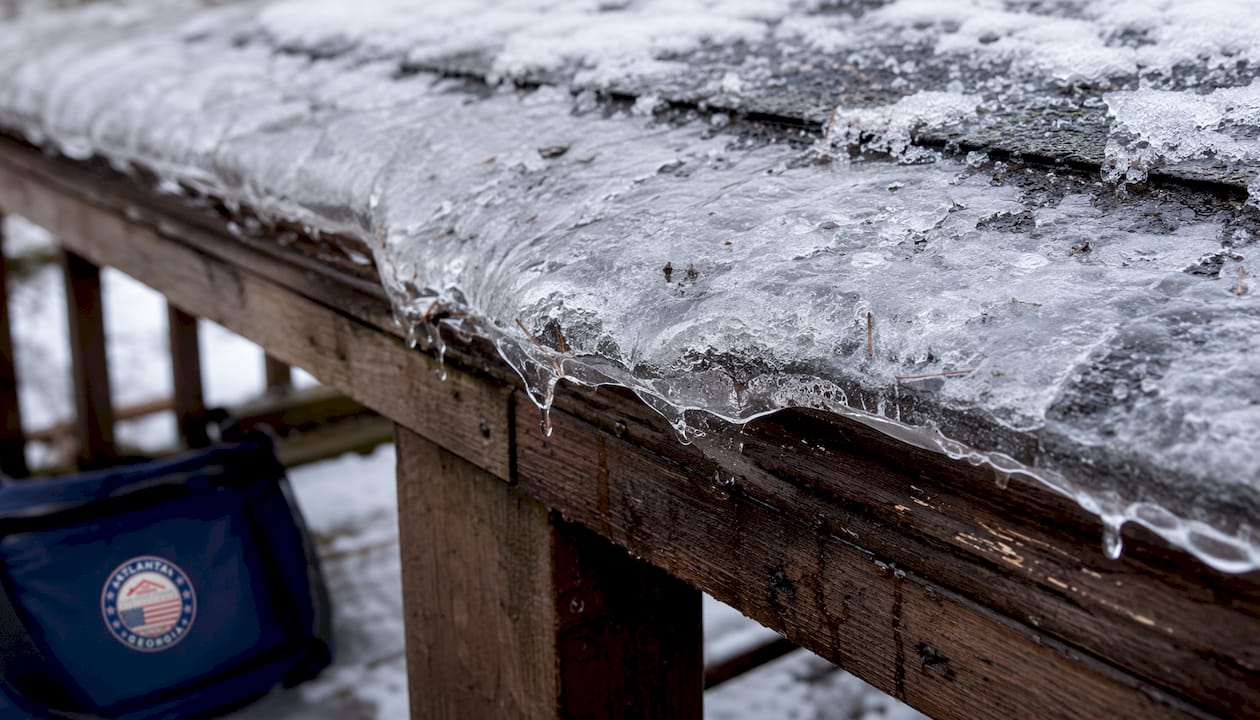
Every time water enters a small crack in flashing, a shingle seam, or a fastener hole and then freezes, it expands. Repeated freezing widens those cracks and weakens attachments over time. A roof that survives one winter may fail in the second or third after enough cycles have degraded the material.
Attic condensation and ventilation failure
Poor soffit-to-ridge ventilation traps warm, humid air in the attic. That moisture condenses on the cold underside of the roof deck, saturating insulation and corroding fasteners. The damage is invisible until a ceiling stain or soft decking reveals it months later, often in spring.
What does winter roof damage actually look like?
Catching damage early, before a small leak becomes a structural repair, requires knowing where to look. The checklist below separates what you can assess safely from the ground from what requires an attic check.
From the ground (binoculars or camera)
- Icicles or ice ridges along the eave line (a visible sign of ice dam activity)
- Missing, lifted, or curled shingles
- Granules washed into gutters or visible on the ground below downspouts
- Sagging or uneven roofline
- Gutters pulling away from the fascia or visibly full of ice
- Damaged or displaced flashing around chimneys, skylights, or vents
- Shingles with visible cracking or brittleness along edges
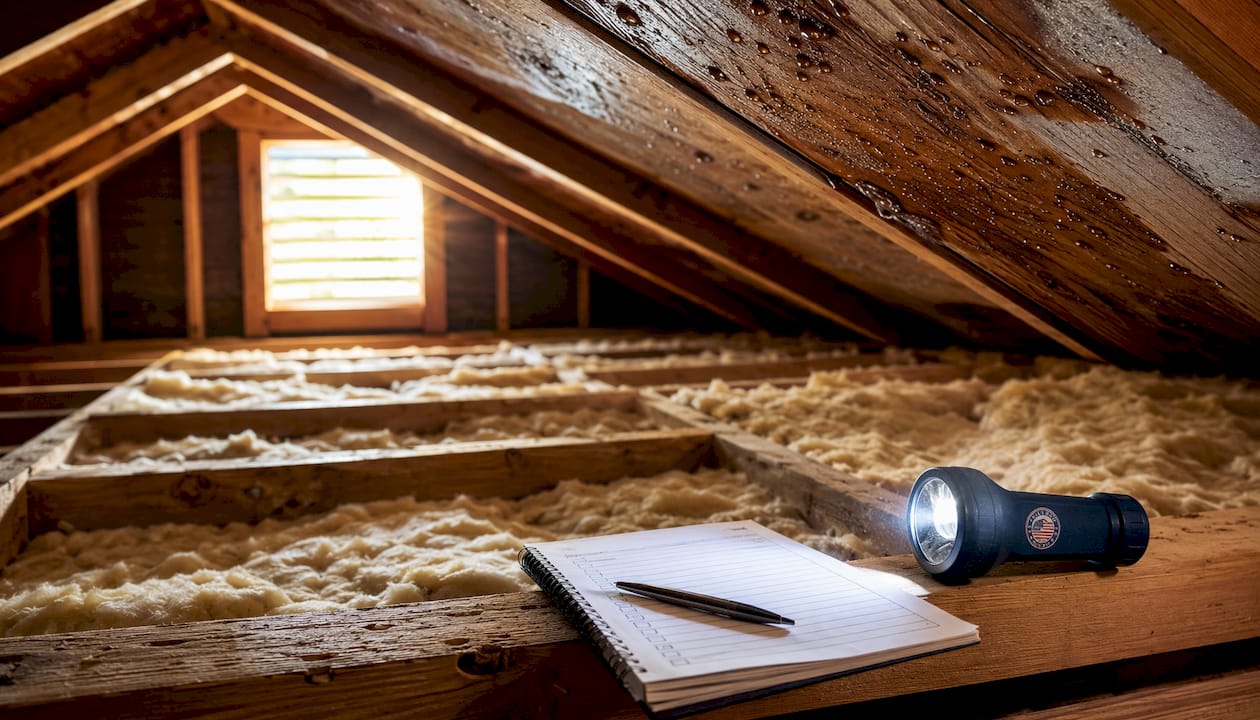
Attic checks (flashlight required)
- Ceiling or wall stains, especially near exterior walls or the ridge
- Wet, compressed, or discolored insulation
- Rusted fasteners or nail heads on the underside of the decking
- Visible daylight at roof seams or around penetrations
- Musty odors or visible mold on wood framing
- Soft or spongy decking when pressed (indicates rot)
Pro Tip: Use a roof inspection checklist and take timestamped photos of every problem area, both wide shots for context and close-ups for detail. Insurers need both to process a claim efficiently.
Some damage does not show up immediately. Ice dams that formed in January may not produce a ceiling stain until March or April, when temperatures rise enough for water to migrate through saturated insulation. A spring inspection is not optional — it is the follow-through that catches what winter left behind.
How winter roof risk varies by U.S. region
The dominant failure mechanism shifts depending on where you live, and knowing your region's pattern helps you prioritize the right prevention work.
- Northeast and New England: Heavy, persistent snow loads combined with sustained cold create the most severe ice dam conditions. Attic air sealing and insulation are the highest-priority investments here.
- Midwest: Freeze–thaw cycles are frequent and damaging. Drifting snow creates concentrated loads on lower roof sections and around dormers.
- Mountain West: Deep snowpack and drifting are the primary structural risks. Multi-plane roofs and additions are common failure points where one section sheds onto another.
- Pacific Northwest: Heavy, wet snow combined with rain-on-snow events creates some of the highest load spikes. Short, intense rain on existing snow can overload roofs not designed for saturated snow weight.
- Southeast (including Georgia and the Atlanta metro area): Infrequent but high-risk. Many roofs in this region are not engineered for repeated snow or rain-on-snow loads. When an atypical winter storm hits, the combination of wet snow, ice, and minimally sloped roofs creates outsized risk. Inspect after any storm that deposits measurable snow or freezing rain.
The IBHS warns specifically that warmer regions face disproportionate risk during unusual storms precisely because local building practices do not account for those loads. For Atlanta-area homeowners, the practical takeaway is straightforward: check local weather alerts before and after any winter weather event, and treat any snow accumulation as a reason to inspect, not ignore.
How to prevent winter roof damage before and after a storm
Prevention breaks into two categories: things you can do this season to reduce immediate risk, and longer-term investments that stop the underlying causes.
Short-term actions
- Clear gutters before the first freeze. Clogged gutters trap ice and add weight while blocking meltwater drainage, accelerating ice dam formation.
- Use a roof rake safely. Pull snow from the edge of the roof while standing on the ground. Leave roughly 2 inches of snow as a protective buffer; scraping down to the surface damages shingles and granules.
- Install gutter heating cables selectively. These can reduce ice buildup at the eave but do not address the underlying heat-loss problem. Use them as a short-term measure, not a permanent fix.
- Apply emergency tarping for active leaks. If water is entering the structure, a temporary tarp over the affected section limits interior damage until a professional can make a permanent repair.
- Trim overhanging branches. Ice-laden limbs that fall on a roof cause concentrated impact damage that is entirely preventable.
- Winterize doors and entry points to reduce heat loss from the building envelope, which in turn reduces attic heat gain. A resource like winterizing your doors covers the practical steps.
Long-term investments with the best return
Pro Tip: Building America Solution Center guidance consistently identifies attic air sealing as the highest-ROI measure for preventing ice dams. Sealing penetrations around lights, plumbing, and ductwork costs far less than repairing repeated water damage.
The priority order for long-term prevention:
- Seal attic air leaks around recessed lights, plumbing stacks, chimneys, and any ceiling penetration.
- Add insulation to meet or exceed the R-value recommended for your climate zone. The National Weather Service recommends a minimum of R-30, with R-38 preferable in colder climates.
- Restore balanced soffit-to-ridge ventilation so cold outside air can flush the attic and keep the roof deck uniformly cold.
- Replace failing flashing around chimneys, skylights, and valleys before another winter cycle widens existing gaps.
- Evaluate roof slope and drainage on flat or low-slope sections where ponding water freezes and adds load.
For Atlanta-area homeowners, extending your roof's lifespan through consistent seasonal maintenance is the most cost-effective approach given the region's mix of mild winters and occasional severe events.
When should you call a roofer after winter weather?
Some situations call for professional help immediately. Others can wait for a scheduled inspection. Knowing the difference protects both your safety and your insurance claim.
Call now if you observe any of the following:
- Visible sagging or deflection in the roofline or decking
- Active water intrusion during or after a storm
- Heavy snow concentrated on one section of the roof
- Falling icicles creating a hazard zone near entryways or HVAC equipment
- Structural cracking sounds from the attic during or after a snow event
For less urgent situations, a professional roofing inspection after winter ends is still worth scheduling. A qualified inspection covers the exterior survey, attic check, flashing assessment, and, where available, moisture meter readings that reveal wet insulation before it causes rot. The written estimate and photos from that inspection become your documentation for an insurance claim.
Questions to ask any contractor before hiring:
- Are you licensed and insured in Georgia?
- Do you take a repair-first approach, or do you default to replacement?
- Can you prepare a scope-of-loss document for my insurer?
- What is your estimated timeline for emergency versus scheduled repairs?
Pro Tip: Hiring locally matters in Georgia. Local crews understand Cherokee County and Atlanta-area storm patterns, and they have established relationships with regional insurance adjusters. The Original Roof Repair Company's repair-first approach means you get an honest assessment rather than an automatic replacement recommendation.
Safe tools and methods for post-storm roof checks
You do not need to climb on the roof to assess winter damage. The right tools let you gather useful information from the ground and the attic safely.
Tools to have on hand:
- Binoculars or a zoom-capable phone camera for exterior scanning from the ground
- A flashlight for attic inspections (check decking, insulation, and fasteners)
- A roof rake with an extension handle for safe snow removal from the ground
- A moisture meter (optional but useful) for checking insulation and wood framing in the attic
- A ladder for ground-level access only, never for rooftop work in winter conditions
Safety rules that are not negotiable:
- Never walk on an icy or snow-covered roof.
- Stay clear of areas directly below gutters and eaves where ice can fall.
- Keep HVAC units and outdoor equipment clear of snow-shedding paths.
- For any rooftop work, call a professional.
When documenting for insurance, capture wide-angle shots that show the full roof section and close-up shots of specific damage. Video walkaround footage is useful for establishing context. Every photo should carry an automatic timestamp from your phone.
Will insurance cover your winter roof damage?
The short answer: sudden storm damage generally is covered; damage from neglected maintenance generally is not. Liberty Mutual's guidance confirms that most homeowners policies cover sudden events like collapse or storm-driven leaks, but exclude damage resulting from long-term wear or deferred maintenance.
Common cost factors for winter roof repairs:
- Extent of water infiltration into decking, insulation, and framing
- Flashing replacement at chimneys, skylights, or valleys
- Emergency tarping and interior water management
- Ice dam mitigation and gutter repair
- Whether full replacement is warranted (The Original Roof Repair Company recommends replacement when repair estimates exceed $4,000)
Steps to protect your claim:
- Document damage immediately with timestamped photos and video.
- Schedule a professional inspection before making permanent repairs.
- Keep all receipts for emergency mitigation (tarps, water extraction).
- Ask your roofer to prepare a written scope of loss with photos for the adjuster.
The Original Roof Repair Company provides insurance claim advocacy for Georgia homeowners, handling documentation and adjuster communication directly. For emergency situations, understanding how emergency roof repair works before you need it helps you move faster when it matters.
Roof repairs can be performed in winter, though some sealing materials require warmer temperatures to cure properly. Contractors use workarounds for emergency situations, but non-urgent repairs are often better scheduled for spring when adhesives seal correctly and conditions are safer for rooftop work.
How much snow or ice actually puts your roof at risk?
Weight matters more than depth, and concentrated loads matter more than average depth.
| Snow or Ice Type | Approximate Safe Depth | Notes |
|---|---|---|
| Fresh, light snow | ~40 inches | Lowest weight per inch; most roofs handle this range |
| Packed or wet snow | ~20 inches | Significantly heavier; reduce this threshold after rain |
| Ice accumulation | ~1 inch = ~1 foot of snow | IBHS data; ice is far denser than fresh snow |
| Rain-on-snow event | Variable; treat as emergency | Saturated snow load can spike rapidly |
These figures come from Legacy Restoration's rule-of-thumb guidance and IBHS engineering data. They apply to average uniform loads on a structurally sound roof. Real-world risk is often higher because loads are rarely uniform.
Drifting and sliding from higher roof sections concentrate weight at specific points, particularly at valleys, dormers, and lower roof sections adjacent to a higher plane. A roof addition or new elevation that sheds onto an older section is a frequent failure point. Even when average depth seems manageable, those local concentrations can exceed the framing's design load.
When using a roof rake, leave approximately 2 inches of snow as a buffer. Scraping down to the surface damages shingles and granules, and the protective layer reduces the risk of the rake catching on flashing or seams.
Local expertise: The Original Roof Repair Company in Cherokee County and the Atlanta area
The Original Roof Repair Company was founded by Eric Manly in Canton, Georgia, with a repair-first philosophy built around honest assessments and transparent pricing. The company serves Cherokee County and 11 surrounding counties within a 35-mile radius of Canton, covering a broad portion of the Atlanta metro area.
Common winter callouts in the Cherokee County and Atlanta area:
- Flashing failures at chimneys and skylights after freeze–thaw cycles
- Emergency tarping following ice storms and mixed-precipitation events
- Insurance documentation for storm-driven shingle loss and water infiltration
- Gutter damage from ice loading and pulling away from fascia boards
The company's repair-first threshold is straightforward: replacement is recommended only when a repair estimate exceeds $4,000 and replacement is the more cost-effective long-term choice. That policy keeps repair costs honest and avoids unnecessary full-replacement recommendations after minor storm events.
Services relevant to winter damage:
- Emergency roof repair and temporary tarping
- Post-storm roof inspection with written estimates
- Insurance claim advocacy and scope-of-loss documentation
- Flashing repair, shingle replacement, and gutter restoration
The company holds BBB accreditation and has built its reputation across four years of repair work in the Atlanta metro area. For homeowners who need to understand when repair is no longer sufficient, the roof replacement red flags guide covers the specific signs that indicate a full replacement is the right call.
A post-winter inspection is the right time to request a prioritized assessment, particularly if you noticed interior staining, icicle formation, or any sagging during the season. Scheduling before spring rain season begins gives you the clearest picture of what winter left behind.
Key Takeaways
Winter roof damage follows predictable patterns, and addressing the underlying causes of heat loss and poor attic ventilation prevents the majority of ice dam and moisture failures.
| Point | Details |
|---|---|
| Ice dams need very little snow | UMass Amherst research shows ice dams can form with as little as 1–2 inches of snow when attic heat loss is present. |
| Ice is far heavier than it looks | One inch of ice weighs approximately as much as one foot of fresh snow, making ice accumulation a serious structural concern. |
| Air sealing beats ice removal | Sealing attic penetrations around lights, plumbing, and ductwork is the highest-ROI long-term fix for preventing ice dams. |
| Document before you repair | Timestamped photos and a professional scope of loss are required for insurance claims; skip this step and coverage may be denied. |
| The Original Roof Repair Company | Serves Cherokee County and the Atlanta metro area with repair-first inspections, emergency tarping, and insurance claim advocacy. |
What most homeowners get wrong about winter roof damage
The conventional wisdom treats winter roof damage as a weather problem. It is not. It is an energy problem that weather exposes.
Every repeat ice dam, every spring ceiling stain, every corroded fastener that shows up in an attic inspection traces back to the same root cause: warm air escaping from the living space into the attic. The weather did not cause the damage. The air leak did. Weather just made it visible.
Atlanta-area homeowners face a specific version of this problem. Because hard winters are infrequent here, many roofs in Cherokee County and the surrounding metro area were built with minimal attention to attic air sealing and insulation. That is fine in a typical year. In an atypical one, when a wet snow event or ice storm hits, those roofs are far more vulnerable than their Northern counterparts because the underlying conditions for ice dam formation and moisture damage are already present. The storm just triggers what was waiting.
The other mistake homeowners make is treating the symptoms rather than the cause. Gutter heating cables, ice melt tablets, and repeated ice removal are all reactive. They cost money every winter and solve nothing permanently. One round of proper attic air sealing and insulation work, done correctly, eliminates the heat-loss pathway that drives ice dam formation in the first place. That is the repair worth making.
One practical item that gets overlooked: check the snow-shedding paths around your entryways and HVAC equipment before winter, not after. Falling ice from a loaded eave can damage a condenser unit or injure someone walking to the door. That is a five-minute inspection that costs nothing.
Roof inspections and emergency repairs for Atlanta-area homeowners
When winter weather hits the Atlanta metro area, The Original Roof Repair Company responds with the kind of service larger contractors often skip: honest assessments, emergency tarping for active leaks, and direct insurance claim support for homeowners navigating the documentation process.

The repair-first approach means you get a straight answer. If the damage is a flashing failure or a few lifted shingles, that is what gets repaired. Replacement is only recommended when repair costs exceed $4,000 and replacement is the smarter long-term investment. No pressure, no upselling.
Service area: Cherokee County and 11 surrounding counties within a 35-mile radius of Canton, Georgia, covering a broad portion of the Atlanta metro area.
Services for winter damage:
- Emergency roof repair and temporary tarping for active leaks
- Post-storm inspections with written estimates and insurance-ready documentation
- Insurance claim advocacy, including scope-of-loss preparation and adjuster coordination
If you noticed interior staining, icicle ridges, or any sagging this past winter, request a prioritized inspection now, before spring rain season adds to the damage. Contact The Original Roof Repair Company at theoriginalroofrepaircompany.com to schedule your assessment.
Useful sources
- UMass Amherst: Preventing Ice Dams — Detailed building-science explanation of ice dam formation; useful for understanding the heat-loss mechanisms behind winter roof leaks.
- Building America Solution Center: Attic Air Sealing for Ice Dam Prevention — Practical guidance on the highest-ROI prevention measures; the authoritative source for attic sealing and insulation recommendations.
- IBHS: Winter Weather Risk Engineering Bulletin — Covers snow load, rain-on-snow risk, and ice weight equivalence; especially relevant for commercial and residential structural risk.
- FEMA: Winter Safety Guidance — Occupant safety, roof and gutter inspection reminders, and ice dam prevention basics from a federal safety perspective.
- govinfo: Snow Load Safety Guide — U.S. government technical guidance on snow load calculations, unbalanced loads, and structural risk thresholds.
- BuildingScience Corporation BSD-135: Attic Condensation and Ice Dams — Explains how attic air leakage causes condensation-driven rot; useful for homeowners dealing with hidden moisture damage.
- National Weather Service: Roof Ice Dam Prevention — Practical homeowner checklist for gutter maintenance, snow removal, and insulation from a weather-authority source.
- Liberty Mutual: Does Home Insurance Cover Snow Damage? — Explains coverage caveats for sudden storm damage versus maintenance-related exclusions.
- The Original Roof Repair Company: Local Roofing Services — Emergency repair, inspection, and insurance claim advocacy for Cherokee County and the Atlanta metro area.
FAQ
Will insurance cover roof damage from snow and ice?
Most homeowners policies cover sudden storm-related damage, such as collapse or a storm-driven leak, but generally exclude damage from neglected maintenance or long-term wear. Document damage immediately and get a professional inspection to support your claim.
How many inches of snow can damage a roof?
Weight matters more than depth. Many roofs can handle a substantial depth of fresh snow, but packed or wet snow is significantly heavier, and ice is much denser than fresh snow. Concentrated drifts or rain-on-snow events create local overloads even when average depth seems safe.
Can a roof be repaired in winter?
Yes, though some sealing materials need warmer temperatures to cure fully. Contractors use workarounds for emergency repairs, but non-urgent work is often better scheduled for spring when adhesives bond correctly and conditions are safer.
What temperature is too cold to replace a roof?
Most roofing manufacturers recommend installing asphalt shingles at temperatures above 40°F, as adhesive strips need warmth to seal properly. Below that threshold, emergency repairs are still possible with professional workarounds, but a full replacement is typically deferred until conditions improve.
How do I know if I have an ice dam?
Look for a ridge of ice along the eave line, icicles that are unusually large or persistent, or water staining on interior ceilings near exterior walls. The UMass Amherst ice dam research notes that ice dams can form with as little as 1–2 inches of snow when attic heat loss is present, so even a modest snowfall warrants a check.