

A roof warranty is a contractual promise from a manufacturer, a roofing contractor, or both, guaranteeing coverage for specific defects or failures for a defined period. Understanding what is roof warranty coverage means knowing exactly what it protects and, just as critically, what it does not. Most roofing projects come with two distinct warranties: a manufacturer material warranty covering factory defects and a contractor workmanship warranty covering installation errors. Neither one alone gives you complete protection. Warranties do not cover storm damage, hail, or normal wear and tear. Those risks fall under homeowners insurance, not your roofing contract.
What is a roof warranty and what are the main types?
Roofing warranties fall into three categories, and each one covers a different source of failure. Knowing the difference protects you from assuming you have coverage you do not actually have.
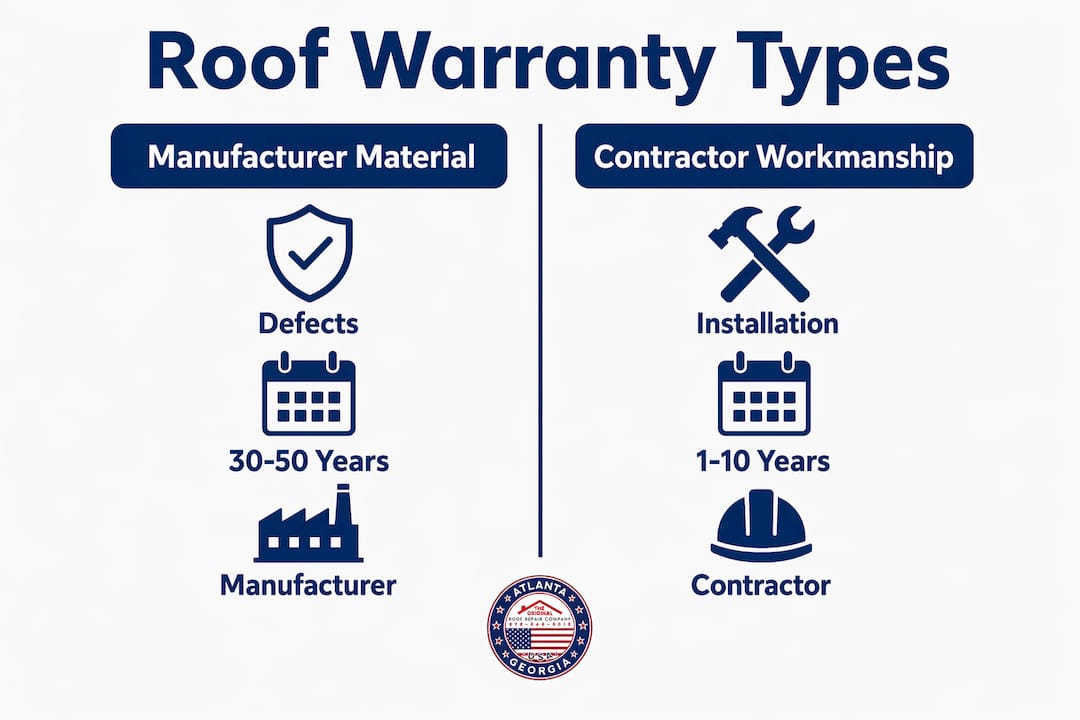
Manufacturer material warranty covers defects that originate at the factory. If shingles crack prematurely, delaminate, or lose granules faster than expected due to a production flaw, the manufacturer is responsible. Manufacturer warranties typically run 30–50 years, but coverage is prorated heavily after the first 10–15 years. That means the manufacturer pays a shrinking percentage of replacement costs as the roof ages. By year 30, that share can drop to roughly 20% of the original value.
Contractor workmanship warranty covers errors made during installation. Poor flashing, incorrect nailing patterns, and improper underlayment placement are all installation faults, not material defects. Basic workmanship warranties last only 1–2 years for uncertified installers, while certified contractors can offer 5–10 years, and top-tier certifications unlock warranties of 25 years or more. This type of warranty is issued by the contractor, not the manufacturer.
System warranty is the most complete option. It combines material and labor coverage under a single manufacturer-backed agreement. To qualify, the contractor must use a full matching product lineup from one manufacturer and hold active certification. System warranties require certified installers and brand-specific components throughout. The benefit is that labor coverage stays non-prorated for decades, and the manufacturer stands behind both the product and the installation.
| Warranty type | What it covers | Typical duration | Who issues it |
|---|---|---|---|
| Manufacturer material | Factory defects in shingles and components | 30–50 years (prorated after 10–15 years) | Shingle manufacturer |
| Contractor workmanship | Installation errors (flashing, nailing, sealing) | 1–25 years depending on certification | Roofing contractor |
| System (enhanced) | Material and labor, non-prorated | 25–50 years | Manufacturer (requires certified installer) |
Pro Tip: Ask your contractor for their specific certification level before signing. A certified installer can offer a workmanship warranty that outlasts a basic manufacturer warranty by decades.
What does roof warranty coverage include and exclude?
Roof warranty coverage is more limited than most homeowners expect. Warranties are legal contracts that limit manufacturer and contractor liability, not broad protection policies. Understanding the boundaries prevents costly surprises at claim time.
What warranties typically cover:
- Premature shingle cracking, blistering, or delamination caused by manufacturing defects
- Granule loss beyond normal aging rates due to factory flaws
- Installation errors such as improper flashing, misaligned shingles, or incorrect fastener placement
- Structural leaks directly caused by workmanship mistakes on a new installation
- Material failures in underlayment or ridge caps when covered under a system warranty
What warranties typically exclude:
- Storm damage from hail, high winds, falling debris, or ice dams
- Normal wear and tear over time
- Damage caused by foot traffic, satellite dish installation, or improper maintenance
- Failures caused by mixing components from different manufacturers, which voids the material warranty
- Repairs made by uncertified contractors after the original installation
The proration schedule is the detail most homeowners overlook. A 50-year warranty sounds like full protection for half a century. In practice, the manufacturer covers 100% of costs in year one, but that percentage drops steadily. By the midpoint of the warranty term, you may receive only partial reimbursement for a valid claim.
Pro Tip: Read the proration table in your warranty document before you sign. Ask the contractor to walk you through what the manufacturer actually pays in years 15, 20, and 30. The numbers are often surprising.
How does the roof warranty claims process work?
Filing a warranty claim requires documentation and a clear understanding of which warranty applies to your problem. The process differs depending on whether the issue is a material defect or an installation error.
-
Identify the source of the problem. A shingle that cracks from the inside out points to a manufacturing defect. A leak at a valley or chimney flashing points to a workmanship error. Getting this right determines which party you contact first.
-
Gather your documentation. Claims processing depends on documentation quality and contractor certification. You need the original invoice, photos of the damage, proof of installation date, and evidence that a certified contractor performed the work.
-
Contact the right party. Manufacturer claims go directly to the manufacturer's warranty department. Workmanship claims go to the original contractor. System warranty claims typically route through the manufacturer since they back both components.
-
Prepare for an inspection. Manufacturers send field representatives to verify that the defect is covered and that the installation met their specifications. If non-brand components were used or an uncertified installer did the work, the claim will be denied.
-
Understand contractor solvency risk. If the original contractor goes out of business or loses certification, a standalone workmanship warranty becomes worthless. Manufacturer-backed system warranties protect you in this scenario because the manufacturer, not the contractor, holds the obligation.
The most common reason claims fail is incomplete documentation. Keep your warranty certificate, installation invoice, and contractor certification records in a single file from day one.
How do roof warranties and storm damage insurance relate?
Warranties and homeowners insurance serve completely different purposes, and confusing the two is one of the most expensive mistakes a homeowner can make.
Standard roof warranties rarely cover storm-related damage such as hail, high winds, or falling debris. That exclusion is not a loophole. It is a fundamental design feature. Warranties cover defects in materials and labor. Storms are external events, and external events are the domain of your homeowners insurance policy.
Key distinctions between warranty and insurance coverage:
- Hail damage to shingles is an insurance claim, not a warranty claim
- Wind damage that lifts or removes shingles falls under your insurance policy
- A manufacturing defect that causes shingles to fail prematurely is a warranty claim
- Water intrusion from a flashing error on a new roof is a workmanship warranty claim
- Damage from a tree branch or debris impact is an insurance matter
Some manufacturers offer wind-resistance ratings on their shingles, such as Class H or Class F ratings under ASTM D3161 and ASTM D7158 standards. A higher wind rating means the shingle is engineered to withstand stronger winds before failing. It does not mean the warranty covers wind damage. The rating describes performance, not coverage.
Special storm-coverage riders exist in some premium contracts, but they are uncommon and typically require an additional cost. Before assuming your warranty includes storm protection, read the exclusions section of the warranty document word for word.
Coordinating a warranty claim and an insurance claim simultaneously is possible when damage has two separate causes. For example, a storm may expose a pre-existing flashing defect. In that case, the insurance adjuster handles storm damage and the contractor handles the workmanship issue. Theoriginalroofrepaircompany assists homeowners with insurance claim documentation and works directly with adjusters to separate storm damage from pre-existing installation faults.
Key Takeaways
A roof warranty covers manufacturing defects and installation errors, but it does not replace homeowners insurance for storm damage, and coverage value drops significantly after the first 10–15 years due to proration.
| Point | Details |
|---|---|
| Two warranties are standard | Every roof should carry both a manufacturer material warranty and a contractor workmanship warranty for full protection. |
| Workmanship coverage matters most | Most roof leaks stem from installation errors, making the workmanship warranty the more critical of the two. |
| "Lifetime" does not mean lifetime | Manufacturer warranties prorate heavily after 10–15 years; coverage can drop to around 20% of original value by year 30. |
| Storm damage needs insurance | Warranties exclude hail, wind, and debris damage; homeowners insurance is the correct coverage for storm-related claims. |
| Contractor certification is critical | Uncertified installers limit workmanship warranties to 1–2 years and can void manufacturer system warranties entirely. |
What most homeowners get wrong about roof warranties
I have been on enough roofs in Cherokee County to know that most homeowners sign their warranty paperwork without reading a single exclusion. The word "lifetime" does the heavy lifting in most sales conversations, and it should not. A "limited lifetime" warranty means the manufacturer defines the coverage length, not you. After year 10 or 15, you are often working with a fraction of the original coverage value.
The workmanship warranty is the one I tell every homeowner to scrutinize first. Most roof failures come from installation errors, not bad shingles. A flashing mistake, a missed nail, a poorly sealed boot. Those are the problems that show up two years after a new roof goes on. If your contractor only offers a one-year workmanship warranty, that is a signal worth paying attention to.
Contractor solvency is the risk nobody talks about at the point of sale. If your roofer closes up shop or loses manufacturer certification before you file a claim, a standalone workmanship warranty is gone with them. A manufacturer-backed system warranty is the only version that survives contractor failure. That is worth paying more for upfront.
My honest advice: ask for the full warranty document before work begins, not after. Read the proration schedule, the exclusions list, and the certification requirements. If a contractor cannot hand you that document before signing, find one who can.
— Eric
Roof warranty and repair services from Theoriginalroofrepaircompany
Theoriginalroofrepaircompany provides warranty-backed roofing services across Cherokee County and 11 surrounding counties, with a repair-first approach that prioritizes honest diagnosis over unnecessary replacement.
Whether you are dealing with a potential workmanship defect, a storm-damaged roof that needs insurance documentation, or an urgent leak that cannot wait, Theoriginalroofrepaircompany handles the full scope. The team documents damage thoroughly, works directly with insurance adjusters, and helps homeowners understand exactly what their warranty covers before any work begins. For urgent situations, emergency roof repair is available when damage cannot wait. For longer-term needs, roof repair services address both warranty-covered defects and damage that falls outside standard coverage. Contact Theoriginalroofrepaircompany for a transparent assessment with no-pressure pricing.
FAQ
What is a roof warranty in simple terms?
A roof warranty is a written contract that guarantees the manufacturer or contractor will repair or replace specific defects for a set number of years. It covers manufacturing flaws and installation errors, but not storm damage or normal aging.
How long does a roof warranty typically last?
Manufacturer warranties typically run 30–50 years, but coverage is prorated after 10–15 years. Workmanship warranties range from 1–2 years for basic installers up to 25 years or more for top-tier certified contractors.
Does a roof warranty cover storm damage?
No. Warranties exclude storm-related damage such as hail, high winds, and falling debris. Homeowners insurance is the correct coverage for storm damage, not the roofing warranty.
What voids a roof warranty?
Using roofing components from different manufacturers, hiring an uncertified contractor, or allowing unauthorized repairs after installation can all void a warranty. Mixing brands voids the manufacturer warranty because system warranties require brand-specific components throughout.
Should I get a roof warranty when replacing my roof?
Yes. A new roof should always include both a manufacturer material warranty and a contractor workmanship warranty. Relying on only one leaves gaps in coverage, since each warranty covers a different source of failure.