
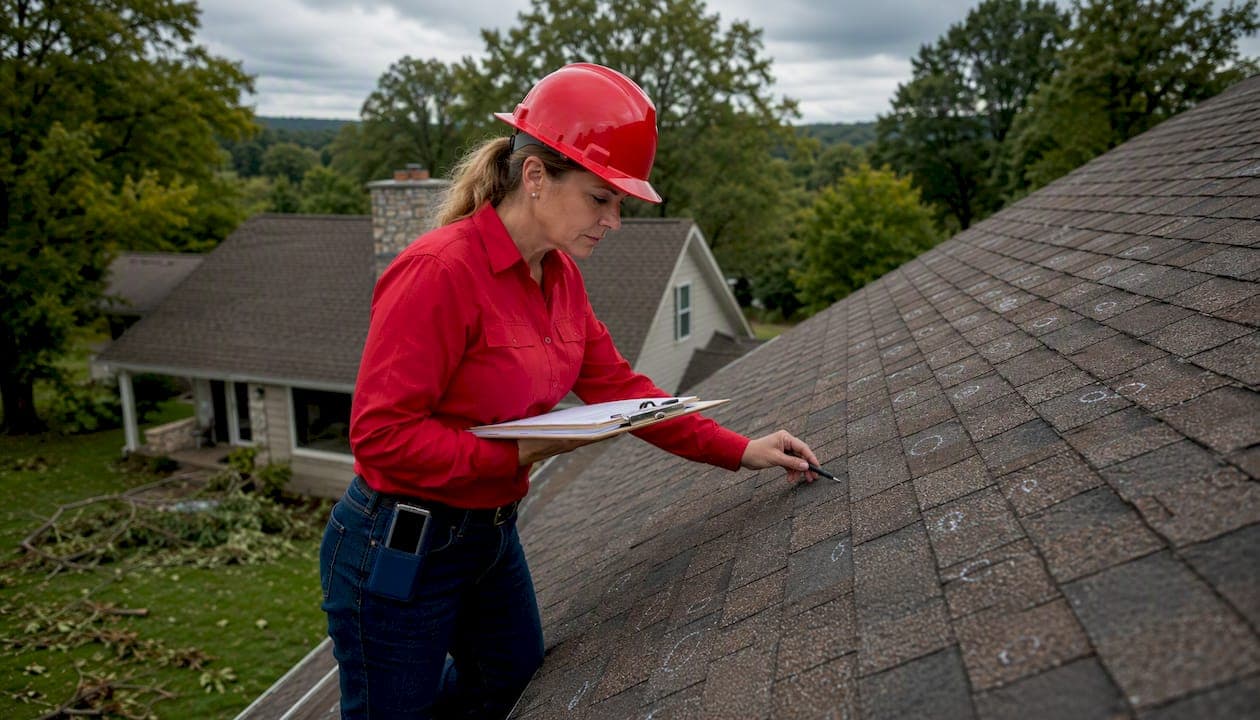
For most homeowners in the Atlanta metro and across Georgia with average-to-high hail exposure, Class 4 (UL 2218) or IBHS-tested asphalt shingles are the right choice. They offer the strongest structural protection available in asphalt, and they frequently qualify for insurance discounts on the wind/hail portion of your premium, although discount amounts vary by carrier. Class 3 is a reasonable compromise when your hail exposure is genuinely low, your budget is tight, or you plan to sell within a few years.
Three reasons Class 4 earns the recommendation for most Georgia homeowners:
- Structural protection. Class 4 shingles are tested against a steel ball sized to simulate the kinetic energy of larger hailstones. They resist back-face breach and water intrusion better than any lower class.
- Insurance savings. Class 4 shingles commonly qualify for carrier discounts applied to the wind/hail portion of your homeowners policy. Georgia carriers vary, so verify eligibility before you buy.
- Long-term value. If you plan to own your home for 7 or more years, the upfront cost premium tends to pay back through avoided storm repairs and premium reductions.
One critical limit: "impact-resistant" does not mean hail-proof. IBHS research confirms that even Class 4 shingles can suffer cosmetic damage, denting, and granule loss in severe storms. The rating reduces structural failure risk; it does not eliminate storm damage.
Table of Contents
- How does the UL 2218 hail impact rating system work?
- How does IBHS testing differ from UL 2218, and why does it matter?
- Class 3 vs Class 4: which one is right for your home?
- What products carry Class 4 or IBHS ratings?
- How do you choose the right impact-rated shingle for your home?
- What should you do after a hail event in Georgia?
- Key Takeaways
- The case for honest assessment over automatic replacement
- Free inspections and insurance claim help for Atlanta-area homeowners
- Useful sources for verifying ratings and hail risk
- FAQ
How does the UL 2218 hail impact rating system work?
UL 2218 is the baseline standard for shingle hail resistance ratings in the United States. It classifies asphalt shingles into four classes using a steel-ball drop test, where a steel ball of a specific diameter is dropped from a set height onto a conditioned shingle sample. The pass/fail criterion is simple: no visible crack or breach on the back face of the shingle.
| Class | Steel Ball Diameter | Drop Height | Equivalent Hail Size | Pass/Fail Criterion |
|---|---|---|---|---|
| 1 | — | — | ~1 inch hail | No back-face breach |
| 2 | — | — | — | No back-face breach |
| 3 | 1.75 inches | 17 feet | ~1.5 inch hail | No back-face breach |
| 4 | — | 20 feet | ~2 inch hail | No back-face breach |
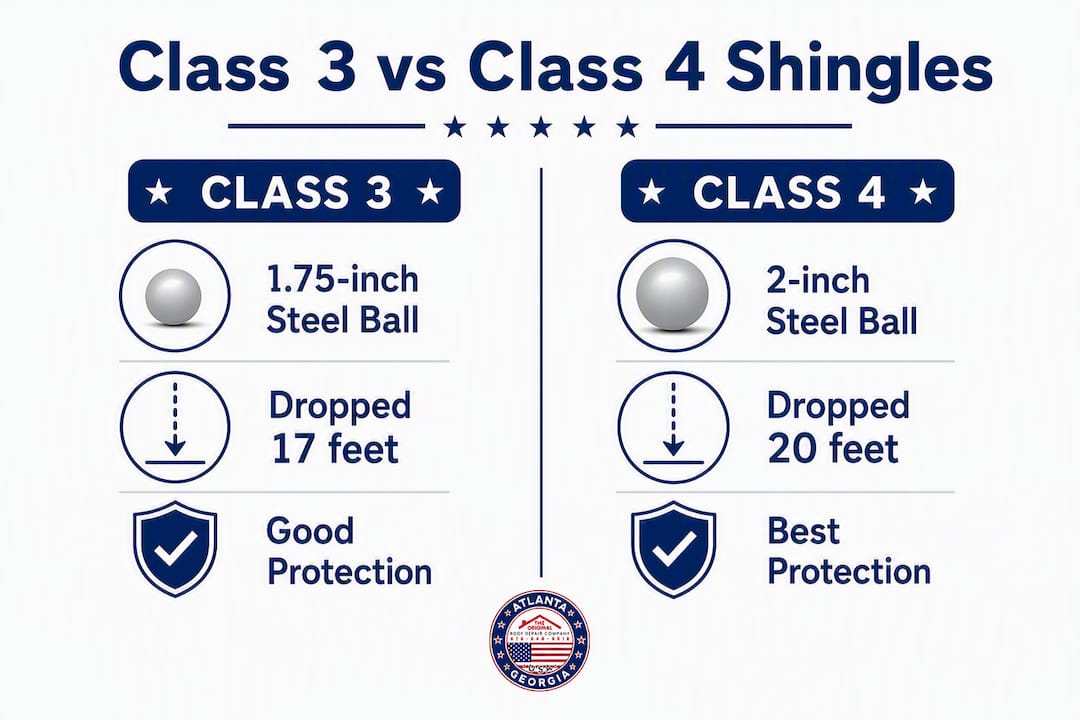
UL 2218 maps each class to a steel ball size and drop height that approximates the kinetic energy of natural hailstones at those diameters. Class 1 is the minimum threshold; Class 4 is the highest.
What UL 2218 does NOT measure matters just as much. The test ignores denting, granule loss, and surface-level damage. A shingle can pass Class 4 with visible dents and stripped granules, because neither counts as a failure under the standard. That gap is exactly why IBHS developed its own protocol.
- Class 1 and 2 shingles offer limited improvement over standard architectural shingles in real hail events.
- Class 3 provides meaningful structural protection for moderate hail exposure.
- Class 4 is the standard insurers most commonly recognize for discounts.
Pro Tip: Polymer-modified (SBS-modified) asphalt shingles consistently outperform traditional fiberglass-mat shingles in impact testing. IBHS testing found polymer-modified IR shingles had 20–50% better passing rates across classes, particularly at larger impact sizes. If Class 4 is your target, ask your contractor specifically for SBS-modified products.
For Atlanta-area homeowners in ZIP codes with documented high-frequency hail, Class 3 is a floor, not a ceiling. Cherokee County and surrounding counties see regular hail activity, and the cost difference between Class 3 and Class 4 rarely justifies stopping short.

How does IBHS testing differ from UL 2218, and why does it matter?
UL 2218 has been the industry baseline since the 1990s. IBHS developed its own protocol because the steel-ball test has a fundamental limitation: steel is not ice. Haag Global testing found that steel-ball protocols can make asphalt shingles appear more hail resistant than ice-ball tests would indicate, because the hardness and impact dynamics of steel differ from natural hailstones.
IBHS uses lab-manufactured hailstones that replicate the material properties, density, and impact energy of natural hail. The protocol evaluates denting and granule loss in addition to structural breach, producing a more complete picture of how a shingle will perform in a real storm.
| Dimension | UL 2218 | IBHS Protocol |
|---|---|---|
| Projectile | Steel ball | Lab-made hailstone |
| Damage assessed | Back-face breach only | Breach, denting, granule loss |
| Rating output | Pass/Fail by class (1–4) | Relative performance score |
| Real-world fidelity | Moderate | Higher |
| What it predicts | Structural water intrusion risk | Structural + cosmetic damage risk |
| Insurer recognition | Widely accepted | Growing; verify with your carrier |
IBHS research is direct on the key limitation: impact-resistant shingles reduce but do not eliminate cosmetic damage. In severe storms, even the best-rated asphalt shingles will show denting and granule loss. The IBHS protocol makes that visible before purchase; UL 2218 does not.
FM Approvals offers a third option: ANSI/FM 4473 uses propelled ice balls instead of steel balls, mirroring UL class levels but with more realistic projectiles. Some carriers accept FM 4473 documentation in place of or alongside UL 2218 certification. Always confirm with your specific insurer.
UL Solutions and IBHS have pursued cooperative testing to improve real-world fidelity across both standards. When a shingle carries both a UL 2218 Class 4 certification and IBHS test results, that combination gives you the most complete picture available.
Class 3 vs Class 4: which one is right for your home?
The honest answer depends on four variables: your local hail frequency, how long you plan to stay, your insurer's discount structure, and your upfront budget.
Class 3 pros and cons:
- Lower installed cost premium over standard architectural shingles
- Meaningful structural improvement over Class 1–2 products
- Some carriers offer modest discounts, though less consistently than for Class 4
- Cosmetic damage outcomes in severe storms are similar to Class 4 (both classes can dent and lose granules)
- Less likely to qualify for the maximum available wind/hail discount
Class 4 pros and cons:
- Highest structural protection available in asphalt shingles
- Most commonly accepted class for carrier discounts on the wind/hail premium portion
- Higher upfront cost per square than Class 3
- Discounts apply to the wind/hail portion of the premium, not the full policy; homeowners should use this base for accurate payback calculations., so payback calculations must use that narrower base
- Best long-term value when ownership horizon is 7–10+ years
| Factor | Class 3 | Class 4 |
|---|---|---|
| Structural protection | Good | Best available in asphalt |
| Cosmetic damage in severe storms | Reduced vs standard | Reduced vs standard |
| Typical insurer discount eligibility | Varies; less consistent | Most commonly accepted threshold |
| Upfront cost premium | Moderate | Higher |
| Ownership horizon fit | Under 7 years | 7+ years |
GAF guidance recommends factoring ownership horizon directly into the class decision: if you plan to stay 7–10 or more years, Class 4's combination of structural protection and insurance savings is more likely to offset the upfront premium.
Pro Tip: Before committing to either class, pull your current homeowners policy and identify the wind/hail line item. Call your carrier and ask specifically what documentation they require for a Class 4 discount and what percentage applies to the wind/hail portion. That single call will tell you whether the payback math works for your situation in Georgia.
For Atlanta-area homeowners, the regional hail pattern tilts the decision toward Class 4 in most cases. Cherokee County and the surrounding metro counties see hail events frequently enough that the structural protection alone justifies the upgrade for anyone planning to stay more than a few years.
What products carry Class 4 or IBHS ratings?
GAF and CertainTeed both offer product lines that commonly carry UL 2218 Class 4 certification. GAF's Timberline ArmorShield II and CertainTeed's Landmark IR are among the products frequently cited in Class 4 discussions. Both manufacturers publish product spec sheets and UL certification documentation on their websites.
When reviewing any manufacturer's product page, look for these specific items:
- A clear statement of UL 2218 class (must say "Class 4," not just "impact resistant")
- The UL file number or UL mark, which you can verify independently through UL's Product iQ database
- IBHS test results, when available, showing performance on denting and granule loss
- FM 4473 certification if your insurer specifically requests it
- The date of testing, since reformulated products may carry outdated certifications
IBHS publishes its own ratings reports. The IBHS impact-resistant shingle ratings database is updated periodically and lists products tested under the IBHS protocol, including performance on surface damage metrics that UL 2218 does not capture.
When you receive a contractor proposal in Georgia, ask that the written estimate include the specific product name, UL 2218 class, and a copy of the manufacturer's certification. Reputable contractors carry this documentation or can pull it within 24 hours. If a proposal lists only "impact-resistant shingles" without a class designation or UL file number, that is a red flag.
How do you choose the right impact-rated shingle for your home?
Start with your risk profile, then layer in budget and ownership plans.
- Check your local hail history. NOAA's storm data tools and local hail maps let you look up hail frequency by county and ZIP code. Cherokee County and most Atlanta-area counties have documented multi-year hail activity. High frequency means Class 4 is almost always the right call.
- Assess your roof's current condition. An older roof with compromised underlayment or existing granule loss gets less benefit from a high-rated shingle overlay. In those cases, full replacement with Class 4 product is the more durable path.
- Determine your ownership horizon. Under 5 years, Class 3 may be sufficient. Seven or more years, Class 4 pays back more reliably through insurance savings and avoided repairs.
- Call your insurer before purchasing. Ask what class they require for a wind/hail discount, what documentation they need post-installation, and who provides certification copies during a claim. Carriers in Georgia vary on all three points.
- Get itemized bids. Ask contractors to break out the cost difference between standard architectural, Class 3, and Class 4 shingles per square. That delta is your payback baseline.
- Verify the product certification in writing. The estimate should name the product, state the UL 2218 class, and include or reference the UL file number. For IBHS-tested products, ask for the IBHS report link.
- Watch for vague claims like "hail-resistant" or "impact-rated" without a class number.
- Confirm that SBS-modified products are available if your contractor recommends them; they perform better at larger impact sizes.
- Ask whether a roof overlay is appropriate for your situation or whether full tear-off is needed to install the new shingle correctly.
- Review roofing insurance policy types before finalizing your decision, since ACV vs. RCV coverage affects your net cost after a claim.
What should you do after a hail event in Georgia?
A contractor-level inspection after a hail event follows a specific sequence. Understanding that sequence helps you know what to ask for and what documentation to keep.
- Prioritize safety first. Do not walk a wet or damaged roof. If you see displaced shingles, exposed decking, or active leaks, call for emergency tarping before any inspection begins.
- Document from the ground. Take date-stamped photos of any visible damage: dented gutters, cracked skylights, damaged window screens, and granule accumulation in downspouts. These are corroborating evidence for a hail claim.
- Schedule a professional inspection. A qualified contractor checks shingle adhesion, granule loss percentage, visible fractures after surface examination, underlayment condition, and attic space for water intrusion signs.
- Apply the repair-vs-replace threshold. The Original Roof Repair Company's operating rule: recommend full replacement when repair costs exceed $4,000 or when inspection reveals reinforcement fractures, pervasive granule loss, or underlayment compromise. Below that threshold, targeted repair is usually the smarter choice. Understanding the difference between cosmetic and functional roof damage is key to making that call correctly.
- Build your claim file. Overlapping high-resolution photos, date/time-stamped drone shots if available, written inspection notes citing UL 2218 class and IBHS findings, and the manufacturer's product certification all strengthen a claim. Preparing roof damage evidence photos correctly from the start reduces adjuster disputes.
- Involve your contractor in the adjuster meeting. A roofing expert on your storm claim can cite the UL/IBHS documentation directly, which adjusters often cannot dispute when the product cert is in hand.
Pro Tip: Store your shingle product certification, UL file number, and installation date in a digital folder alongside your homeowners policy. When a claim is filed, your contractor can reference that documentation immediately. Adjusters who see a Class 4 cert on file are less likely to dispute the IR discount you were promised at installation.
Haag Global testing found reinforcement fractures after desaturation that visual inspection alone did not reveal. That finding matters for Georgia homeowners: a shingle that looks intact after a storm may have hidden structural damage. A contractor who knows to look for desaturation indicators provides a more complete assessment than a visual-only check.
Key Takeaways
Class 4 (UL 2218) or IBHS-tested shingles are the most defensible choice for Georgia homeowners with average-to-high hail exposure, combining structural protection with insurance discount eligibility when ownership horizon exceeds seven years.
| Point | Details |
|---|---|
| Pick Class 4 for high-risk areas | Class 4 resists a 2-inch steel ball from 20 feet and is the most commonly accepted class for carrier discounts. |
| Verify certification before purchase | Confirm the UL 2218 class number, UL file number, and IBHS results in writing on the contractor's estimate. |
| Calculate discounts on wind/hail only | Insurance discounts apply to the wind/hail premium portion, not the full policy; run payback math on that narrower base. |
| Ownership horizon drives the decision | Class 4 pays back most reliably at 7+ years of ownership; Class 3 is a reasonable compromise for shorter horizons. |
| The Original Roof Repair Company | Provides free inspections, UL/IBHS documentation for claims, and repair-first assessments across Cherokee County and 11 surrounding Georgia counties. |
The case for honest assessment over automatic replacement
The hail impact rating conversation tends to get hijacked by one of two extremes: contractors who push full replacement after every storm, and homeowners who assume a Class 4 label means their roof is untouchable. Neither position holds up.
What the IBHS research actually shows is that impact-resistant shingles reduce the risk of water intrusion and structural failure. They do not prevent cosmetic damage, and they do not make a claim unnecessary after a severe event. The honest contractor job is to assess what actually happened, document it accurately, and recommend repair or replacement based on what the roof needs, not what generates the largest invoice.
The repair-first philosophy matters here because it protects homeowners from two directions: from unnecessary replacement costs when targeted repair is sufficient, and from underestimating real damage when hidden reinforcement fractures are present. Both errors cost money. The $4,000 threshold that guides The Original Roof Repair Company's replacement recommendations is not arbitrary; it reflects the point at which repair scope typically approaches replacement value, and where a new Class 4 installation becomes the more durable and cost-effective path.
BBB accreditation and four years of documented work across the Atlanta metro area back that approach. Free inspections exist precisely so homeowners can get an honest assessment before committing to either path.
Free inspections and insurance claim help for Atlanta-area homeowners
Choosing the right impact-rated shingle is only half the decision. Getting it installed correctly, documented properly, and recognized by your carrier for a discount requires a contractor who knows the paperwork as well as the product.
The Original Roof Repair Company handles the full process for homeowners across Cherokee County and 11 surrounding Georgia counties: free roof inspections, written estimates that include UL 2218 class and product certification, and direct insurance claim advocacy with your carrier and adjuster. When repair is the right call, the company provides transparent pricing and targeted work. When damage crosses the replacement threshold, the team recommends full roof replacement with Class 4 product and handles the documentation your insurer needs to recognize the upgrade.
Request a free inspection to get a clear, no-pressure assessment of your roof's current condition and impact rating options.
Useful sources for verifying ratings and hail risk
- IBHS Hail Impact Performance of Asphalt Shingles: IBHS's at-a-glance summary of hailstone test results using 1.5- and 2.0-inch lab-manufactured hailstones. Use this to compare product performance on surface damage metrics UL 2218 does not capture.
- IBHS Impact Resistance Test Protocol for Asphalt Shingles: The full protocol document explaining IBHS methodology, hailstone specifications, and damage assessment criteria. Authoritative for understanding what IBHS ratings actually measure.
- IBHS Impact-Resistant Shingle Ratings: IBHS's most current published ratings database, listing products tested under the IBHS protocol. Check here for specific product performance data.
- UL Product iQ: UL's certification database where you can verify a specific product's UL 2218 class and file number. Always confirm the cert is current, not from a reformulated product.
- Haag Global: Testing of Impact-Resistant Asphalt Shingles: Independent analysis of steel-ball vs. ice-ball test limitations, including FM 4473 discussion. Useful for understanding why UL 2218 alone may understate real-world vulnerability.
FAQ
What is the difference between UL 2218 Class 3 and Class 4?
Class 3 uses a 1.75-inch steel ball dropped from 17 feet; Class 4 uses a 2-inch steel ball dropped from 20 feet. Class 4 is the highest rating and the class most commonly accepted by insurers for wind/hail premium discounts.
Does a Class 4 shingle prevent all hail damage?
No. IBHS research confirms that even Class 4 shingles can suffer cosmetic damage, denting, and granule loss in severe storms. The rating reduces structural breach and water intrusion risk; it does not make a roof hail-proof.
How do I know if my shingle is actually Class 4 certified?
Ask your contractor for the product's UL file number and verify it through UL's Product iQ database. The written estimate should state the UL 2218 class explicitly, not just use the phrase "impact resistant."
Will Class 4 shingles lower my homeowners insurance premium?
Discounts apply to the wind/hail portion of your premium, not the full policy. Eligibility and discount size vary by carrier and state, so confirm the specific terms with your Georgia insurer before purchasing.
When should I call The Original Roof Repair Company after a hail storm?
Call for a free inspection as soon as it is safe to do so after a storm. The Original Roof Repair Company documents damage, provides written estimates with product certifications, and handles insurance claim advocacy across Cherokee County and 11 surrounding Georgia counties.