
Filing multiple insurance claims usually raises your premiums, and in some cases can lead to non-renewal. The outcome depends on four things: fault, claim type, how often you file, and your state's rules. Multiple at-fault auto accidents within a typical rating period will likely trigger a surcharge and may push you into a higher-risk tier. Two separate comprehensive claims for hail damage, by contrast, are typically treated more leniently, though they still appear on your record. The Insurance Information Institute confirms that the impact of any claim depends heavily on these variables, not just the dollar amount.
Key signals insurers use when reviewing your file:
- CLUE report (Comprehensive Loss Underwriting Exchange): a claims database that tracks home and auto losses for up to seven years
- Motor Vehicle Report (MVR): records traffic violations and at-fault accidents for auto policies
- Georgia Department of Insurance guidance: outlines state-specific protections on non-renewal and cancellation that Georgia policyholders can rely on
Key Takeaways
Multiple claims raise premiums because each additional claim increases an insurer's statistical estimate of your future losses, with fault, claim type, and filing frequency determining how severe and how lasting that increase will be.
| Point | Details |
|---|---|
| Fault drives the largest increases | At-fault claims trigger surcharges and tier changes faster than not-at-fault or weather-related losses. |
| Look-back windows run 3–5 years | Most insurers rate on a 3–5 year window; claims age off, but CLUE reports persist for up to seven years. |
| Frequency can hurt more than severity | Filing three small claims may look worse to an underwriter than one large loss of equal total value. |
| Get an estimate before you file | Comparing repair cost to deductible plus future premium impact is the core file-vs-pay decision rule. |
| The Original Roof Repair Company | Provides free inspections, written estimates, and insurance claim advocacy for Atlanta-area homeowners before and during the claims process. |
Table of Contents
- Why multiple claims affect premiums: what insurers actually see
- How multiple claims translate into higher premiums
- Does fault change how your premiums are affected?
- Which claim types hurt your premiums the most?
- How long does a claim affect your premiums?
- Can an insurer cancel or non-renew you for multiple claims?
- Should you file a claim or pay out of pocket?
- How multiple claims affect your options when shopping for new coverage
- What Georgia homeowners should know about roof and storm claims
- What homeowners often get wrong about filing claims
- Roof inspections and claim advocacy from The Original Roof Repair Company
- Sources
- FAQ
Why multiple claims affect premiums: what insurers actually see
When you file a claim, it does not disappear after the check clears. Insurers query two primary databases at renewal. For home policies, they pull your CLUE report, maintained by LexisNexis, which logs claim dates, types, and payout amounts for up to seven years. For auto policies, they pull your MVR, which records accidents and violations. Both reports are available to every carrier you approach for a new quote, which means your claims history follows you when you switch.
Beyond the databases, underwriters look at observable risk signals: how many claims you filed, how severe they were, whether you were at fault, and what type of coverage triggered each claim. Actuarial research published in the Variance Journal shows that shared random-effects credibility models pool claim histories across multiple coverages, meaning a home claim and an auto claim can jointly raise the insurer's estimate of your future risk, even if neither alone would trigger a surcharge.
Pro Tip: You can request your CLUE report for free once per year through LexisNexis. Review it for errors before your renewal date. If you find an inaccurate entry, dispute it in writing. The Georgia Department of Insurance consumer resources can guide you through the dispute process if your insurer is unresponsive.
How multiple claims translate into higher premiums
Insurers price policies using credibility theory: the more claims you have on record, the more weight your personal history carries relative to the average policyholder in your rating class. A single claim shifts that weight modestly. Two or three claims in a short window shift it substantially, because the insurer's statistical model now treats you as a higher-expected-loss risk.
Frequency often matters more than severity for renewal decisions. A policyholder who files three small claims totaling $6,000 over two years can look worse to an underwriter than one who files a single $18,000 claim after a major storm. The reason: frequent small claims suggest a pattern of behavior, while a single large loss may be a one-time event. GEICO's claims guidance notes that the size of a premium increase after a claim depends on fault and insurer practices, and that effects typically persist for several years.
At renewal, insurers typically respond to a multi-claim history in one of these ways:
- Apply a surcharge (a flat percentage added to your base rate)
- Move you to a higher risk tier within the same company, which carries a higher base rate
- Offer renewal at a significantly elevated premium
- Decline to renew and refer you to the non-standard market
Statistic callout: Actuarial claim-count models, including Poisson and Negative Binomial distributions used by CAS actuarial proceedings, show that each additional claim in a look-back window increases the insurer's posterior estimate of your future claim frequency, compounding the premium effect.
Does fault change how your premiums are affected?
At-fault incidents trigger surcharges faster and at higher rates than not-at-fault claims. An at-fault collision tells the insurer something about your driving behavior. A not-at-fault accident, by contrast, is less predictive of future losses, and many states limit how much insurers can penalize you for it.
Georgia adds important nuance here. Under Georgia law, an insurer generally cannot immediately cancel your policy solely because of a not-at-fault accident. However, Georgia law does allow non-renewal at the end of the policy term, and partial-fault allocations complicate the picture. The line between "not at fault" and "partially at fault" is not always drawn in your favor.
Pro Tip: If you receive a non-renewal notice in Georgia, request a written explanation from your insurer and cross-reference it with the Georgia Department of Insurance consumer guide. State rules on tenure and non-renewal limits may apply to your situation.
Which claim types hurt your premiums the most?
Not all claims carry equal weight. Here is how common claim types typically rank by insurer concern:
- At-fault liability claims (auto): Highest impact. These signal behavioral risk and trigger the largest surcharges.
- Collision claims (at-fault): High impact, especially when repeated within a short window.
- Recurring water or mold claims (home): Serious for home policies. Repeated water damage suggests a maintenance problem, and insurers may non-renew or exclude water coverage entirely.
- Roof and storm claims (home): Variable. A single hail or wind claim is often treated as a weather event outside your control. Multiple roof claims in a few years raise underwriting flags, particularly if the roof is aging.
- Comprehensive claims (auto): Lower impact than collision. Theft, weather, and animal strikes are generally seen as random events, though multiple claims in a short window still compound premium effects.
- Single-event catastrophic claims: Sometimes treated differently when a declared disaster is involved, because the loss is clearly external.
Pro Tip: For Georgia homeowners, roof age is a critical factor. An older roof with multiple prior claims may be underwritten under actual cash value rather than replacement cost, which reduces your payout and may not cover a full replacement. Before filing a second roof claim, get a professional inspection to understand your roof's current condition and what your policy will actually pay.
How long does a claim affect your premiums?
Most insurers use a 3–5 year look-back window for rating purposes. Claims that fall outside that window typically stop affecting your premium calculation, though they may still appear on your CLUE report for up to seven years and influence underwriting decisions at new carriers.
The distinction between a temporary surcharge and a tier change matters. A surcharge is a time-limited penalty that expires when the claim ages off the rating window. A tier change, by contrast, moves you into a different risk classification with a higher base rate, and climbing back to a preferred tier can take longer than the surcharge period alone.
Statistic callout: GEICO's guidance states that premium effects from a claim commonly persist for several years, with the exact duration varying by insurer and state. Check your policy's surcharge schedule and your state DOI for the specific window that applies to you.
Repeated claims within a short window can extend the effective impact beyond the standard look-back period, because each new claim resets the clock on the most recent entry. Two claims filed 18 months apart mean you carry a two-claim history for longer than if both had occurred in the same month.
Can an insurer cancel or non-renew you for multiple claims?
Yes, and the distinction between cancellation and non-renewal matters. Cancellation terminates your policy mid-term and is subject to strict state rules. In Georgia, mid-term cancellation is generally limited to specific grounds such as non-payment or fraud. Non-renewal happens at the end of your policy term and is easier for insurers to execute, though Georgia law does include some protections for long-term policyholders.
Common insurer actions after multiple claims, in rough order of severity:
- Rate increase at renewal
- Surcharge applied to one or more coverage lines
- Removal of discounts (claims-free discount, loyalty discount)
- Placement in a higher-risk tier within the same company
- Non-renewal, with referral to the non-standard or surplus market
- In rare cases, mid-term cancellation for fraud or material misrepresentation
If you receive a non-renewal notice, take these steps:
- Request a written explanation from your insurer.
- Contact the Georgia Department of Insurance to verify whether the non-renewal complies with state rules.
- Begin shopping immediately — you typically have 30–60 days before coverage lapses.
- Gather documentation of your claims history, including any not-at-fault designations, to present to new carriers.
Should you file a claim or pay out of pocket?
The core decision rule is straightforward: compare the repair cost to your deductible, then factor in the likely premium increase over the next 3–5 years.
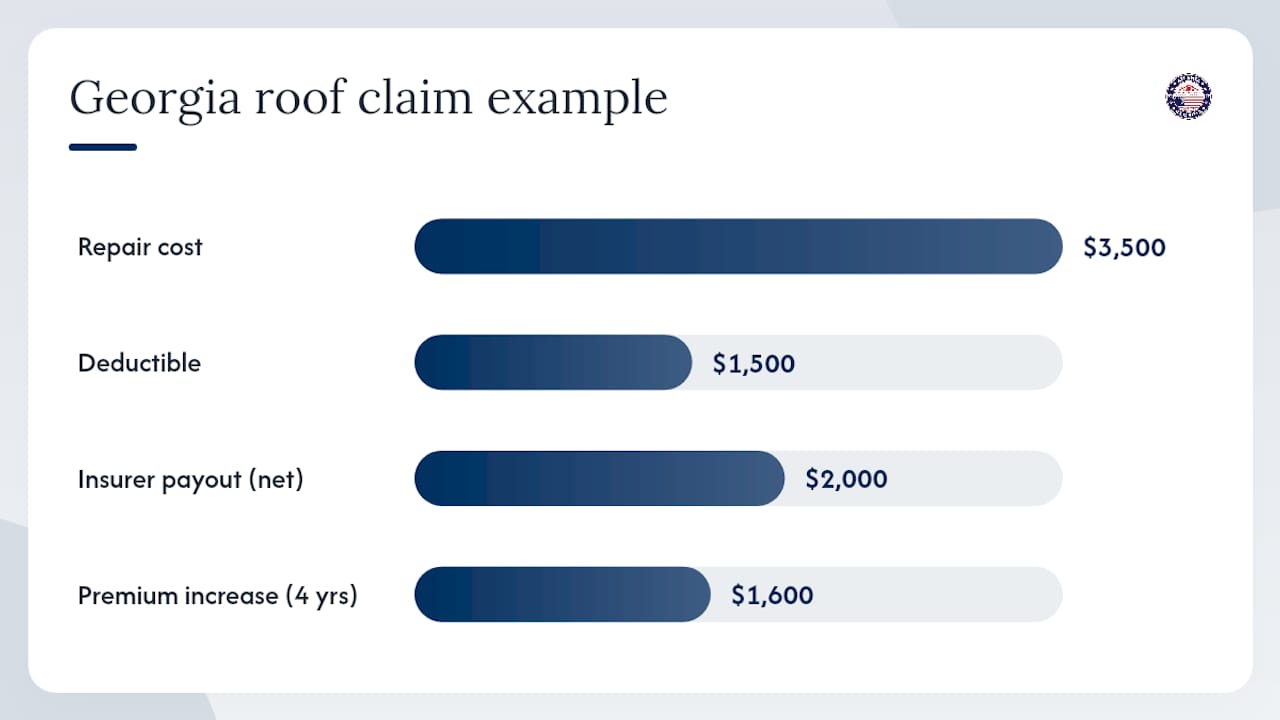
A worked example for Georgia homeowners: a roof repair estimate comes in at $3,500, and your deductible is $1,500. Filing nets you $2,000 from the insurer. But if that claim raises your annual premium by $400 and the surcharge lasts four years, you pay an extra $1,600 in premiums, nearly wiping out the benefit. Add in the risk of a second claim pushing you toward non-renewal, and paying out of pocket often makes more financial sense for smaller losses.
A practical decision sequence:
- Get a contractor estimate before calling your insurer. Contractor guidance consistently recommends this step, because the estimate tells you whether the repair cost meaningfully exceeds your deductible.
- Calculate the net benefit: repair cost minus deductible, minus estimated premium increases over the surcharge period.
- Consider your current claim count. If you have filed one claim in the past three years, a second claim carries more risk than if your record is clean.
- Check whether your policy includes accident forgiveness or a claims-free discount you would lose.
Pro Tip: For roof damage specifically, document everything with dated photos before any repair work begins. A detailed roof damage report strengthens your position whether you file or negotiate directly. If the damage is marginal relative to your deductible, a professional inspection can confirm the scope before you commit to a claim.
Pro Tip: Ask your insurer whether your policy includes accident forgiveness or a first-claim waiver. Some carriers offer these as add-ons, and they can protect your rate after a single incident.
Pro Tip: Review your roof warranty vs. insurance claim options before filing. Some damage may be covered under a manufacturer or contractor warranty, which avoids a claim entirely.
How multiple claims affect your options when shopping for new coverage
A multi-claim history does not lock you out of coverage, but it narrows your options and raises your starting quote. New carriers pull your CLUE report and MVR before binding coverage, so there is no way to present a clean slate. What you can do is manage how that history is presented.
Practical steps when shopping with a claims history:
- Work with an independent agent who has access to multiple carriers, including non-standard and surplus lines markets. A captive agent can only offer one company's rates.
- Bundle policies where possible. Combining home and auto with one carrier often produces a discount that partially offsets the surcharge from your claims history.
- Ask about prior-claims explanation letters. Some carriers will consider a written explanation for not-at-fault or weather-related claims when underwriting.
- Time your shopping carefully. If a claim is 30 months old and your look-back window is 36 months, waiting a few more months before switching can meaningfully improve your quote.
For landlords managing multiple properties, the compounding effect of claims across properties is a separate underwriting consideration. Resources on landlord insurance for multiple properties explain how carriers assess cross-property risk, which follows similar credibility logic to multi-peril personal lines.
What Georgia homeowners should know about roof and storm claims
Roof claims are among the most common home insurance claims in the Atlanta metro area, and they carry specific underwriting risks that differ from other loss types. Wind and hail events are frequent across Cherokee County and the surrounding counties, and a single severe storm can prompt dozens of claims in one neighborhood.
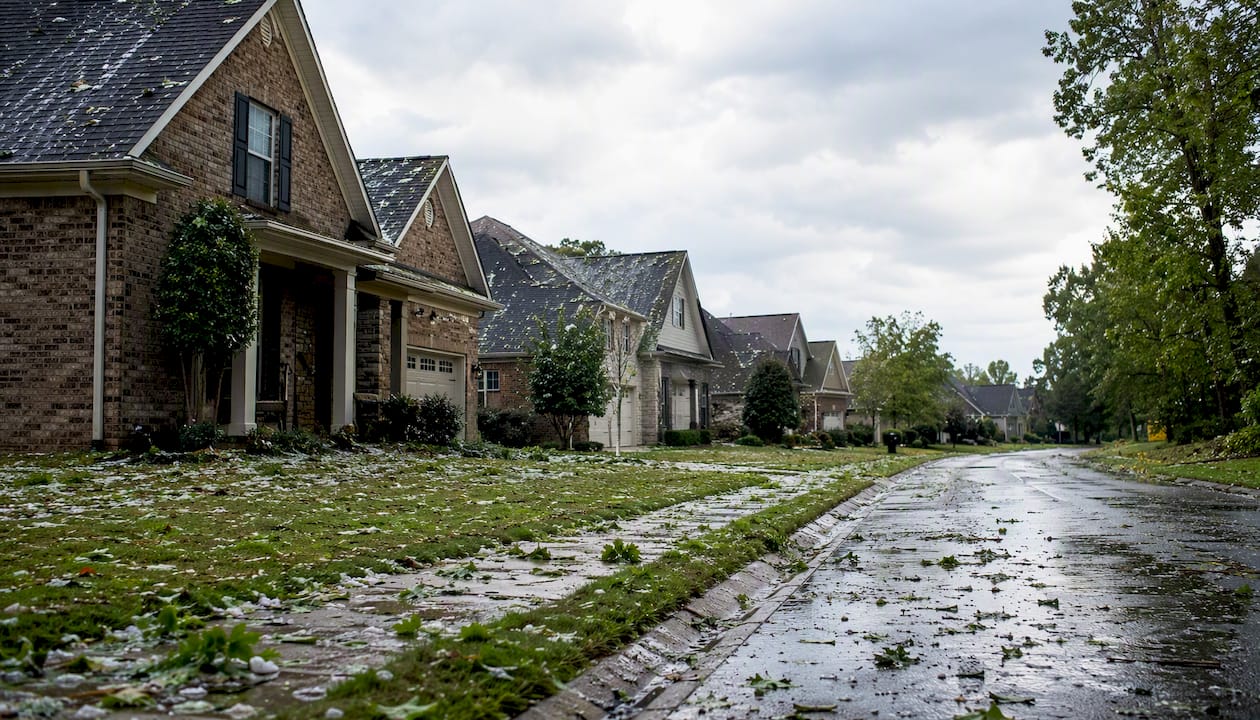
A single weather-related roof claim is usually treated as a random event. A second roof claim within three to five years, however, signals to underwriters that the property may have ongoing vulnerability, whether from roof age, installation quality, or repeated exposure. Repeated storm claims can lead to higher premiums, exclusion of wind or hail coverage, or non-renewal of the home policy.
Working with a local roofing contractor before filing changes the outcome in two concrete ways. First, a professional inspection and written estimate establishes the actual scope of damage, which prevents both under-claiming and over-claiming. Second, documented evidence of the damage, including dated photos and a formal report, supports the claim if an adjuster disputes the scope or underpays. Georgia homeowners should be aware that adjusters sometimes underpay roof claims, and having independent documentation is the most effective counter.
Key considerations for Georgia homeowners managing roof claims:
- Roof age directly affects payout. Older roofs may be covered at actual cash value, not replacement cost, reducing the insurer's payment significantly.
- Prior repairs documented by a licensed contractor can demonstrate that the damage is storm-related rather than maintenance-related, which matters for coverage eligibility.
- If a repair estimate comes in under $4,000, repair is almost always the smarter financial choice over replacement, and filing a claim for a repair-sized loss rarely makes sense when weighed against future premium effects.
- A roofing insurance advocate who works directly with carriers and adjusters can document damage thoroughly and negotiate on your behalf, improving both claim outcomes and the accuracy of the insurer's assessment.
Pro Tip: Before filing any storm claim in Georgia, get a free roof inspection and written estimate. Knowing the actual repair cost relative to your deductible is the single most useful piece of information for making the file-vs-pay decision.
What homeowners often get wrong about filing claims
Most homeowners treat the file-vs-pay decision as binary: either the damage happened and you file, or it did not and you do not. The reality is more nuanced, and the cost of getting it wrong compounds over time.
The most common mistake is filing small claims reflexively, without calculating the multi-year premium impact. A $1,200 repair filed as a claim against a $1,000 deductible nets $200 from the insurer and potentially costs far more in surcharges over the next three to five years. That math rarely works in the homeowner's favor.
A second overlooked point: the CLUE report captures inquiries, not just paid claims, in some cases. Calling your insurer to "ask about" a potential claim can sometimes create a record, even if you never formally file. Confirm your insurer's inquiry policy before making that call.
The repair-first approach that The Original Roof Repair Company applies to roofing reflects the same logic. Diagnosing the actual problem, getting a precise estimate, and repairing what needs repair, rather than replacing everything, keeps claim amounts lower, preserves your claims history, and protects your insurability over the long term.
Roof inspections and claim advocacy from The Original Roof Repair Company
Storm damage in the Atlanta area and across Cherokee County moves fast, and so does the decision about whether to file. The Original Roof Repair Company offers free roof inspections and written estimates before you contact your insurer, giving you the documentation you need to make an informed decision.

The repair-first approach means you get an honest assessment of what the damage actually requires, not a replacement pitch. For losses that warrant a claim, the company provides storm and hail damage documentation and works directly with carriers and adjusters on your behalf, the kind of roof insurance claim advocacy that produces more accurate settlements and fewer underpaid claims. For damage that does not justify a claim, you get a clear repair estimate and avoid a claims record entry that could raise your premiums for years. Schedule a free inspection with The Original Roof Repair Company before your next renewal or after any storm event.
Sources
- Multi-Peril Frequency Credibility Premium via Shared Random Effects
- How much does auto insurance go up after a claim? - GEICO
- CONSUMER GUIDE
Pro Tip: Bookmark the Georgia Department of Insurance website and check it any time you receive a non-renewal notice or a rate increase you cannot explain. State rules change, and the DOI consumer guide is updated to reflect current protections.
This article is general information, not a substitute for advice from a qualified financial advisor. Consult a qualified financial professional about your own circumstances before acting on anything here.
FAQ
Does the amount of a claim affect my premium?
Yes. Larger claims generally produce larger surcharges, but frequency often matters as much as dollar amount. An insurer may react more strongly to three small claims than to one large one.
Can an insurance company drop you for multiple claims?
Yes, though mid-term cancellation is restricted in Georgia. Non-renewal at the end of your policy term is more common and easier for insurers to execute after multiple claims within a short window.
Do claims affect insurance premiums even if I was not at fault?
Not-at-fault claims typically carry less penalty than at-fault ones, but they still appear on your CLUE report and can influence underwriting. In Georgia, partial-fault allocations mean "not at fault" is not always a clean designation.
Does filing two claims in the same year on different cars raise my rates?
It can. Each claim is evaluated separately, but multiple claims across vehicles on the same policy increase your overall claim frequency, which insurers factor into renewal pricing. The impact depends on fault, claim type, and your insurer's rating rules.
When does it make sense to pay out of pocket instead of filing?
When the repair cost minus your deductible is small relative to the likely premium increase over the next 3–5 years, paying out of pocket usually makes more financial sense. Get a contractor estimate first to know the actual repair cost before making that call.