
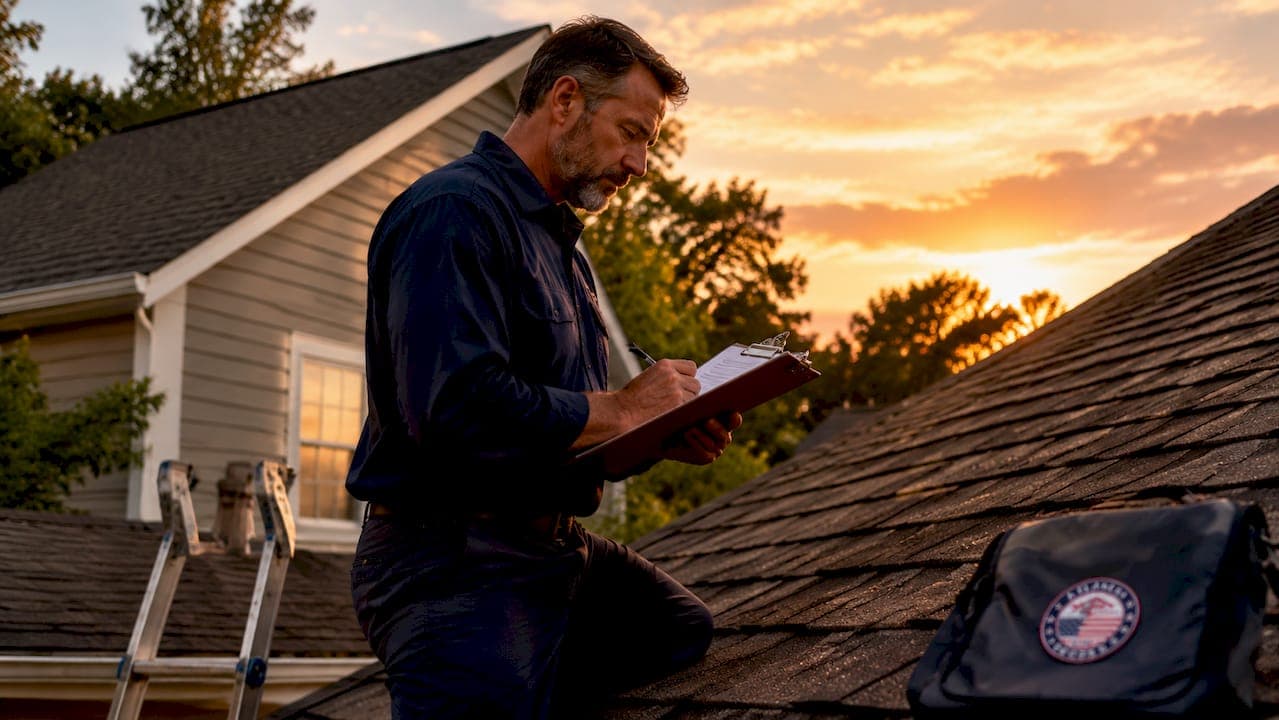
A roof damage report is a formal, written evaluation produced by a certified roofing professional that documents every instance of storm-related damage on your roof and specifies the repairs required to restore it. The industry standard term for this document is a "roof inspection report," and understanding what it contains is the single most important step a homeowner can take before filing a storm insurance claim. In Canton, Cherokee County, and across the greater Atlanta, Georgia area, storms bring hail, high winds, and falling debris that can compromise a roof in ways that are not visible from the ground. A thorough report gives your insurer the verified evidence it needs to process your claim accurately and without unnecessary delays.
What does a roof damage report include?
A professional roof inspection report is built around verifiable data, not general observations. Professional reports include GPS-verified measurements, local building code references, annotated photos keyed to specific roof sections, and a line-item repair estimate. Each of those elements serves a specific purpose in the claims process.
The core components of a thorough report are:
- Inspector credentials: The report must identify the inspector by name, license number, and company affiliation. This establishes the document's authority with your insurer.
- Roof dimensions and pitch: Total square footage (measured in "squares," where one square equals 100 square feet), roof pitch, and complexity scores are documented. GPS-verified measurements and labeled roof diagrams map directly to estimate line items and help adjusters validate scopes quickly.
- Material specifications: The report identifies shingle type, manufacturer, age, and condition. This matters because older materials may trigger depreciation calculations in your policy.
- Annotated photo documentation: Every damage point is photographed and linked to a specific location on a roof diagram. Photos keyed to damage location and repair line items reduce back-and-forth questions during claim adjustment.
- Line-item repair estimate: Labor and material costs are broken out individually, not bundled into a single total. This format matches the structure insurers use internally.
- Building code references: Georgia's International Residential Code (IRC) requirements for ventilation, ice and water shield, and step flashing must appear when those items are part of the repair scope.
| Report Element | Why It Matters for Your Claim |
|---|---|
| Inspector credentials | Establishes document authority with the insurer |
| GPS-verified measurements | Prevents disputes over square footage and waste factors |
| Annotated photos | Ties visible damage directly to repair line items |
| Building code references | Justifies code-required upgrades the adjuster may miss |
| Line-item estimate | Matches insurer's internal format for faster review |
Pro Tip: Request that your inspector include ridge, hip, and valley lengths in the report. Detailed roof geometry metrics enable defensible waste factor calculations, which prevents payment disputes over material quantities.

How do roof damage reports support insurance claims in Georgia?
Georgia homeowners face specific deadlines and documentation standards that make a thorough roof assessment non-negotiable. Georgia policies require claims notice within 30–45 days of discovering storm damage. Missing that window gives your insurer grounds to deny the claim on timing alone, regardless of how severe the damage is.
A well-prepared report satisfies insurer documentation requirements in four concrete ways:
- It establishes a damage timeline. Date-stamped photos with metadata, combined with regional weather data from the storm event, prove that the damage occurred during a covered weather event rather than from gradual wear.
- It reduces adjuster questions. Insurance adjusters prioritize clarity and verifiable data. The cleanest, most accurate reports move to the front of the approval queue. A disorganized report with missing photos or vague descriptions invites delays and follow-up requests.
- It supports code-compliant repair costs. Standard homeowners insurance in Georgia covers sudden storm-related damage including wind, hail, and falling debris. A report that references IRC requirements justifies the full cost of bringing your roof up to current code, not just patching the visible damage.
- It creates a record for appeals. If your initial claim is underpaid, a certified report is the foundation for a supplement or formal dispute. Without it, you are arguing against an adjuster's scope with no competing documentation.
Maintaining detailed roof records, including inspection reports, photos, repair receipts, and policy declarations, supports faster claims and appeals by establishing a clear condition and damage timeline. Homeowners who keep these records before a storm hits are in a significantly stronger position than those who start gathering documentation after the fact.
Common pitfalls in roof reports and storm claims
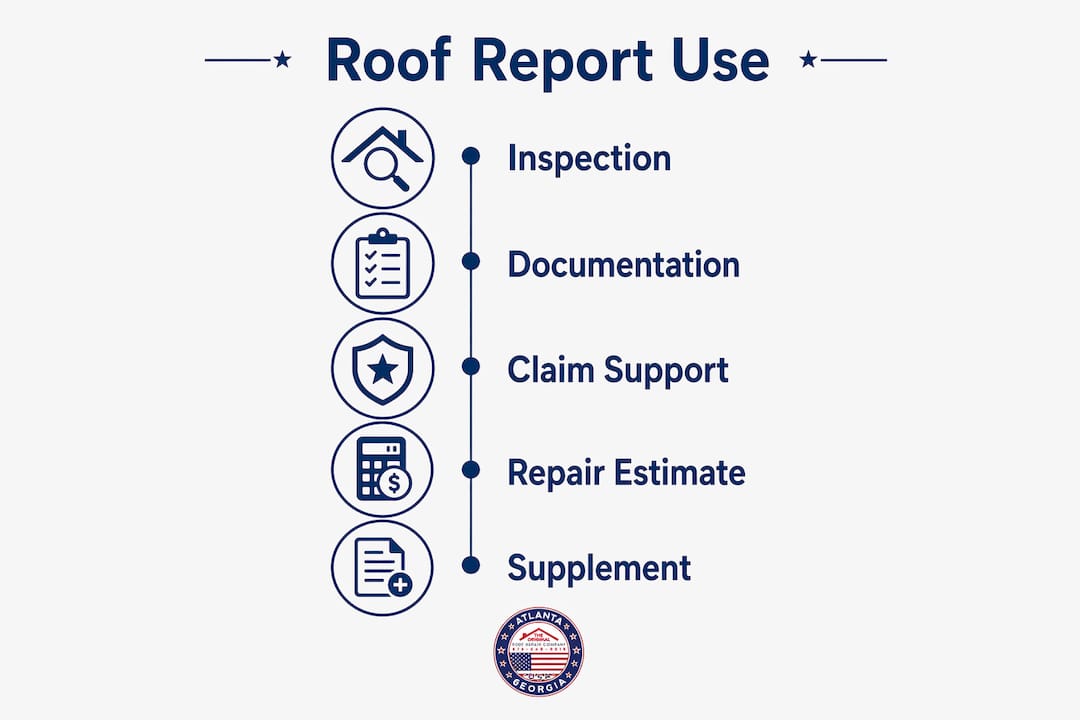
The most damaging misconception homeowners carry into a storm claim is that the insurance adjuster's initial estimate is the final word. It is not. First adjuster estimates rarely capture full repair scopes or code requirements. Verifying and supplementing with contractors familiar with local codes increases both claim accuracy and final payment.
The most common errors that cost homeowners money include:
- Relying solely on the adjuster's report. Adjusters work from simplified templates and are generally not trained as building code experts. They frequently miss code-required repairs such as ventilation upgrades, step flashing replacement, and ice and water shield installation.
- Incomplete photo documentation. Photos that show general roof condition without tying specific images to specific damage locations give adjusters little to work with. Every photo needs a corresponding location reference.
- Missing material specifications. A report that lists "shingles damaged" without specifying the manufacturer, product line, or color makes it nearly impossible to match materials during repair, which can trigger a full replacement claim that was otherwise avoidable.
- No weather data corroboration. A damage report without a corresponding weather event record is vulnerable to the insurer attributing damage to pre-existing wear rather than the storm.
- Accepting the first scope without review. Many homeowners sign off on an adjuster's scope without comparing it to a certified contractor's assessment. That gap is where underpayment happens. You can learn more about this pattern in the guide on why adjusters underpay roof claims in Georgia.
Pro Tip: Ask your contractor to provide a side-by-side comparison of the adjuster's scope and the certified inspection report. Any line item present in the contractor's report but absent from the adjuster's scope is a candidate for a supplement claim.
How to use your roof assessment to maximize your storm claim
Using a roof damage assessment effectively requires more than handing it to your insurer and waiting. The process is active, and homeowners who engage with it recover more money.
- Read the report before submitting it. Confirm that every area of damage you observed is documented. If you noticed missing shingles on the north slope and the report omits that section, request a revision before filing.
- Compare it line by line with the adjuster's scope. When the adjuster's estimate arrives, place it next to the certified report. Items present in your report but absent from the adjuster's scope are the basis for a supplement claim.
- File supplements for missed or undervalued items. Roofing insurance supplements on average recover significant additional funds for homeowners by documenting missed items such as rotted decking, code-required ice and water shields, step flashing, ventilation upgrades, and overhead and profit costs.
- Work with a contractor who knows Georgia building codes. A contractor unfamiliar with local IRC requirements cannot write a report that justifies code-compliant repairs. Cherokee County and the broader Atlanta metro area have specific enforcement standards that must appear in the documentation.
- Keep every document in one place. Create a physical or digital folder containing the inspection report, all photos with metadata intact, the adjuster's scope, your policy declarations page, and all written communications with your insurer. This record supports both the initial claim and any appeal. The wind damage claim checklist for Georgia homeowners is a practical starting point for organizing this documentation.
- Do not delay repairs past your policy's timeline. Georgia policies typically require that you take reasonable steps to prevent further damage after a storm. Waiting too long to act can give the insurer grounds to deny damage that occurred after the initial event.
Key Takeaways
A certified roof inspection report is the single document that determines whether your storm insurance claim is paid in full, underpaid, or denied.
| Point | Details |
|---|---|
| Report components matter | GPS measurements, annotated photos, and code references are required for a defensible claim. |
| Georgia claim deadlines are strict | Notify your insurer within 30–45 days of discovering storm damage to avoid denial. |
| Adjuster estimates are not final | First scopes frequently miss code-required repairs; supplements recover the difference. |
| Photo documentation is specific | Every photo must tie to a named damage location and a corresponding repair line item. |
| Maintain ongoing roof records | Pre-storm inspection reports and repair receipts strengthen every future claim. |
What I've learned after four years of storm claims in Cherokee County
After working through hundreds of storm damage cases across Canton, Ball Ground, and the surrounding Cherokee County communities, one pattern stands out clearly. The homeowners who get paid fairly are the ones who treated their roof inspection report as a legal document from the start, not as a formality.
The most frustrating situations I encounter are not the severe damage cases. Those are usually straightforward. The difficult cases are the ones where a homeowner accepted the adjuster's initial scope, signed off, and only called us months later when the repair fell short. By that point, the supplement window is narrow and the documentation trail is cold.
Technology has genuinely changed what a good report looks like. Aerial measurement tools and drone photography now produce geometry data that is accepted by virtually every major carrier as reliable third-party documentation. A report built on that foundation is much harder for an adjuster to dispute than one built on a contractor's manual tape measure.
My honest advice: do not wait for a storm to think about your roof records. A pre-storm inspection report, even a simple one, establishes a baseline condition that makes every future claim cleaner and faster. The homeowners who maintain those records consistently get better outcomes, not because they argue harder, but because they have better evidence.
— Eric
How The Original Roof Repair Company helps with roof damage reports
The Original Roof Repair Company provides professional roof inspections in Canton, Cherokee County, and across the greater Atlanta, Georgia area, with documentation built specifically for insurance claim submission.

Every inspection produces a certified report with GPS-verified measurements, annotated photos, line-item estimates, and Georgia IRC code references. The team works directly with insurance carriers and adjusters on the homeowner's behalf, identifying missed items and filing supplements when the initial scope falls short. For homeowners dealing with recent storm damage, emergency roof repair services are available to stop active leaks while the claim process moves forward. For full claim support from inspection through settlement, the roof insurance claims service page outlines every step of the process.
FAQ
What is a roof damage report?
A roof damage report is a certified professional document that records all storm-related damage to a roof, including measurements, material specifications, annotated photos, and a line-item repair estimate. It is the primary document used to support a homeowner's insurance claim.
How soon must I file a roof damage claim in Georgia?
Georgia policies require homeowners to notify their insurer within 30–45 days of discovering storm damage. Filing after that window gives the insurer grounds to deny the claim based on timing.
Is the insurance adjuster's report the same as a contractor's inspection report?
No. Adjuster reports are produced from simplified templates, and adjusters are generally not building code experts. A certified contractor's inspection report captures code-required repairs and material specifications that adjuster scopes routinely omit.
What is a roofing supplement claim?
A supplement claim is a formal request to add missed or undervalued items to an approved insurance scope. Supplements commonly cover code-required ventilation upgrades, ice and water shield, step flashing, and overhead and profit costs that the initial adjuster estimate excluded.
How do I read a roof inspection report?
Start with the inspector's credentials and the total roof area in squares. Then review the annotated photo section to match each image to its location on the roof diagram. Finally, compare the line-item estimate against your adjuster's scope to identify any gaps worth supplementing.