
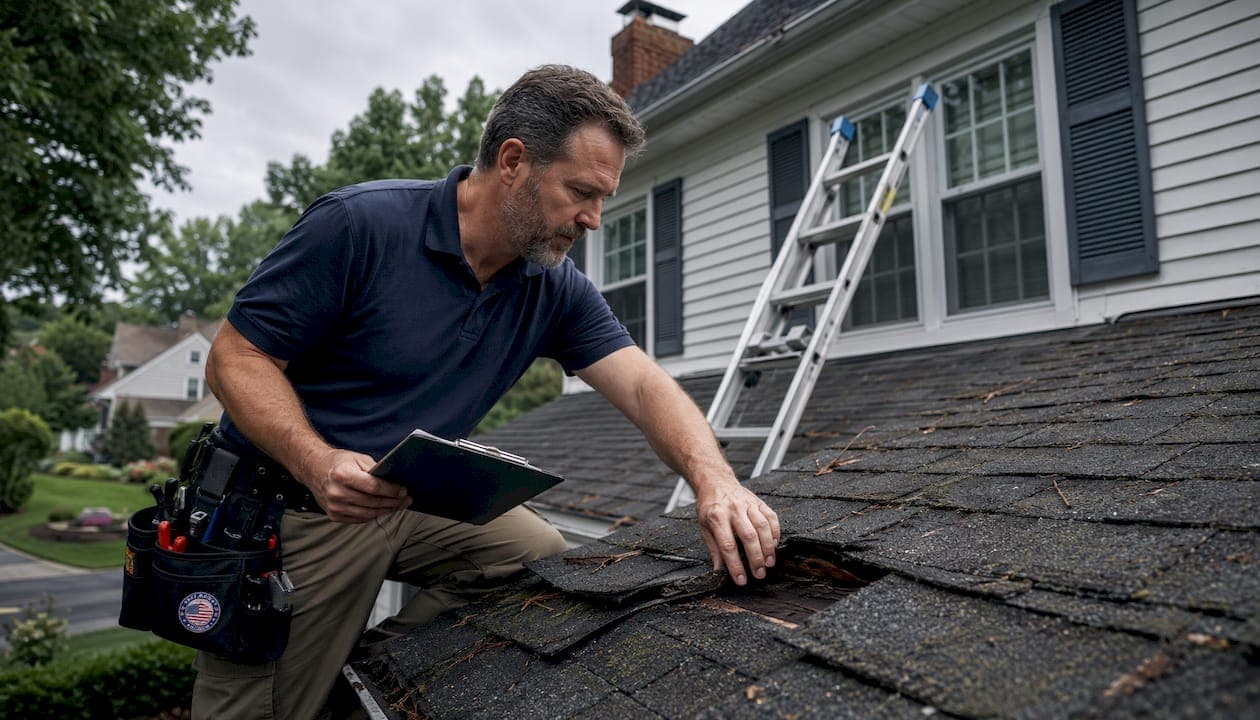
What is a partial roof replacement claim?
A partial roof replacement claim is when your insurance company approves payment to repair only the damaged section of your roof, not the entire system. Under a standard HO-3 homeowners policy, insurers are obligated to pay for physical loss to the property — meaning the specific area damaged, not the whole roof by default.
Key facts to understand upfront:
- Partial claims are the insurer's default position when damage is localized
- Common triggers include wind damage to one slope, hail on a single section, or a fallen tree limb
- Matching shingles and building code requirements can force a broader scope of repair
- Your policy's settlement basis (Replacement Cost Value vs. Actual Cash Value) determines how much you actually receive
Table of Contents
- How insurance companies handle partial roof replacement claims
- Partial vs. full roof replacement: what your coverage actually covers
- What to do when your insurer offers only a partial repair
- Expert perspective from The Original Roof Repair Company on Georgia claims
- Common pitfalls in partial roof insurance claim disputes
- Typical costs and deductibles for partial roof replacement claims
- Documentation that strengthens your partial roof claim
- How long does a partial roof claim take to approve and schedule?
- The Original Roof Repair Company handles partial claims the right way
- FAQ
- Key Takeaways
How insurance companies handle partial roof replacement claims
Insurers follow a structured process when evaluating partial roof damage coverage. An adjuster inspects the roof, documents the damaged area, and produces a Scope of Loss that defines what the company will pay to repair.
Certain building codes include a damage threshold which, if surpassed within a specified time period, may require the entire roofing system to be updated to current standards. That can shift a partial claim into a full replacement scenario.
Depreciation also shapes the payout. RCV policies pay the full material cost once repairs are completed; ACV policies pay only the depreciated value, which on a 15-year-old roof can be a fraction of actual replacement cost. Insurers issue the initial check at ACV, then release recoverable depreciation after you submit proof of completed work.
Additional factors adjusters weigh:
- Shingle availability and whether a matching product exists
- Age and overall condition of the roof
- Whether underlayment, decking, or flashing also requires replacement
- State-specific matching regulations that may expand the insurer's obligation
Partial vs. full roof replacement: what your coverage actually covers
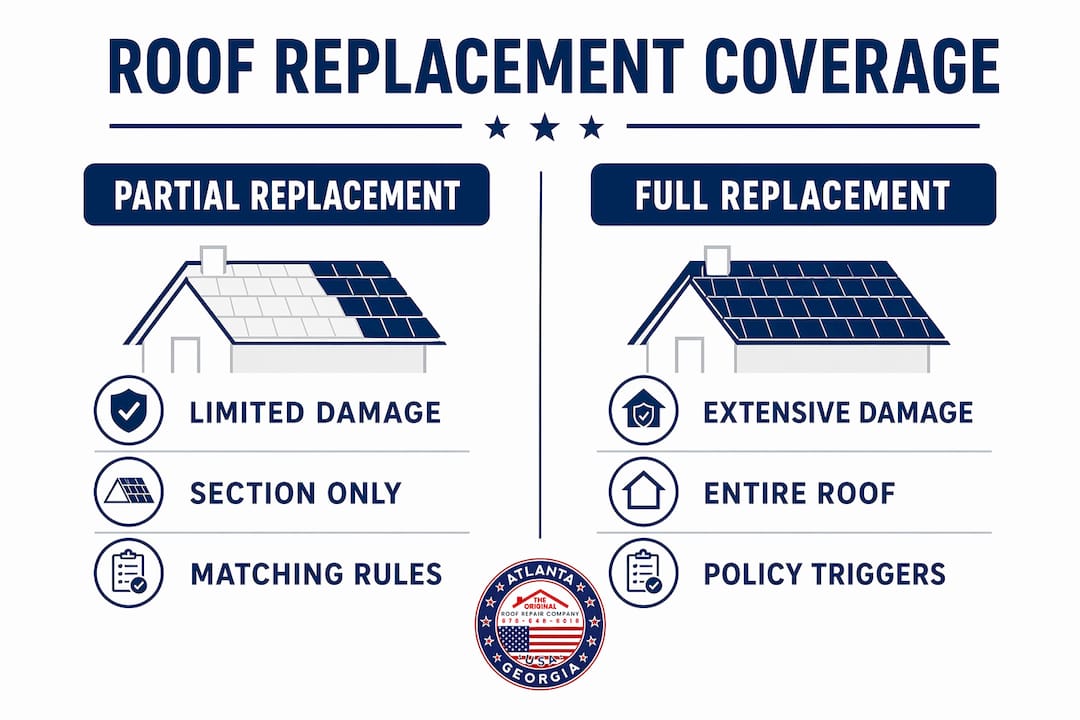
The core difference between a partial and full roof replacement claim comes down to damage extent and policy triggers.
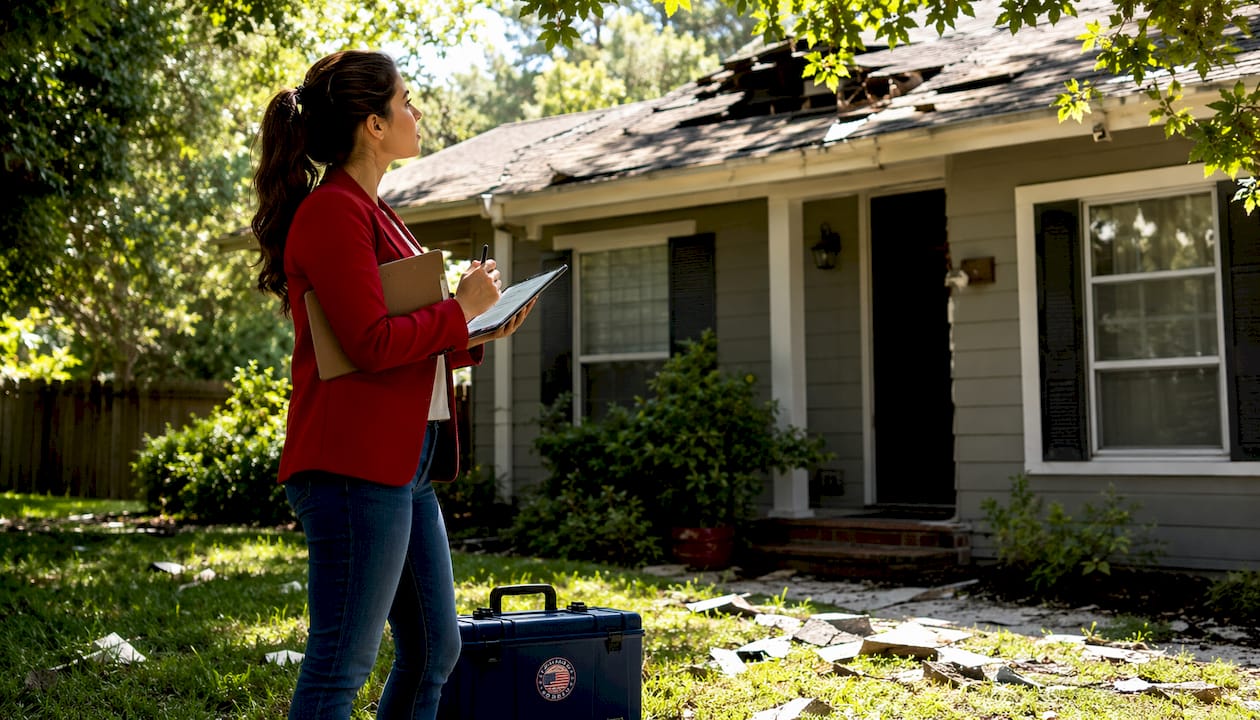
A partial claim covers one slope, section, or defined area. A full replacement claim covers the entire roof system, and insurers approve it when damage is widespread, when matching shingles are discontinued, or when building codes mandate it. Homes with uniform roofing materials sell faster and at higher values, which is why matching disputes matter beyond aesthetics.
Policy type shapes the financial gap significantly:
- RCV policies restore your roof to pre-loss condition with new materials, making matching disputes most common here
- ACV policies pay depreciated value, leaving a larger out-of-pocket gap regardless of partial or full scope
- Matching endorsements explicitly require the insurer to replace undamaged shingles when a match cannot be sourced
- Ordinance or law coverage pays for code-required upgrades; without it, you may owe the cost of bringing undamaged sections up to current code yourself
Many states have regulations requiring that replaced roofing materials match the original in color, size, and quality, as explained in this mantenimiento de tejados guía práctica. Where those rules apply, some courts have ruled that "covered property" means the entire roof, strengthening full-replacement claims.
What to do when your insurer offers only a partial repair
Receiving a partial approval is not the end of the claim. Many partial approvals are successfully challenged with the right documentation and process.
- Review the Scope of Loss carefully. Confirm every damaged component is listed, including underlayment, flashing, and decking.
- Get an independent contractor assessment. A roofer experienced in insurance scoping can identify line items the adjuster missed.
- Order an ITEL lab report if your shingles may be discontinued. This lab test objectively confirms whether a matching product exists and becomes the technical foundation for a supplement.
- File a formal supplement citing matching regulations, building code triggers, and any additional damage documented after the initial inspection.
- Request a reinspection if the adjuster's initial visit was brief or incomplete.
- Use your policy's appraisal clause if negotiations stall. An independent appraiser and neutral umpire can resolve disputes faster than litigation.
- File a complaint with your state's department of insurance if the insurer ignores applicable matching regulations.
You can cash the initial partial repair check and still retain the right to supplement the claim. Accepting the first payment does not waive your right to pursue additional coverage.
Expert perspective from The Original Roof Repair Company on Georgia claims

Georgia homeowners in the Atlanta metro area face the same insurer tactics seen nationwide, and a few specific to the Southeast's storm patterns.
Adjusters prioritize functional adequacy over visual uniformity. That means they approve a repair that keeps water out, even when the patched section looks nothing like the rest of the roof. The standard for homeowners is pre-loss restoration, not just weatherproofing. That gap is where most disputes begin.
Ordinance or law coverage is an optional endorsement that can help pay for code-required upgrades during repairs; without it, policyholders may be responsible for some costs of bringing undamaged sections up to code. If your policy doesn't include this endorsement, ask your agent to add it before the next storm season.
Line-of-sight evaluations are another tool worth knowing. This standard requires that repairs look visually uniform from the main viewing points of the property. When a partial repair fails that test, it supports a broader replacement scope.
Pro Tip: Submit your supplement before the insurer closes the claim file. Timing matters. A supplement filed with photographic evidence, a contractor's written assessment, and an ITEL lab report carries far more weight than a verbal dispute after the file is closed. The Original Roof Repair Company documents damage and files supplements on behalf of Atlanta-area homeowners as part of its insurance claim advocacy service.
Common pitfalls in partial roof insurance claim disputes
The most frequent mistake homeowners make is accepting the first offer without independent verification. Adjusters can miss secondary damage, underlayment failures, and code-required components that add legitimate cost to the claim.
Other pitfalls to avoid:
- Signing a release or "direction to pay" without understanding what rights you're waiving
- Letting the claim deadline pass without completing repairs or filing a supplement
- Hiring a contractor unfamiliar with insurance scoping, who may miss supplemental line items
- Failing to document pre-repair conditions with photos and written reports
Typical costs and deductibles for partial roof replacement claims
Partial roof replacement costs vary by material, slope complexity, and damage extent. Your deductible applies regardless of whether the claim is partial or full. For Georgia homeowners, wind and hail deductibles are sometimes set as a percentage of the dwelling coverage rather than a flat dollar amount, which can significantly affect your net payout.
On an ACV policy, recoverable depreciation is withheld until repairs are complete. On a 12-year-old roof with a 25-year lifespan, nearly half the replacement cost may be held back initially. Understanding your policy's settlement basis before a claim occurs is the single most effective way to avoid payout surprises.
Documentation that strengthens your partial roof claim
Strong documentation is what separates a settled claim from a disputed one. Gather the following before and after any adjuster visit:
- Dated photographs of all damaged areas, including close-ups of shingle damage, flashing, and decking
- A written contractor assessment identifying all storm-related damage
- ITEL lab report confirming shingle discontinuation if applicable
- Building permit history and prior maintenance records
- Itemized estimates from a licensed roofer covering full scope, including code-required components
A supplement supported by this evidence is far more likely to succeed than one based on verbal disagreement alone.
How long does a partial roof claim take to approve and schedule?
Most insurers complete the initial adjuster inspection within 7–14 days of a filed claim. Approval of the Scope of Loss typically follows within a few days to two weeks after that. Supplements add time, often 2–4 additional weeks depending on the insurer's review process and whether a reinspection is required.
Once approved, scheduling depends on contractor availability and material lead times. In Georgia, post-storm demand can extend contractor schedules by several weeks. File promptly and keep written records of every communication with your insurer, including dates, names, and what was discussed.
The Original Roof Repair Company handles partial claims the right way
When your insurer offers less than your roof damage warrants, you need a contractor who understands both roofing and the claims process.
The Original Roof Repair Company, based in Canton, Georgia, serves homeowners across Cherokee County and 11 surrounding counties in the Atlanta metro area. The company documents storm, hail, and wind damage thoroughly, works directly with carriers and adjusters, and files supplements when the initial scope falls short. With a repair-first approach and transparent pricing, The Original Roof Repair Company recommends full replacement only when repair costs exceed $4,000 and replacement is the smarter financial decision. BBB accredited and built on four years of honest, no-pressure service. Get a professional assessment and roof insurance claim support from a team that knows how to document what your roof actually needs.
FAQ
Can you get a partial roof replacement through insurance?
Yes. Insurance companies routinely approve partial roof replacement when damage is limited to a specific section and caused by a covered event such as wind or hail. Coverage depends on damage extent, shingle availability, and your policy terms.
What not to say to a roof insurance adjuster?
Avoid speculating about cause, age, or pre-existing conditions without documentation. Stick to observable, storm-related damage and let your contractor's written assessment speak to scope.
What are common reasons for roof claim denials?
Insurers most often deny claims citing wear and tear, pre-existing damage, cosmetic-only damage exclusions, or damage below the policy deductible. Filing with thorough photographic evidence and a contractor report reduces denial risk.
Is a partial roof replacement tax deductible?
Generally, no. Insurance-covered roof repairs on a primary residence are not tax deductible. Consult a tax professional for guidance specific to rental properties or home office situations.
Key Takeaways
A partial roof replacement claim covers only the damaged section of your roof, but matching rules, building codes, and policy type can expand what your insurer owes.
| Point | Details |
|---|---|
| Default insurer position | Insurers pay for physically damaged sections only under standard HO-3 policies. |
| 25% damage threshold | Damage exceeding 25% of total roof area can trigger a full code-compliant replacement. |
| Policy settlement basis | RCV policies pay full material cost after repairs; ACV policies pay depreciated value upfront. |
| Ordinance or law coverage | This endorsement typically adds 10–25% of dwelling coverage and pays for code-required upgrades during repairs. |
| The Original Roof Repair Company | Serves Atlanta-area homeowners with insurance claim advocacy, damage documentation, and supplement filing. |