
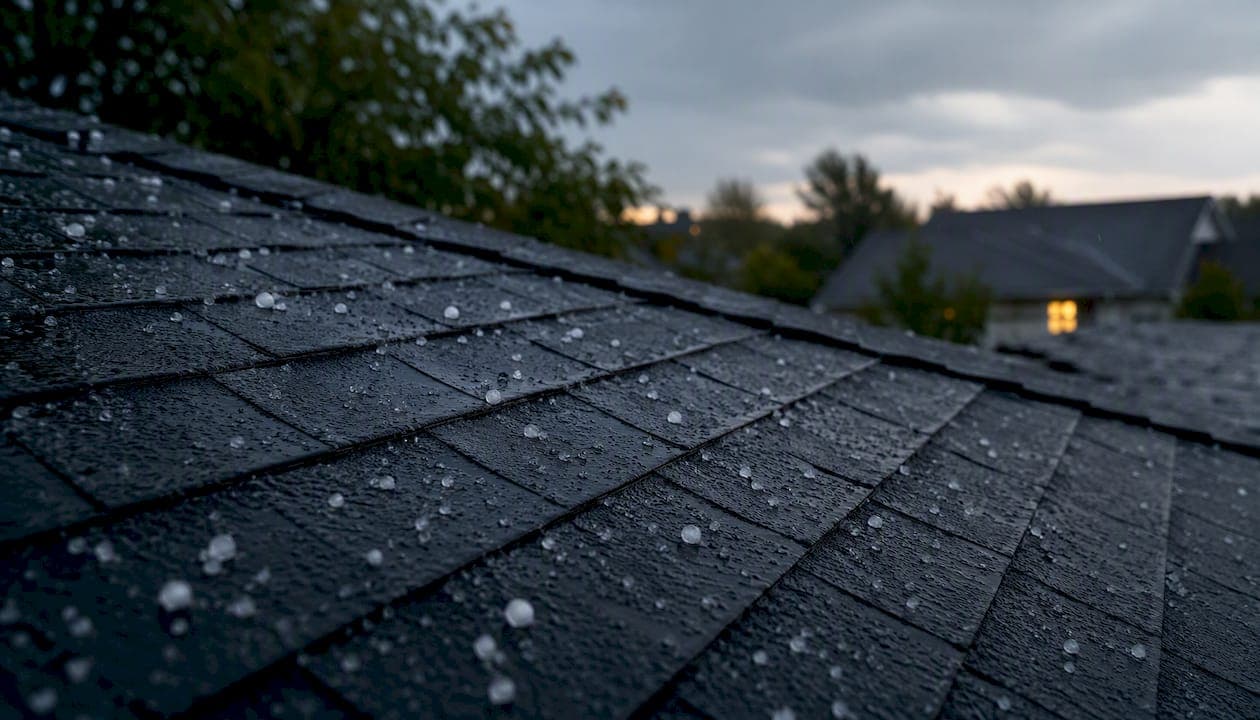
Hail claims rise sharply in spring because colliding cold northern air and warm, humid Gulf air produce powerful updrafts that grow large hailstones, and lower freezing levels let those stones reach the ground intact. AccuWeather meteorologists confirm this seasonal air-mass dynamic is the primary driver behind the spring surge in hail damage. If hail just hit your home, here is what to do right now:
- Stay inside until the storm passes completely.
- Photograph everything — roof, siding, windows, vehicles, and any interior leaks — before touching anything.
- Contact your insurer to open a claim, then schedule a professional roof inspection.
Farmers Insurance reports that hail-related homeowners claims represented about 31% of total homeowners claims volume and roughly 20% of claim dollars paid in recent reporting. For Atlanta and Cherokee County homeowners, The Original Roof Repair Company offers free inspections and insurance claim advocacy after spring storms.
Key Takeaways
Spring's air-mass collisions and lower freezing levels produce more large hail, which drives a concentrated surge in homeowner insurance claims from April through June.
| Point | Details |
|---|---|
| Spring meteorology drives the spike | Cold northern air colliding with Gulf moisture creates large hail that reaches the ground intact due to lower freezing levels. |
| Claims concentrate April–June | RMIIA data shows May 2019 and April 2020 as peak months; Farmers reports hail makes up 31% of homeowners claims volume. |
| Financial exposure is significant | Cotality estimates 43.5 million U.S. properties at moderate-or-greater hail risk, representing ~$17.8 trillion in reconstruction cost value. |
| Document early, review your policy | Photograph damage before any repairs, confirm your deductible type, and check whether your policy pays RCV or ACV on the roof. |
| The Original Roof Repair Company | Offers free inspections and claim advocacy across the Atlanta metro and Cherokee County after spring hail events. |
Pro Tip: Set a calendar reminder each February to photograph your roof, review your policy deductibles, and enable NOAA weather alerts before Georgia's spring storm season begins in March.
Table of Contents
- Why spring weather creates more hail than any other season
- How spring storms translate into a surge in insurance claims
- Where spring hail hits hardest, including Georgia and Atlanta
- How hail damages your home and what repairs typically cost
- What to do before, during, and after a hailstorm
- How a roofing expert helps you through the claims process
- Policy details to review before storm season peaks
- What the claim timeline looks like and mistakes that raise your costs
- What spring hail season looks like from the field in Georgia
- The Original Roof Repair Company is ready when spring storms hit
- Sources
- FAQ
Why spring weather creates more hail than any other season
The core mechanics come down to three factors working together: a strong jet stream, frequent air-mass collisions, and lower atmospheric freezing levels.
Every spring, the jet stream positions itself directly over the central and southern United States, acting as a trigger line where cold, dry air from Canada collides with warm, moisture-laden air flowing north from the Gulf of Mexico. That collision forces air upward in violent updrafts inside severe thunderstorms. Inside those updrafts, water droplets are carried above the freezing level, coat ice particles in successive layers, and grow into hailstones. Stronger updrafts mean larger hail.
The freezing level is the altitude at which air temperature drops to 32°F. In spring, that level sits lower in the atmosphere than it does in midsummer. A lower freezing level gives hailstones less warm air to pass through on the way down, so they arrive at the ground larger and harder. By July, the freezing level climbs higher, and smaller stones melt before landing. LendingTree's analysis of seasonal storm damage confirms that spring months consistently produce the highest hail-involved damage totals, partly because of these strong updrafts and abundant low-level moisture.
How spring storms translate into a surge in insurance claims
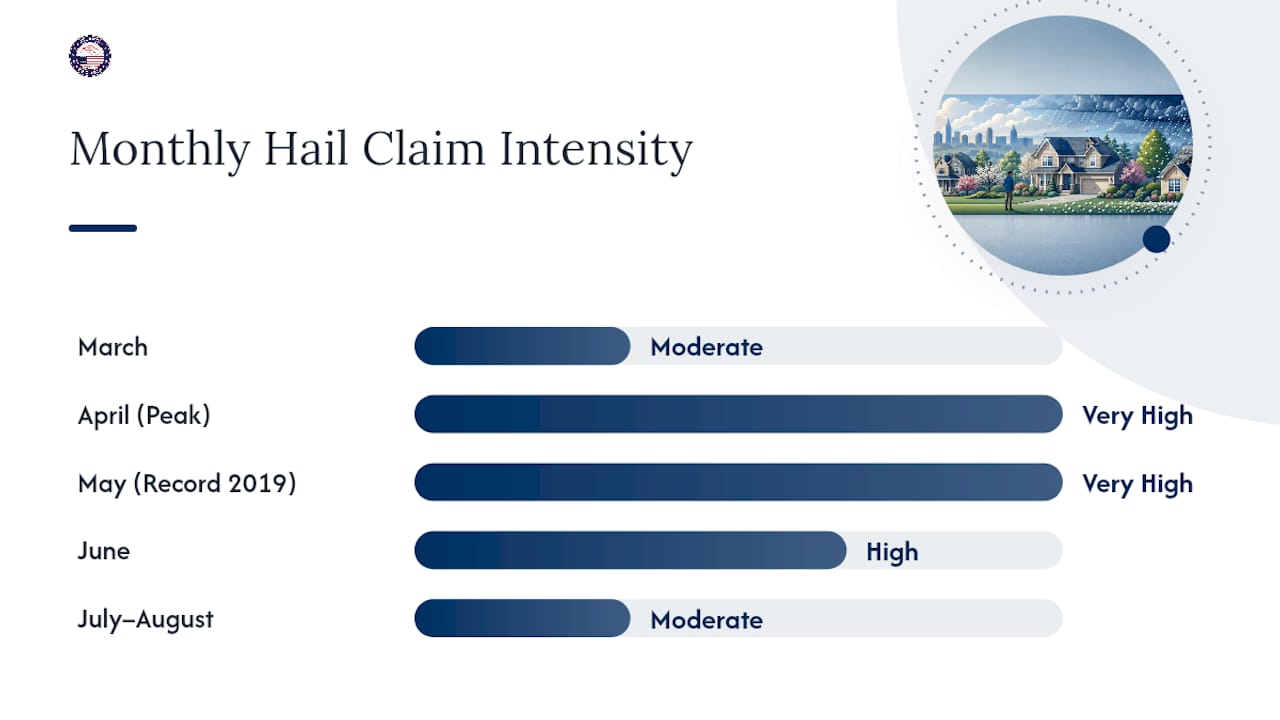
April through June is when claim volumes concentrate. RMIIA foreCAST data covering 2018–2020 shows hail claims clustered heavily in the April–August window, with May 2019 and April 2020 recording the highest monthly claim volumes in that period.
| Month | Claim Activity Level | Notes |
|---|---|---|
| March | Moderate | Season opens; Georgia/Southeast active |
| April | Very High | Peak month nationally and in Georgia |
| May | Very High | Record monthly volumes in 2019 |
| June | High | Plains and Midwest peak continues |
| July–August | Moderate | Activity shifts; lower freezing levels reduce large hail |
Guidewire's industry summary notes that severe convective storms, with hail as a primary driver, generated roughly $50 billion in global insured losses in 2025. During peak spring months, adjusters are stretched thin, contractor schedules fill fast, and claim processing slows. A homeowner who files in May may wait weeks for an initial inspection appointment.
Statistic to know: Farmers Insurance found hail-related claims made up about 31% of total homeowners claims volume in recent data, underscoring how concentrated the spring surge really is.
Where spring hail hits hardest, including Georgia and Atlanta
The highest spring hail risk falls across a broad corridor:
- Texas and Oklahoma: The southern Plains see frequent large hail from March through May, with Dallas-Fort Worth among the most exposed metros nationally.
- Midwest and High Plains (Kansas, Nebraska, Colorado): Peak activity runs April through June; golf-ball-size hail is not uncommon.
- Georgia and the Atlanta metro: The National Weather Service Atlanta office identifies March through May as the primary severe weather season for North and Central Georgia, with April as the most favored month for large hail. Storms typically develop in the afternoon and evening hours.
- Mountain West: Hail risk extends into Colorado's Front Range and parts of Wyoming, often peaking slightly later in May–June.
For Atlanta-area homeowners, April is the month to watch most closely. Sign up for NOAA weather alerts or enable push notifications from the National Weather Service's Atlanta office to get cell-level warnings before storms arrive. The Original Roof Repair Company's weather alerts page also tracks local storm activity across Cherokee County and surrounding areas.
How hail damages your home and what repairs typically cost
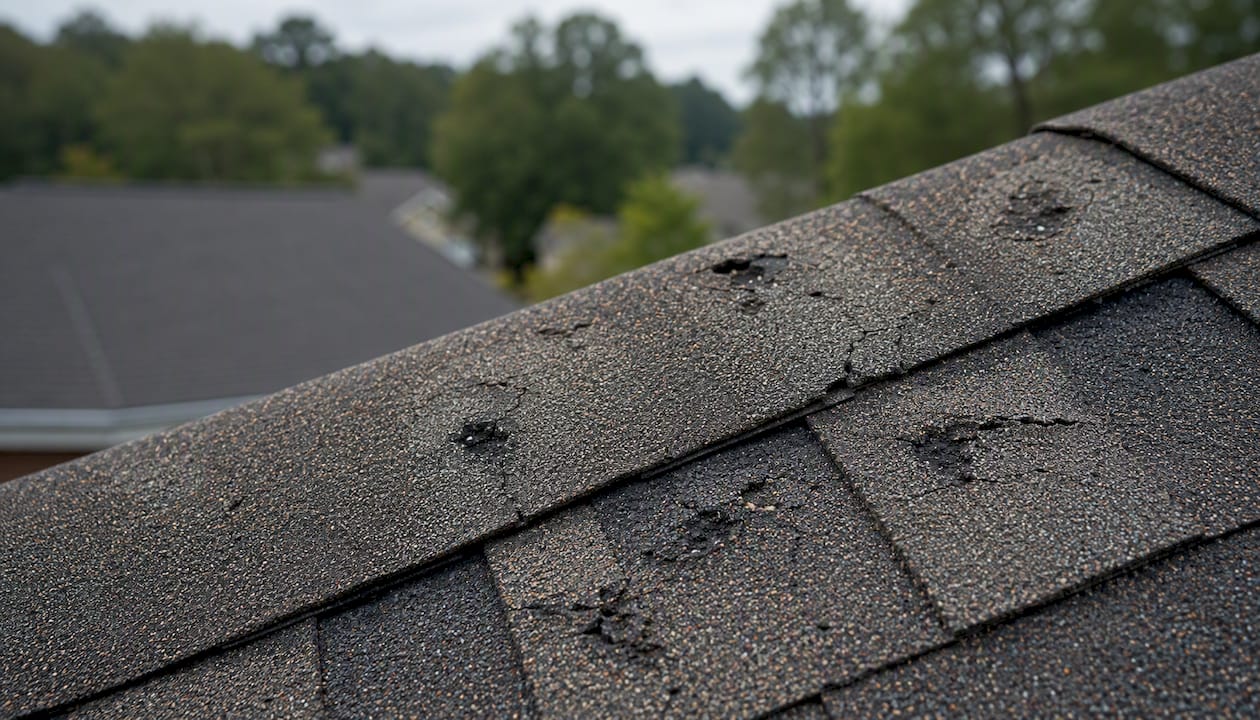
Large hail damages shingles, underlayment, flashing, gutters, siding, windows, and vehicles. The severity depends on hailstone size, wind speed, and, critically, the age and condition of the roof.
Cotality's 2026 severe convective storm risk report estimates that over 43.5 million U.S. properties fall into moderate-or-greater hail risk categories, representing approximately $17.8 trillion in reconstruction cost value. That figure reflects how much is financially at stake across the country's housing stock.
| Risk Category | Properties at Risk | Reconstruction Cost Value |
|---|---|---|
| Moderate or greater hail risk | 43.5 million+ | ~$17.8 trillion |
Older roofs amplify damage. Shingles that have lost granule coverage become brittle and crack under impact that a newer roof would absorb. ClaimsJournal's industry reporting emphasizes that even cosmetic hail hits can compromise shingle integrity and cause leaks months later, which is why early professional inspection matters. Rising material and labor costs mean claim payouts have grown, and repeated hail losses in a region can push premiums higher at renewal. Knowing your roof's impact rating before storm season helps you assess whether an upgrade to Class 3 or Class 4 shingles makes financial sense.
What to do before, during, and after a hailstorm
Before storm season:
- Inspect your roof for missing shingles, cracked flashing, or granule loss in gutters.
- Trim overhanging branches that can amplify impact damage.
- Photograph your roof and all exterior surfaces to establish a pre-storm baseline.
- Review your policy for hail/wind deductibles and replacement-cost vs. actual-cash-value terms.
- Enable NOAA weather alerts on your phone.
During the storm: Stay indoors, away from windows. Move vehicles into a garage if time allows. Never access the roof during active hail.
Post-storm documentation (in order):
- Wait until the storm fully passes before going outside.
- Take wide-angle photos of the full roof, then close-ups of any visible damage.
- Photograph siding, gutters, window screens, and vehicles.
- Document interior water intrusion with photos and note the date and time.
- Retain any damaged materials — do not discard them before an adjuster visits.
- If temporary tarping is needed, hire a professional and keep all receipts.
- Record the date, time, and storm alert reference when you contact your insurer.
Pro Tip: Log every conversation with your insurer and any contractors: date, time, name of the person you spoke with, and any reference numbers given. This record protects you if a dispute arises during settlement.
How a roofing expert helps you through the claims process
Call a qualified roofer as soon as hail is suspected, before the adjuster visits, to understand the full storm damage restoration process. A professional inspection gives you an independent, documented account of the damage, which is especially useful when an adjuster's initial estimate comes in lower than actual repair costs.
The Original Roof Repair Company provides thorough post-storm inspections across the Atlanta metro and Cherokee County. The inspection covers the full roof surface, flashing, gutters, and any penetrations, with photos and written documentation formatted to support a claim. When damage is disputed, that documentation becomes the basis for a supplemental claim or adjuster conversation.
Temporary tarping and emergency mitigation are also part of the service. Stopping water intrusion quickly prevents secondary damage, which can otherwise inflate total repair costs significantly. For a full picture of what the emergency repair process involves and what to expect on timeline, the company's guide walks through each step.
Pro Tip: Always get a written estimate before authorizing any repair work. An itemized estimate gives you a clear comparison point against the adjuster's scope of loss.
Understanding when to call a roofing professional is one of the most practical decisions you can make after a storm.
Policy details to review before storm season peaks
Find these items on your declarations page now, not after a storm hits:
- Deductible type: Does your policy carry a separate wind/hail deductible? It may be a percentage of your dwelling coverage (e.g., 1%–2%), not a flat dollar amount, which can mean thousands out of pocket.
- Roof settlement method: Replacement cost value (RCV) pays to replace the roof at current prices. Actual cash value (ACV) subtracts depreciation, which can leave a significant gap on an older roof.
- Roof age and depreciation schedules: Some carriers apply steep depreciation to roofs over 10–15 years old. Georgia-specific rules can affect how older roofs are handled at settlement.
- Endorsements and exclusions: Check for cosmetic damage exclusions, which some carriers add to limit payouts for dents without functional damage.
- Vehicle coverage: Confirm your auto policy includes comprehensive coverage, which is what pays for hail damage to vehicles.
Questions to ask your agent: "Do I have a separate hail deductible, and what is the amount?" "How does my roof's age affect the settlement?" "Are there depreciation caps or schedules I should know about?" For Georgia homeowners, storm damage coverage specifics vary by carrier and policy year, so a pre-season review with your agent is worth the call.
What the claim timeline looks like and mistakes that raise your costs
During spring peak season, expect delays at every stage. A realistic timeline:
- FNOL to initial adjuster contact: 3–14 days, often longer in April–May when claim volumes spike.
- Inspection and estimate: 1–3 weeks after contact.
- Authorization and contracting: 1–3 weeks depending on carrier and scope.
- Repairs completed: 2–8 weeks from authorization, depending on contractor availability and material lead times.
Delaying temporary repairs after a hailstorm is one of the most common and costly mistakes homeowners make. Rain entering through compromised shingles causes interior damage that may not be covered if the insurer determines the homeowner failed to mitigate. Document everything and act quickly on temporary protection.
Common pitfalls that inflate final costs or reduce settlements:
- Signing an assignment of benefits (AOB) without understanding what rights you are transferring.
- Accepting the first settlement check without verifying it covers the full scope of damage.
- Hiring an unvetted contractor who performs substandard repairs or disappears after a deposit.
- Waiting too long to file — most policies have a claim filing window, and Georgia carriers may enforce it strictly.
Reviewing common storm damage claim mistakes before you file can prevent the most expensive errors.
What spring hail season looks like from the field in Georgia
Spring in Cherokee County and across the Atlanta metro brings a predictable pattern: a quiet February, then a sharp uptick in storm activity through March and April that catches many homeowners off guard. The calls that come in after an April storm often involve roofs that looked fine from the ground but had significant granule loss and cracked shingles that only showed up under close inspection.
The repair-first approach at The Original Roof Repair Company means the goal on every inspection is an honest assessment, not a replacement sale. When a repair is the right answer, that is what gets recommended. When hail damage is extensive enough that repair costs would exceed $4,000 and replacement is the smarter financial decision, that conversation happens plainly, with numbers to back it up. Free inspections exist because homeowners deserve to know what they are dealing with before committing to anything.
The Original Roof Repair Company is ready when spring storms hit
After a hailstorm, Atlanta and Cherokee County homeowners need fast, honest answers, not a sales pitch. The Original Roof Repair Company provides free roof inspections, detailed storm documentation, and direct insurance claim support for homeowners navigating the spring claims process.

The inspection covers the full roof surface, flashing, gutters, and siding, with photo documentation formatted to support your claim. When temporary protection is needed, the team handles emergency tarping and mitigation to stop water intrusion before it becomes a larger problem. The service area covers Canton, Cherokee County, and 11 surrounding counties across the Atlanta metro. BBB accredited and built on a repair-first approach, The Original Roof Repair Company works directly with adjusters on your behalf. Schedule your free roof inspection today.
Sources
- Why are hailstorms most common in spring?
- National Weather Service (Atlanta) severe weather climatology
- 2026 Cotality severe convective storm risk report
- RMIIA foreCAST: 2018–2020 hail loss claims by month
- Spring Storm Season: The Weather Risks Driving Insurance Losses | Guidewire
- ClaimsJournal: Industry reports on hail financial impact and inspection importance
- Tornado-, Hail-Involved Damage Highest in Spring | LendingTree
This article is general information, not a substitute for advice from a qualified financial advisor. Consult a qualified financial professional about your own circumstances before acting on anything here.
FAQ
Why do hail claims spike in spring specifically?
Spring's strong jet stream drives frequent collisions between cold northern air and warm Gulf moisture, producing powerful updrafts and large hailstones. Lower atmospheric freezing levels in spring mean those stones reach the ground before melting, unlike in midsummer.
When is hail season in Georgia and the Atlanta area?
The National Weather Service identifies March through May as Georgia's primary severe weather season, with April as the peak month for large hail. Storms typically develop in the afternoon and evening hours.
What share of homeowners claims does hail represent?
Farmers Insurance reports that hail-related claims made up about 31% of total homeowners claims volume and roughly 20% of claim dollars paid in recent data.
How long does a spring hail claim typically take to resolve?
During peak season, expect 3–14 days from filing to initial adjuster contact, then several additional weeks for inspection, authorization, and repairs. High claim volumes in April and May extend every stage of the process.
Should I get a roof inspection even if damage looks minor?
Yes. Small hail impacts can strip granules and crack shingle underlayment without visible signs from the ground. A professional inspection documents the full scope of damage, which strengthens your claim and catches problems before they cause interior leaks.