
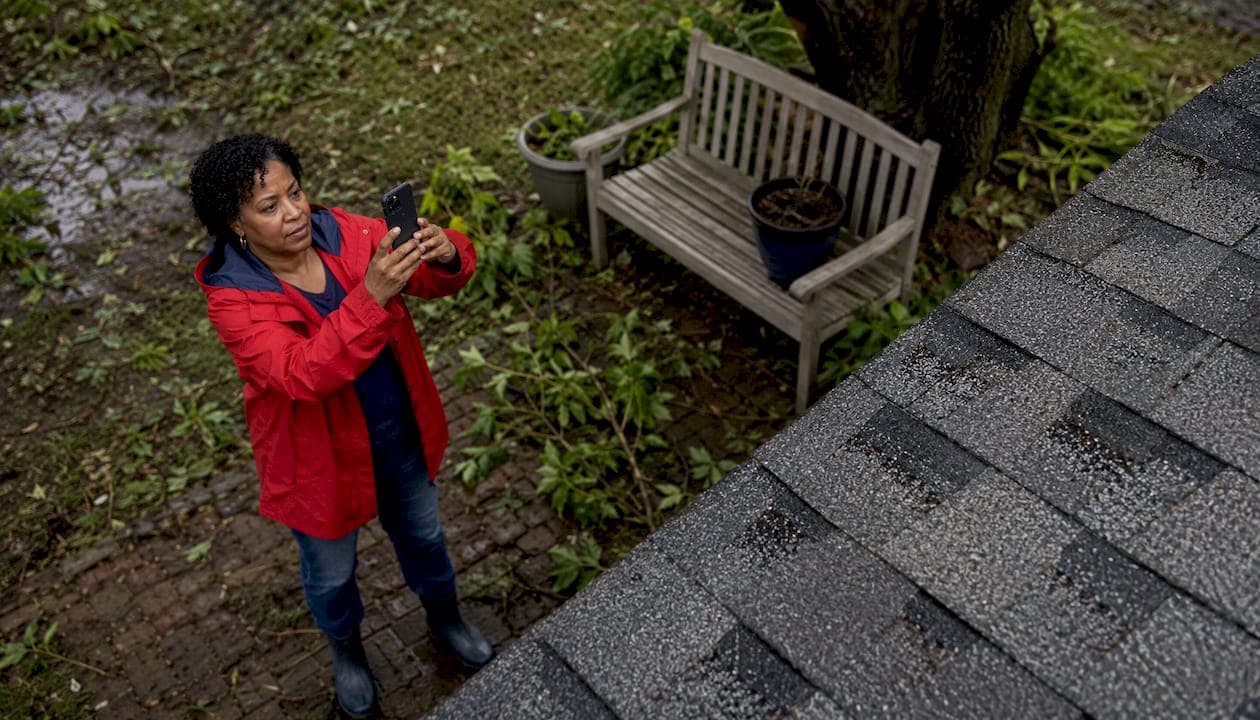
Wind-driven rain damage occurs when wind first tears open or lifts part of your roof or walls, then forces rain through that breach into your home. That sequence matters more than anything else when it comes to your insurance claim. If wind created the opening, the damage is typically covered under a standard homeowners policy. If the opening was already there from wear or deferred maintenance, the insurer will likely deny it. Three things to do right now: photograph every visible breach before touching anything, place tarps or buckets to limit further damage, and call a licensed local roofer for a documented inspection before you speak at length with your adjuster.
Immediate checklist:
- Photograph the exterior from the yard (wide-angle and close-up) and all interior water stains before cleanup.
- Apply temporary tarps or contain water with buckets; keep every receipt.
- Call a professional roofer to inspect and document the damage, then report the loss to your insurer.
Table of Contents
- What wind-driven rain damage actually means and how it differs from a normal leak
- Where wind-driven rain gets into your home and what it damages
- How to tell if your home has wind-driven rain damage
- Does homeowners insurance cover wind-driven rain?
- What evidence to gather for a wind-driven rain insurance claim
- What to do in the hours right after a storm
- How to reduce future wind-driven rain risk
- When to call a roofer or public adjuster
- How Georgia law and Atlanta-area practice affect your claim
- Key Takeaways
- What local experience actually tells you about documentation timing
- Storm damage inspections and claim advocacy for Georgia homeowners
- Useful sources for weather records and insurance guidance
- FAQ
What wind-driven rain damage actually means and how it differs from a normal leak
The phrase "wind-driven rain" is industry shorthand, and it can actually work against you if you use it carelessly with your insurer. The real legal question is sequencing: did wind damage the building envelope first, creating an opening, and did rain then enter through that opening? That sequence is what separates a covered windstorm loss from an excluded maintenance issue or flood claim.
Ordinary rain falls vertically and relies on gravity. Wind-driven rain is propelled horizontally or at steep angles, generating pressure that can force water through gaps a calm rain would never reach. Flashing seams, ridge vents, and window frames that handle normal rainfall can fail completely under that lateral pressure.
| Type of water event | How water enters | Typical coverage |
|---|---|---|
| Ordinary rain leak | Through pre-existing gap or worn seal | Usually denied (maintenance) |
| Wind-driven rain (created opening) | Wind lifts shingles or tears flashing; rain enters breach | Covered under HO-3 windstorm peril |
| Flood / storm surge | Rising water enters from ground level | Excluded from homeowners policy; needs separate flood policy |
Flood insurance covers rising water and storm surge. A standard homeowners policy does not, even when wind pushes that water toward your house. The distinction is critical in Georgia, where heavy thunderstorms can produce both wind damage and localized flooding in the same event.
Where wind-driven rain gets into your home and what it damages
Wind attacks a roof from multiple directions simultaneously, and the damage is rarely limited to one spot. Understanding the common entry points helps you know exactly where to look and photograph.
Primary entry points:
- Lifted or missing shingles: High winds break the adhesive bond between shingles, allowing them to lift, crease, or blow off entirely. Even shingles that settle back down may have broken their seal, leaving nail holes and gaps exposed.
- Damaged flashing: Step flashing at chimneys, skylights, and dormers is one of the first things to fail. When flashing bends or separates, rain has a direct path into the wall cavity.
- Failed window and door seals: Wind pressure can flex frames enough to break weatherstripping seals, letting water track along the frame and into the wall.
- Roof penetrations: Vent boots, pipe collars, and chimney caps can crack or shift under wind load, opening gaps around penetrations.
- Soffits and gable vents: Wind-driven rain can enter through open soffits or damaged gable vents and saturate attic insulation without producing any visible ceiling stain for days.
Once inside, water follows the path of least resistance. It saturates roof sheathing, soaks insulation, and wicks into wall framing. Secondary effects include mold growth within 24–48 hours of sustained moisture, wood rot in structural members, and electrical hazards when water contacts junction boxes or wiring in attics. Forensic inspections use lift tests, macro photography of shingle creases, and fastener pull-through evidence to prove uplift occurred even when shingles appear to have settled back into place after the storm.
Pro Tip: Attics, the area behind baseboards, and the wall cavity around chimneys are where hidden damage concentrates. Take wide-angle photos of the entire attic floor and close-ups of any discoloration on sheathing or insulation, then map those interior spots to the nearest exterior breach.

How to tell if your home has wind-driven rain damage
Visible signs on the exterior and interior together tell the story insurers need to see. A single interior stain without a corresponding exterior breach is hard to tie to a storm. Both together, photographed and dated, build the cause-effect chain.
| Sign | Where to look | What to photograph |
|---|---|---|
| Lifted or missing shingles | Roof field, ridgeline, valleys | Wide-angle of affected area, close-up of lifted edge or bare deck |
| Torn or bent flashing | Chimney, skylights, dormers, valleys | Close-up showing gap or separation from substrate |
| Creased or granule-loss shingles | Downwind slopes | Macro shot showing crease line or bare mat |
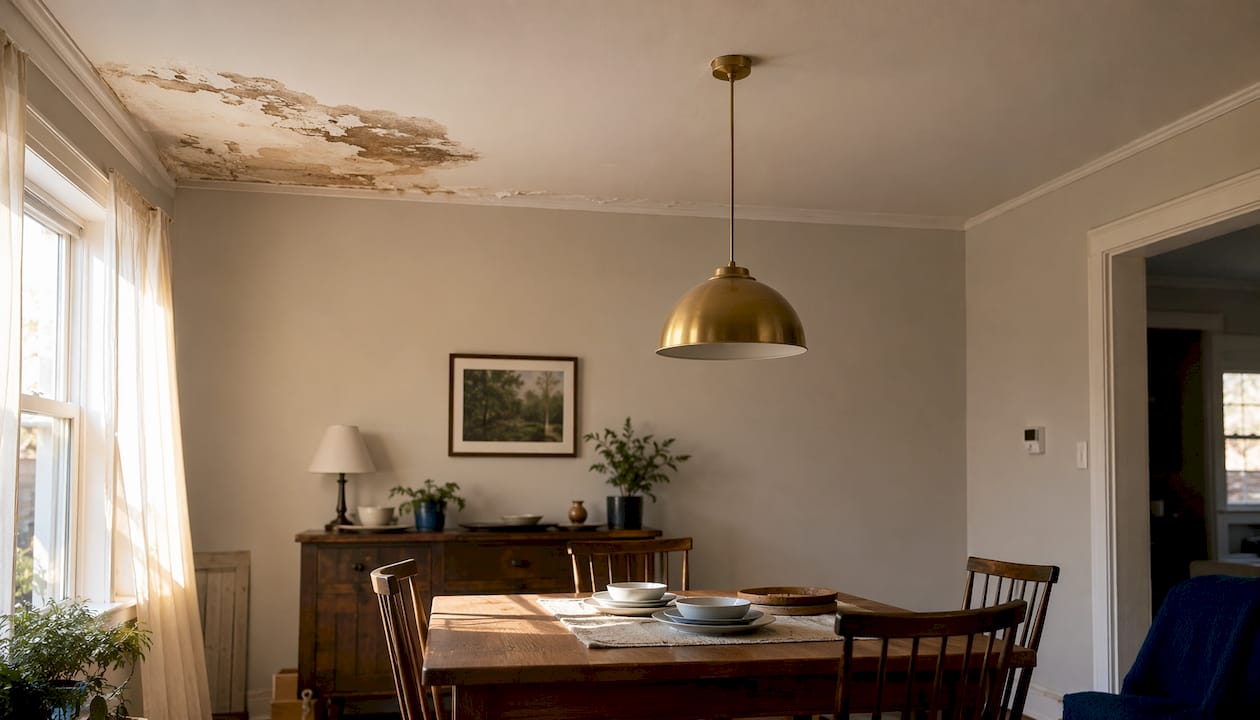
| Interior water stains | Ceilings, walls near exterior, attic sheathing | Stain with measurement reference, mapped to exterior breach |
| Damp or compressed insulation | Attic floor, wall cavities | Insulation condition with surrounding sheathing visible |
| Warped or buckled drywall | Walls below windows, ceilings below roof penetrations | Full panel shot plus close-up of deformation |
For safe documentation, stay on the ground and use a telephoto lens or a drone to capture roof-level detail. Do not climb onto a wet or structurally compromised roof. Interior photos are often more valuable to an adjuster than exterior shots because they show the water path directly. Follow a step-by-step photo guide to make sure you capture the angles and metadata that matter most.
Pro Tip: Never delete original photo files. The embedded metadata (date, time, GPS coordinates) is evidence. Back up photos to a cloud folder immediately and share that folder link with your contractor and adjuster.
Does homeowners insurance cover wind-driven rain?
Standard HO-3 policies cover windstorm as a named peril, and interior water damage is covered when wind first created the opening that let rain in. That is the created-opening rule, and it is the central test in Georgia and across most of the country. Coverage is not automatic just because a storm occurred.
Common reasons claims are denied:
- Wear and tear / maintenance: If the insurer can show the shingles were already deteriorating or the flashing was already loose, they will argue the opening existed before the storm.
- Pre-existing openings: Ridge vents, attic vents, and soffit gaps are designed openings. Rain entering through them without wind first enlarging or damaging them is typically excluded.
- Seepage and gradual infiltration: Slow leaks that developed over time, even if worsened by a storm, are usually treated as maintenance losses.
- Flood or storm-surge exclusion: Water that entered from ground level, overflowing drains, or rising water is excluded from a standard homeowners policy regardless of wind involvement.
Wind speed matters in establishing cause. Shingle uplift typically begins at sustained wind speeds around 45–50 mph on older or improperly fastened roofs, and standard three-tab shingles are rated to specific wind speeds that forensic teams compare against recorded storm data. When recorded wind speeds at your property coordinates exceed the rated capacity of your roofing materials, that correlation directly supports the created-opening argument.
Insurers frequently invoke wear-and-tear arguments unless you can show a storm-created breach. The key insurer defense is that wind was not the "but-for" cause of the opening. Your job is to prove it was. Understanding how Georgia policies classify storm damage before you file gives you a clearer picture of what your carrier will scrutinize.
What evidence to gather for a wind-driven rain insurance claim
The cause-effect chain insurers need is: recorded wind event → documented breach in the building envelope → water intrusion mapped to that breach. Every item below contributes one link in that chain.
| Evidence item | How to obtain it | Why it matters |
|---|---|---|
| Date-stamped exterior photos | Smartphone or drone, taken same day as storm | Establishes breach existed immediately after storm |
| Date-stamped interior photos | Smartphone, mapping water path to exterior breach | Shows intrusion route, not pre-existing leak |
| Written timeline | Your own contemporaneous notes | Undermines insurer's pre-existing-damage argument |
| NOAA/NEXRAD wind speed data | weather.gov climate data portal | Corroborates wind speed at your property coordinates |
| Contractor inspection report | Licensed roofer with written, photo-documented report | Describes created opening and maps water path |
| Emergency repair receipts | Keep all invoices for tarps, labor, materials | Demonstrates mitigation and documents scope |
Pull wind speed data from the National Weather Service for your county on the date of the storm. Download and save the radar snapshot and the hourly wind observation closest to your address. That record, combined with a contractor's report describing the physical breach, is the core of a defensible claim.
When you talk to your adjuster, describe the physical sequence rather than using the shorthand phrase "wind-driven rain." Say: "Wind tore shingles off the north slope of my roof, and rain entered through the exposed deck." That framing keeps the adjuster focused on the covered peril (windstorm) rather than the excluded one (rain). The wind-driven rain label can inadvertently shift the conversation toward exclusions.
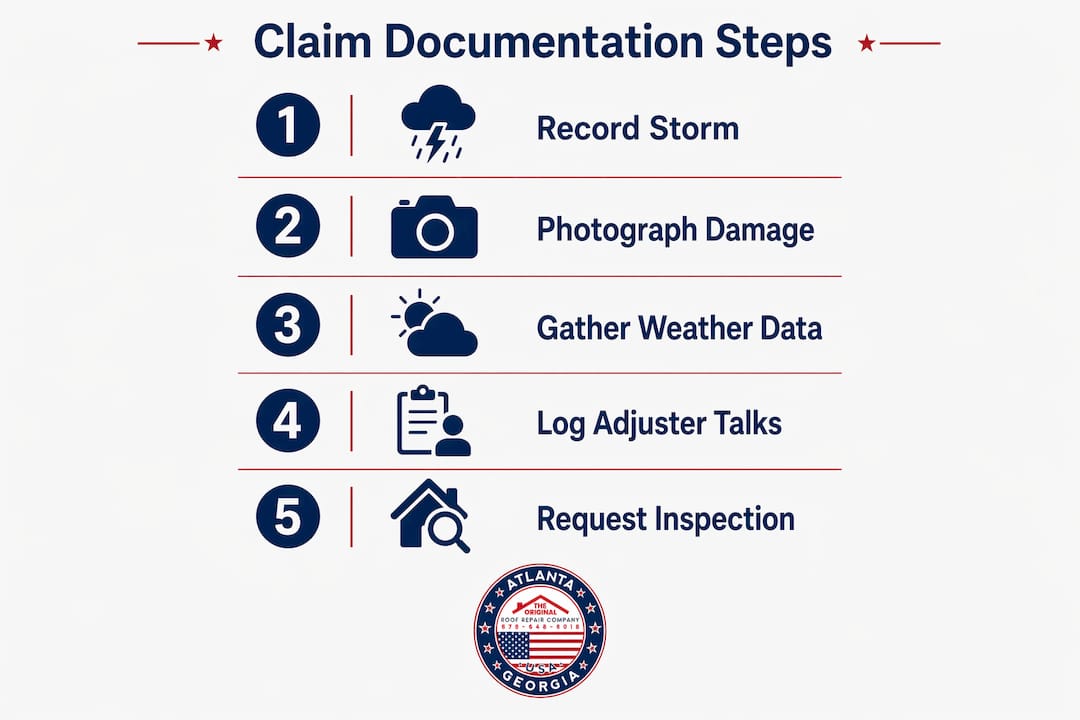
Pro Tip: Keep a running log of every conversation with your insurer: date, time, name of the representative, and a summary of what was said. That log has resolved disputes over what was promised or denied during the claim process.
A complete wind damage claim checklist for Georgia homeowners walks through each documentation step in detail, including common pitfalls that lead to denials.
What to do in the hours right after a storm
Speed matters for two reasons: further water intrusion causes additional damage, and delay gives insurers grounds to argue the damage worsened due to your inaction.
The rule of thumb from experienced claim advocates: Photograph first, mitigate second, report third. Never reverse that order. Cleaning up before documenting removes the evidence your claim depends on. Even five minutes with a smartphone camera before you move a single piece of furniture can change a claim outcome.
Ordered steps:
- Confirm the structure is safe to enter. If there is any doubt about electrical hazards or structural stability, stay out and call emergency services.
- Photograph all visible damage, interior and exterior, before moving anything.
- Move valuables away from active leaks and place buckets or towels to contain water spread.
- Apply temporary tarps over breached roof areas or board up broken windows. Keep every receipt.
- Call a licensed roofer for emergency tarping and a documented inspection, as shown in this roof reparation project by VW Concreting.
- Report the loss to your insurance company and get a claim number.
- Record the adjuster's name, visit date, and any statements made during the inspection.
Preserve all text messages and emails related to the claim. If an adjuster says something verbally that matters, follow up with a written summary sent by email so there is a record.
How to reduce future wind-driven rain risk
Prevention focuses on two things: keeping the building envelope sealed so wind has no existing gaps to exploit, and using materials rated for the wind speeds common in your area.
Routine maintenance tasks:
- Schedule an annual roof inspection, ideally before storm season, to catch failing flashing, cracked sealant, and loose shingles before wind finds them.
- Replace step flashing at chimneys, skylights, and dormers at the first sign of separation or rust.
- Reseal all roof penetrations (vent boots, pipe collars) every few years; rubber boots crack with UV exposure.
- Keep gutters clear so water drains away from fascia and soffit, reducing moisture intrusion at the eave.
Material and retrofit options:
- High-wind-rated architectural shingles (rated to 110–130 mph) outperform standard three-tab shingles on exposed roof planes.
- Closed or solid soffits eliminate the open-vent pathway that lets wind-driven rain enter attic spaces directly.
- Upgraded nail patterns (six nails per shingle instead of four) and enhanced adhesive strips significantly reduce uplift on steep-slope roofs.
- Metal step flashing at all penetrations, rather than caulk-only seals, provides a durable mechanical barrier against lateral water pressure.
Localized damage to a few shingles or a single flashing section warrants repair, not replacement. When multiple roof planes show uplift, sheathing is saturated in several areas, or the repair estimate approaches or exceeds $4,000, a full roof replacement is often the more cost-effective path. Repeated patching on a roof with widespread adhesive failure rarely holds through the next storm season.
Pro Tip: Verify that any contractor you hire carries current general liability and workers' compensation insurance before they set foot on your roof. Require before-and-after photos as part of every repair contract.
When to call a roofer or public adjuster
An active leak, structural damage visible from the ground, or an insurer dispute over cause are all clear triggers for professional help. A licensed roofer provides the physical inspection and written report. A public adjuster advocates for your claim settlement. Both serve different functions, and in complex cases you may need both.
| Situation | Who to call | What they provide |
|---|---|---|
| Active leak, visible breach | Licensed roofer (emergency) | Tarping, documented inspection report |
| Insurer disputes cause of damage | Public adjuster or attorney | Independent claim advocacy, negotiation |
| Complex multi-point damage | Roofer + forensic inspector | Comprehensive report mapping all breaches |
| Claim denied or underpaid | Public adjuster | Re-inspection, supplemental claim filing |
Free visual inspections are standard practice among reputable local roofers. A written, photo-documented inspection report typically comes with the service when the roofer is also assisting with your claim. Emergency tarping is usually billed separately and reimbursable through your claim. Full repair or replacement timelines depend on material availability and adjuster approval, but most straightforward claims move from inspection to approved repair within two to six weeks.
Questions to ask on the first call: Do you carry liability and workers' comp insurance? Will you provide a written report with photos? Have you worked with my insurer before? Do you charge for the initial inspection?
How Georgia law and Atlanta-area practice affect your claim
Georgia courts have consistently applied the created-opening rule. In Sun Insurance Office, Ltd. v. Guest Camera Store, Inc., a Georgia appellate court found coverage when wind directly or through projected objects breached the building envelope and allowed rain to enter. Earlier Georgia cases, including First of Georgia Insurance v. Worthington, show how courts weigh competing expert theories about wind versus pre-existing deterioration, and why contemporaneous evidence and eyewitness accounts carry significant weight.
Local evidence sources and Georgia-specific considerations:
- Pull wind speed records from the National Weather Service Atlanta office or the nearest NWS station for your county. Request hourly observations for the storm date and download the NEXRAD radar snapshot.
- Cherokee County and surrounding Atlanta-area counties are served by multiple NOAA weather stations. Property-specific wind data can be requested through weather.gov's climate data portal using your ZIP code and storm date.
- Local contractor reports and drone imagery carry particular weight in Georgia claims because they provide property-specific evidence rather than regional averages.
- Georgia's insurance complaint process is handled through the Georgia Office of Insurance and Safety Fire Commissioner, which is a resource if your claim is improperly denied.
Atlanta-area storms frequently produce localized wind gusts well above regional averages, particularly in Cherokee, Cobb, and Fulton counties. A contractor familiar with local storm patterns and NWS data sources can correlate recorded wind speeds to your specific roof's rated capacity, which is the forensic link that closes most coverage disputes.
Key Takeaways
Wind-driven rain damage is covered under a standard homeowners policy only when wind first creates a breach in the building envelope, and proving that sequence with weather records, dated photos, and a contractor's inspection report is what determines claim success.
| Point | Details |
|---|---|
| Created-opening rule is decisive | Coverage depends on proving wind breached the roof or walls before rain entered, not just that a storm occurred. |
| Document before you mitigate | Photograph all damage, interior and exterior, before moving anything or making temporary repairs. |
| NOAA data corroborates your claim | Pull wind speed records from weather.gov for your property's ZIP code and storm date to support the cause-effect chain. |
| Avoid the "wind-driven rain" label | Tell your adjuster "wind tore shingles off my roof, letting rain in" to keep focus on the covered windstorm peril. |
| The Original Roof Repair Company | Provides free inspections, emergency tarping, and documented reports for Georgia homeowners navigating wind damage claims. |
What local experience actually tells you about documentation timing
Most homeowners assume that reporting a storm quickly is enough. It is not. What actually changes a claim outcome is the quality and timing of the physical evidence, not the speed of the phone call to the insurer.
The most common pattern in denied or underpaid claims is a gap between the storm and the first professional inspection. That gap gives insurers room to argue that the damage worsened due to neglect, or that the original breach was pre-existing. A contractor's report dated within 24–48 hours of the storm, with photos showing fresh wood exposure, clean shingle creases, and undisturbed granule loss patterns, is far harder to dispute than a report written two weeks later.
In the Atlanta area and across Cherokee County, storms can produce highly localized damage. A neighborhood a mile away may have no claims while your block has three. That localization actually helps your case, because NWS data for your specific ZIP code on the storm date can show a wind event that matches your damage pattern precisely. Combining that weather record with a contractor's written report is the documentation standard that holds up in Georgia claims.
Storm damage inspections and claim advocacy for Georgia homeowners
After a wind event, the difference between a paid claim and a denied one often comes down to how quickly and thoroughly the damage is documented. The Original Roof Repair Company provides free roof inspections for homeowners across Cherokee County and 11 surrounding counties in the greater Atlanta area, with written, photo-documented reports that map every breach and water path your adjuster needs to see.

The company handles emergency tarping to stop active leaks, documents storm and wind damage for insurance purposes, and works directly with carriers and adjusters on the homeowner's behalf. The repair-first approach means you get an honest assessment of whether a targeted repair or a full replacement is the right call, with transparent pricing and no pressure. If you have visible damage or a suspected breach after a storm, schedule a free inspection and get a written report in hand before your adjuster visits.
Request a roof insurance claim inspection from The Original Roof Repair Company and have a documented report ready when your adjuster arrives.
Useful sources for weather records and insurance guidance
Official sources for wind data, flood vs. wind distinctions, and Georgia insurance guidance:
- NOAA / National Weather Service climate data portal at weather.gov: download hourly wind observations and NEXRAD radar snapshots by ZIP code and date for your storm event.
- FEMA / National Flood Insurance Program wind vs. floodwater fact sheet: explains the distinction between flood-covered losses and wind-driven rain covered under homeowners policies.
- FloodSmart.gov at floodsmart.gov: FEMA's consumer resource for understanding what flood insurance covers and how it differs from homeowners coverage.
- FEMA.gov at fema.gov: broader disaster assistance resources and guidance on filing claims after declared weather events.
- Georgia Office of Insurance and Safety Fire Commissioner: the state agency that handles insurance complaints and licensing; contact them if your claim is improperly denied or delayed.
- NWS Atlanta / Peachtree City office at weather.gov/ohx: the local NWS office serving the Atlanta metro area, including Cherokee County; provides storm event archives and local wind reports.
FAQ
What does wind-driven rain mean for insurance purposes?
Wind-driven rain refers to rain forced into a building through an opening that wind created or enlarged during a storm. For insurance, coverage under a standard homeowners policy depends on proving that wind breached the building envelope first, making the windstorm the cause of the interior water damage.
Does homeowners insurance cover wind-driven rain damage?
Standard HO-3 policies cover interior water damage caused by wind-driven rain when wind first created the opening that let rain in. Claims are commonly denied when the insurer argues the opening existed before the storm due to wear, maintenance neglect, or gradual deterioration.
How do I know if my roof has wind damage?
Look for lifted, missing, or creased shingles; torn or separated flashing at chimneys and skylights; and interior water stains that map to a specific exterior breach. A licensed roofer can confirm damage through a documented inspection that includes close-up photos and a written report describing the breach.
Will insurance pay for wind damage to a roof in Georgia?
Yes, when the created-opening rule is satisfied. Georgia courts have upheld coverage when wind directly breached the building envelope and rain entered through that breach. The claim must be supported by weather records, dated photos, and a contractor's inspection report linking the storm to the specific damage.
What is the first thing to do after wind damages my roof?
Photograph all visible damage, interior and exterior, before touching anything. Then apply temporary tarps or contain active leaks, keep all receipts, and call a licensed roofer for a documented inspection before speaking at length with your adjuster.