

An endorsement in a roof policy is a written amendment that adds, removes, or changes how your roof is covered under your base homeowners policy. It takes legal precedence over the original policy language wherever it addresses a specific point. Three things to do right now:
- Pull out your declarations page and look for any listed endorsements or attached form numbers.
- Photograph the declarations page so you have a dated record before your next renewal or storm.
- Call your agent and ask directly: "How does each endorsement on my policy affect a roof claim payout?"
Table of Contents
- What is an endorsement in a roof policy, and how does it work?
- What are the most common roof-specific endorsements?
- What is the IBHS FORTIFIED roof endorsement?
- How do endorsements change what you actually get paid?
- How do you find, add, or remove a roof endorsement?
- What do endorsements cost, and how fast do they take effect?
- When do endorsements reduce or remove your coverage?
- When should you hire a contractor or claims advocate?
- Key Takeaways
- The endorsement detail most homeowners miss
- Roof inspection and claims support from The Original Roof Repair Company
- Useful sources for verifying endorsements and local rules
- FAQ
What is an endorsement in a roof policy, and how does it work?
An endorsement, sometimes called a rider or amendment, is a separate written document that modifies specific terms of your standard homeowners policy. Where the endorsement speaks, it overrides the base policy. The rest of the policy stays intact.
Endorsements can work in four directions: they can add coverage you did not have, limit coverage you thought you had, change how a claim is settled (for example, switching from replacement cost to actual cash value), or add new exclusions. That last category is where homeowners get surprised.
Your declarations page is the map. It lists every active endorsement by name and form number. Form numbers matter because they identify the exact version of the endorsement language your insurer is using. If you ever dispute a claim or escalate to Georgia's Office of Insurance and Safety Fire Commissioner, quoting the form number puts you on solid footing. A quick example: if your base policy promises replacement cost value on all structures but an attached endorsement form reads "roof surfaces settled at actual cash value," the endorsement wins at claim time.
What are the most common roof-specific endorsements?
These are the endorsements most likely to affect your next roof claim, particularly in the Atlanta area where wind and hail are frequent perils:
- Ordinance or law coverage. Pays for code-required upgrades triggered by a covered loss. Often structured as a percentage of Coverage A (your dwelling limit), such as 10%, or as a separate dollar limit. Without it, you pay out of pocket for any code upgrade the county requires.
- Matching of undamaged property. Requires the insurer to replace undamaged sections so the finished roof matches repaired areas. Without a matching endorsement, your insurer typically replaces only the damaged section, leaving mismatched materials visible. Georgia does not currently have a state matching statute, so the endorsement controls this outcome entirely.
- Roof actual cash value (ACV) endorsement. Limits roof settlement to ACV even when the rest of your home is covered at replacement cost. Increasingly common on older roofs at renewal.
- Extended or guaranteed replacement cost. Pays above your policy limit if material and labor costs spike after a major storm, up to a stated percentage or with no cap.
- Impact-resistant roofing discount endorsement. Acknowledges that your roof meets an impact-resistance rating (typically Class 3 or Class 4) and applies a premium credit. Insurers may offer this as a policy feature or a named endorsement.
- Windstorm or hail rider. In some markets, wind and hail coverage is stripped from the base policy and sold separately, often with its own deductible. Check whether yours is a flat dollar amount or a percentage of Coverage A.
- Roofing materials payment schedule. A depreciation schedule built into the endorsement that reduces payout based on roof age and material type.
- Cosmetic damage exclusion. Excludes hail dents or dings that do not affect the roof's ability to shed water. Increasingly common and easy to miss.
- Inflation guard. Automatically increases Coverage A limits annually to keep pace with construction cost inflation, which indirectly protects full replacement cost on the roof.
For Atlanta and Cherokee County homeowners, the endorsements with the most day-to-day impact are wind/hail riders, ordinance or law, and matching. Those three together can mean the difference between a fully covered replacement and a five-figure out-of-pocket bill.
What is the IBHS FORTIFIED roof endorsement?
IBHS FORTIFIED is a construction standard developed by the Insurance Institute for Business & Home Safety that specifies how roofs should be built or retrofitted to resist wind and hail damage. A FORTIFIED roof endorsement, when offered by an insurer, typically requires that after a covered loss, the replacement roof be built to IBHS FORTIFIED standards rather than just minimum building code.
Eligibility checks vary by carrier, but common requirements include:
- A current roof inspection by a FORTIFIED-certified evaluator
- Proper roof-to-wall attachments (hurricane straps or clips)
- Sealed roof deck with approved underlayment
- Correct fastener type, count, and nailing pattern
- Roof pitch within the program's acceptable range
- Use of a FORTIFIED-certified contractor
The premium credit for meeting FORTIFIED standards can be meaningful in storm-prone areas, though the exact amount is carrier-specific and not publicly standardized. One trade-off: if your policy includes a FORTIFIED endorsement and you also carry ordinance or law coverage, a covered loss may trigger both the FORTIFIED upgrade requirement and code-compliance costs simultaneously. That combination can push the total project cost above what either endorsement covers alone. Confirm with your agent how the two interact before a loss occurs.
How do endorsements change what you actually get paid?
The clearest way to see the impact is through RCV versus ACV math. RCV (replacement cost value) pays the full cost to replace your roof without deducting for age or wear. ACV (actual cash value) subtracts depreciation first.

Here is how that plays out on a $15,000 roof replacement:
| Scenario | Gross Claim | Depreciation (10-year-old roof) | Deductible | You Receive |
|---|---|---|---|---|
| RCV policy | $15,000 | — | $1,500 | $13,500 |
| ACV endorsement | $15,000 | $7,500 | $1,500 | $6,000 |
That $7,500 gap comes directly out of your pocket. On a storm-prone street in Canton or Marietta, that is a real exposure.
Ordinance or law and matching endorsements can push the math in the other direction. If a hailstorm damages half your roof and the county requires a full tear-off to meet current code, ordinance coverage pays for the code-upgrade portion. If the original shingle color is discontinued, a matching endorsement requires the insurer to replace the undamaged half so the finished roof looks uniform. In storm-prone Atlanta, matching or ordinance endorsements can convert a significant shortfall into a covered expense.
Watch your renewal notices. Insurers sometimes add an ACV roof endorsement mid-policy or at renewal as a roof ages, without a phone call to explain what changed. A homeowner who does not read the renewal declarations may assume full replacement coverage still applies, then discover the shortfall only after filing a claim.
How do you find, add, or remove a roof endorsement?
- Locate your declarations page. It is typically the first two to four pages of your policy packet, labeled "Declarations" or "Dec Page." Your insurer's online portal usually has a downloadable version.
- List every endorsement by name and form number. Write them down or photograph them. Common form-number prefixes include "HO 04" (ISO standard endorsements) and carrier-specific alphanumeric codes.
- Check effective dates and coverage limits. Confirm when each endorsement became active and whether it carries its own sublimit or deductible.
- Ask your agent specific questions. Useful questions: "Does my roof settle at RCV or ACV?" "Do I have matching coverage?" "Is ordinance or law included, and what is the limit?" "Has anything changed from last year's declarations?"
- Gather documentation before requesting a change. Collect a recent roof inspection report, dated photos, a contractor's line-item estimate, and any manufacturer letters confirming discontinued materials if you are adding matching coverage.
- Submit the change request in writing. Email creates a time-stamped record. Ask for written confirmation of the new effective date.
After adding an endorsement, expect a prorated premium adjustment billed to your next statement. Some endorsements, particularly those covering pre-existing conditions, carry a waiting period or exclude damage that predates the endorsement's effective date. Removal of an endorsement typically takes effect at the next renewal unless the insurer allows a mid-term change.
What do endorsements cost, and how fast do they take effect?
Premium impact depends on the endorsement type, your roof's age and condition, local storm risk, and your insurer's underwriting rules. A few general reference points:
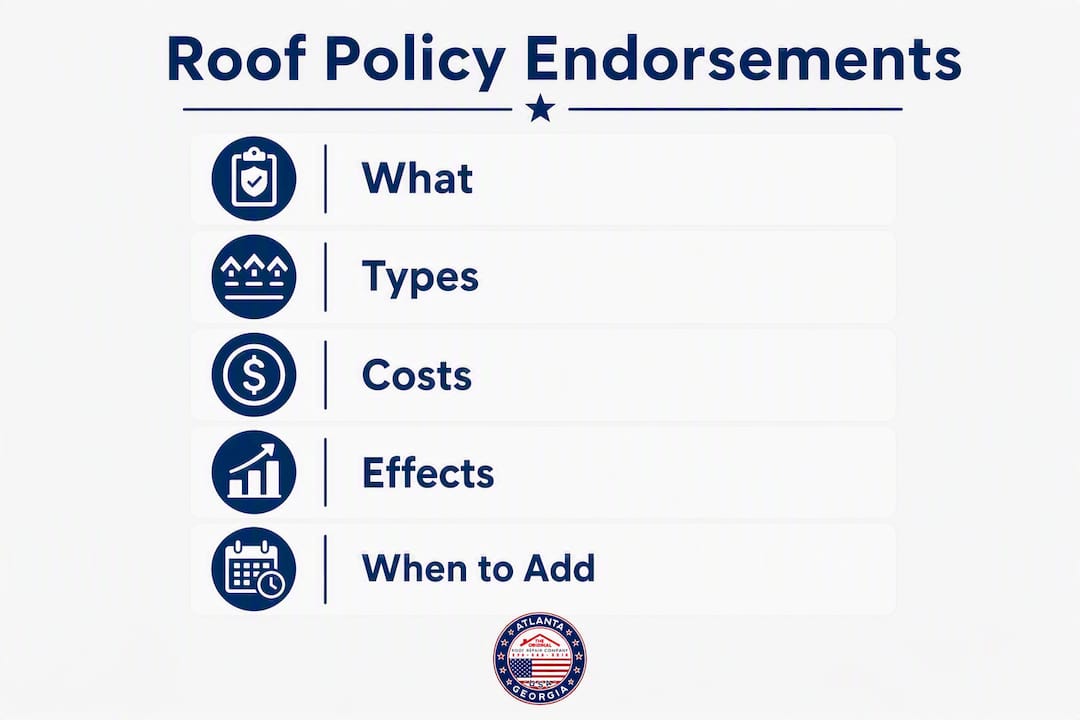
Matching endorsements commonly add about 1–4% to the annual premium, while ordinance or law coverage typically costs less than matching. Impact-resistant endorsements often reduce the premium rather than increase it, since Class 4 shingles lower the insurer's loss exposure.
In the Atlanta metro and Cherokee County, local storm frequency pushes insurers to price wind/hail coverage carefully. A roof over 15 years old may trigger an inspection requirement before any new endorsement is added.
Timing: endorsements added at inception or renewal take effect on the policy start date. Mid-term additions usually take effect the day after the insurer processes the request, with a prorated premium charge. Changes requested after a loss event are almost never retroactive.
When do endorsements reduce or remove your coverage?
Some endorsements are written specifically to limit what the insurer pays. Red flags to look for on your declarations page:
- Cosmetic damage exclusion. Denies payment for hail dents that do not affect the roof's water-shedding function, even when the damage is visible and reduces resale value. If you see this on your policy, get a contractor inspection after any hail event to document whether functional damage exists alongside cosmetic damage.
- ACV-only roof settlement on an otherwise RCV policy. The rest of your home pays full replacement cost, but the roof does not. This is the most financially consequential mismatch on a standard policy.
- Age-based roof limits. Some endorsements cap the payout at a percentage of the roof's value based on age, independent of ACV calculations.
- Material or workmanship exclusions. Exclude damage attributed to installation defects or non-approved materials.
If you spot any of these, ask your agent for written clarification of exactly what triggers the exclusion. For a wind damage claim in Georgia, a cosmetic exclusion combined with an ACV endorsement can reduce a legitimate claim to near zero.
To dispute an adverse endorsement added at renewal, request the underwriting notes in writing. If the insurer cannot justify the change with an inspection or actuarial basis, escalate to the Georgia Office of Insurance and Safety Fire Commissioner. Document every conversation with a date and the representative's name.
When should you hire a contractor or claims advocate?
Hire a licensed roofing contractor or claims advocate when repairs are substantial, or visible structural damage suggests a full replacement.
- The insurer offers ACV settlement on a roof that shows signs of total loss.
- A matching dispute is in play and the original materials may be discontinued.
- The adjuster's scope of loss omits damage you can see from the ground.
A qualified contractor should deliver a signed inspection report with dated photos, an annotated damage map identifying each affected area, a line-item estimate in a format adjusters recognize (Xactimate-style), and any manufacturer or distributor documentation confirming discontinued materials.
Pro Tip: A contractor's written confirmation that the original shingle color or profile is no longer manufactured is often the single most effective piece of evidence in a matching dispute. Secure that letter before your adjuster closes the file.
Matching disputes are most effectively resolved when homeowners supply documented proof that the original material is discontinued. Without that letter, the insurer has no obligation to treat the repair as a matching problem. Contractors who understand why documentation matters for storm claims build this step into their standard scope process.
The Original Roof Repair Company serves Cherokee County and 11 surrounding counties in the Atlanta metro area, providing inspection reports, damage documentation packages, and direct adjuster coordination for homeowners navigating roof insurance claims.
Key Takeaways
A roof policy endorsement is a written amendment that overrides your base policy on specific points, and checking your declarations page before a storm or renewal is the single most important step you can take.
| Point | Details |
|---|---|
| Endorsement definition | A written amendment that adds, limits, or changes roof coverage and overrides base policy language. |
| RCV vs. ACV impact | An ACV endorsement on a roof can significantly reduce your payout compared to RCV settlement. |
| Matching and ordinance value | In Atlanta, these endorsements can convert a significant shortfall into a covered expense. |
| Red flags at renewal | Insurers can add ACV roof endorsements at renewal without a phone call; always read the new declarations page. |
| The Original Roof Repair Company | Provides free inspections, line-item estimates, and adjuster coordination for Atlanta-area homeowners navigating roof claims. |
The endorsement detail most homeowners miss
Most homeowners focus on whether they have coverage. The more important question is how that coverage pays. An ACV endorsement buried on page four of a declarations packet can cut a legitimate claim in half, and the homeowner only finds out after the adjuster's check arrives.
Matching coverage gets underestimated in a similar way. Georgia has no state matching statute, which means without a specific endorsement, your insurer has no legal obligation to replace undamaged sections for visual uniformity. On a partial hail loss where the damaged section runs along the front slope, that can mean a visible patchwork repair on the most prominent part of your home. Adding matching coverage for about 1–4% of your annual premium is one of the clearest value trades in residential insurance.
The other pattern worth flagging: ordinance or law coverage is often set as a percentage of Coverage A by default, and that limit may not keep pace with current construction costs in the Atlanta area. A full tear-off with code-required deck replacement and updated flashing can exceed that figure on a larger home. Ask your agent whether the limit is adequate before you need it.
Roof inspection and claims support from The Original Roof Repair Company
When a roof claim involves endorsement disputes, ACV shortfalls, or matching issues, the documentation you submit to the adjuster determines the outcome. The Original Roof Repair Company provides free roof inspections, line-item damage estimates, and a complete claims documentation package, including dated photos, annotated damage maps, and manufacturer discontinuation letters when matching is in dispute.
The company serves homeowners across Cherokee County and 11 surrounding counties in the Atlanta metro area, handling everything from emergency tarping after a storm to full adjuster coordination on complex claims. If your insurer is offering ACV on a roof that shows clear total-loss indicators, or if a matching dispute is stalling your claim, a professional inspection report changes the conversation. Schedule a free roof inspection or contact the team directly to discuss your claim situation.
Useful sources for verifying endorsements and local rules
These resources help homeowners confirm endorsement language, state requirements, and FORTIFIED eligibility:
- IBHS FORTIFIED Home Program: Official program details, contractor certification lookup, and eligibility standards for FORTIFIED roof designations.
- Insurance Institute for Business & Home Safety (IBHS): Research and technical standards behind FORTIFIED and other resilience programs.
Georgia does not currently have a matching statute, but the regulatory landscape can change. Check the Georgia Office of Insurance and Safety Fire Commissioner's website before your next renewal to confirm current rules.
FAQ
What is a roof endorsement?
A roof endorsement is a written amendment attached to your homeowners policy that changes how roof damage claims are handled, such as switching from replacement cost to actual cash value settlement or adding matching coverage.
What does "endorsement" mean in insurance?
An endorsement is a formal modification to an insurance policy that overrides the base policy language on the specific point it addresses; it can add, limit, or remove coverage.
Can an endorsement remove coverage from my policy?
Yes. Endorsements such as cosmetic damage exclusions or ACV-only roof settlement clauses can significantly reduce or effectively eliminate payment for certain types of roof damage, even on an otherwise comprehensive policy.
How long does an endorsement stay on my policy?
An endorsement remains part of your policy until it is removed by mutual agreement, replaced by a different endorsement, or the policy is cancelled. Insurers can also add or change endorsements at renewal, which is why reviewing your declarations page every year matters.
When should I contact a contractor about my roof endorsements?
Contact a licensed contractor when your repair estimate is substantial, when the insurer's settlement offer appears to reflect ACV rather than replacement cost, or when a matching dispute involves materials that may be discontinued. The Original Roof Repair Company provides free inspections and claims documentation for Atlanta-area homeowners in exactly these situations.