
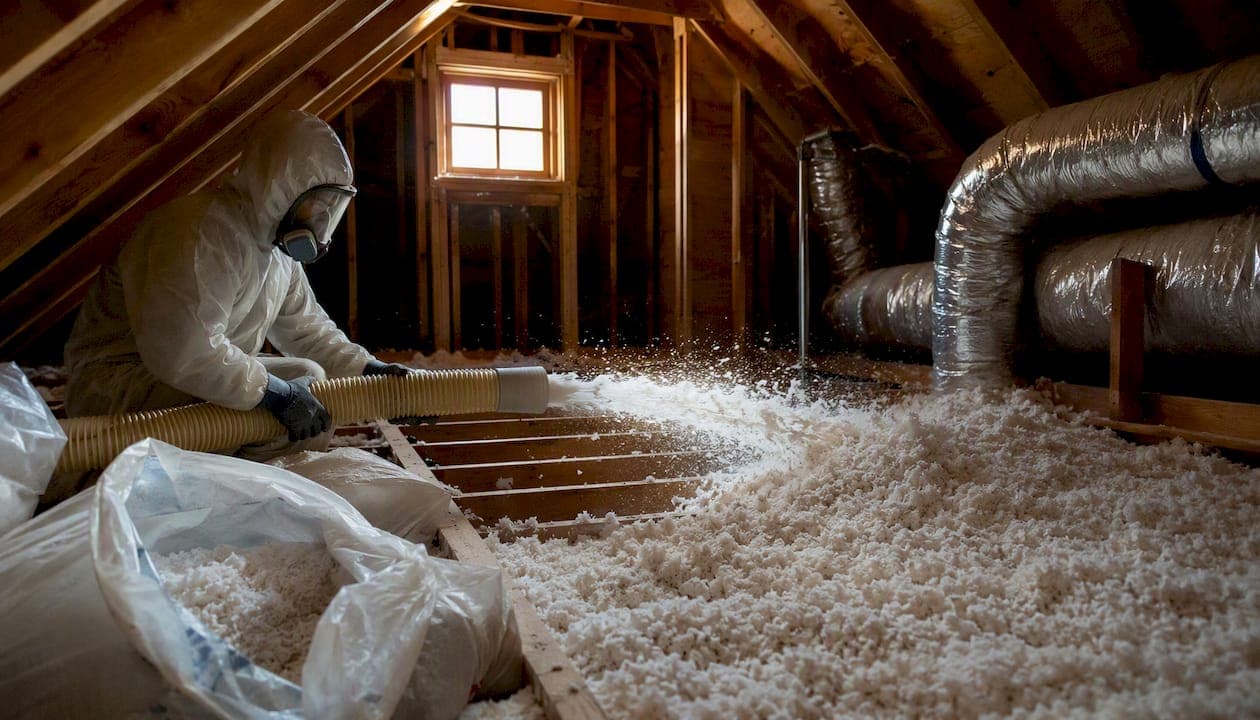
Blown-in attic insulation, also called loose-fill insulation, is cellulose, fiberglass, or mineral wool material installed with a blowing machine to fill attic floors, wall cavities, and irregular spaces with gap-free thermal coverage. It's the right choice when you're retrofitting an existing attic, topping off settled insulation, or working around obstructions that make batt rolls impractical. Three quick facts every homeowner should know before starting:
- R-value matters more than depth alone. Manufacturers publish coverage charts specifying the exact weight and thickness needed to hit a target R-value. Following those charts is required, not optional.
- FTC labeling rules apply. Any contractor installing loose-fill insulation must give you a signed receipt listing the insulation type, coverage area, thickness, R-value, and bag count per ASTM C 764 guidance.
- IECC guidance requires attic rulers. The International Energy Conservation Code calls for depth-indicator rulers placed in the attic so installed thickness can be verified visually during and after installation.
Key Takeaways
Blown-in attic insulation performs as rated only when the roof is sound, the attic is dry, and installation follows the manufacturer's coverage chart to the correct depth and bag count.
| Point | Details |
|---|---|
| Material choice matters | Cellulose costs least but absorbs moisture; fiberglass resists moisture; mineral wool leads on fire and sound resistance. |
| Coverage charts are required | Installers must follow manufacturer bag counts and thickness specs to hit the target R-value. |
| FTC receipt is your protection | Request a signed receipt listing insulation type, R-value, thickness, coverage area, and bag count before the crew leaves. |
| Fix the roof first | Unresolved leaks or flashing failures will saturate blown-in insulation and cause mold before damage is visible. |
| The Original Roof Repair Company | Offers free roof inspections across the Atlanta metro to confirm the roof is sound before insulation work begins. |
Table of Contents
- What types of blown-in insulation are best for your attic?
- How is attic insulation installed with a blowing machine?
- What are the real pros and cons of blown-in attic insulation?
- Should you DIY blown-in insulation or hire a contractor?
- Safety and health considerations before and during installation
- What to fix on your roof before adding blown-in insulation
- A contractor's honest take on attic insulation failures in Georgia
- Fix your roof first, then insulate with confidence
- Sources
- FAQ
What types of blown-in insulation are best for your attic?
Three materials dominate the market. Each behaves differently in an attic, and the right pick depends on your climate, budget, and priorities. For Atlanta-area homeowners, humidity and summer cooling load are the deciding factors more often than price alone.
Cellulose
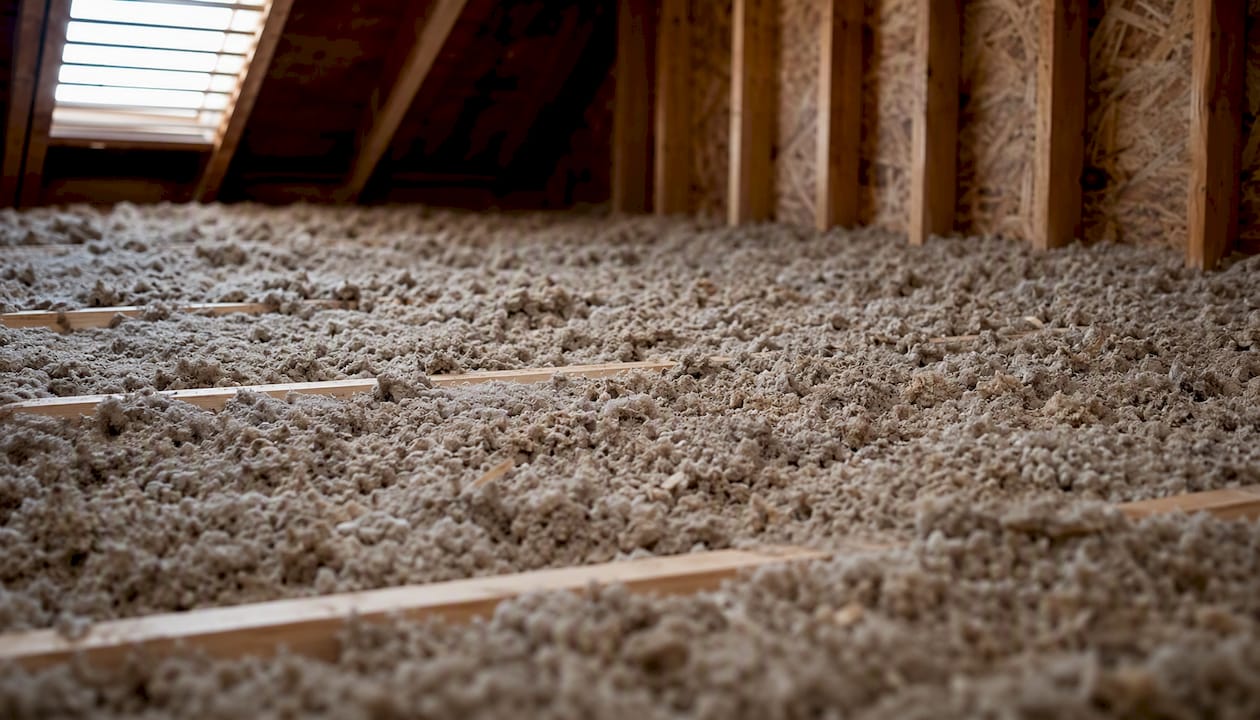
It settles more than other materials over time, which means installers must overshoot the target depth to account for that loss. In Georgia's humid summers, cellulose can absorb moisture if a slow roof leak goes undetected, concealing the wetting until mold takes hold. It delivers roughly R-3.2 to R-3.8 per inch and is generally the lowest-cost option per bag.
Fiberglass
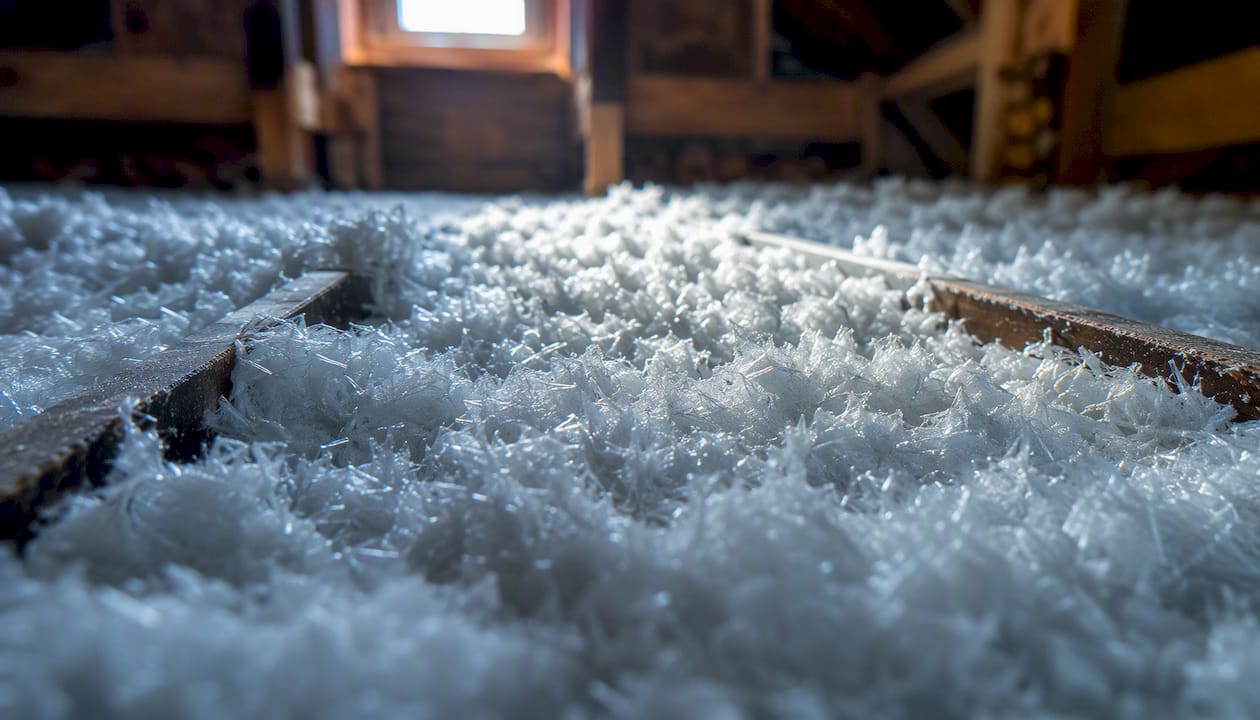
Loose-fill fiberglass is spun glass fiber that resists moisture and does not settle as dramatically as cellulose. Its R-value runs approximately R-2.2 to R-2.7 per inch, which means you need more depth to hit the same R-value target. It's non-combustible and does not support mold growth. Mid-range cost, widely available at home improvement stores, and a reasonable DIY candidate for attic topping.
Mineral/rock wool
Mineral wool (also sold as rock wool or slag wool) offers the highest fire resistance of the three and performs well for sound attenuation between floors. It holds its R-value in humid conditions without the moisture-absorption risk of cellulose. Johns Manville and other manufacturers position it as the professional's choice when fire or sound resistance is the primary concern. The tradeoff is cost: mineral wool typically runs higher per bag than both cellulose and fiberglass.
| Feature | Cellulose | Fiberglass | Mineral Wool |
|---|---|---|---|
| R-value per inch | ~R-3.2–3.8 | ~R-2.2–2.7 | ~R-3.0 |
| Moisture behavior | Absorbs moisture | Resists moisture | Resists moisture |
| Fire resistance | Good (borate-treated) | Non-combustible | Excellent |
| Recycled content | High | Moderate | Moderate |
| Relative cost | Low | Medium | High |
| Best use case | Eco-conscious retrofits | General attic topping | Fire/sound priority |
- Cellulose suits homeowners prioritizing recycled content and low upfront cost, provided the attic is dry and the roof is sound.
- Fiberglass works well for most Atlanta attics where moisture is a concern but budget is tight.
- Mineral wool is worth the premium in homes near a fireplace, with shared walls, or where HVAC noise is an issue.
Pro Tip: If your Georgia home has an older gas furnace or wood-burning fireplace in or near the attic, mineral wool's fire resistance justifies the higher cost. The performance gap over cellulose in a fire scenario is significant.
How is attic insulation installed with a blowing machine?
Blown-in insulation requires a blowing machine, a long flexible hose, and a hopper where bags of loose-fill material are loaded. A typical attic job runs with a two-person crew: one person feeds bags into the machine outside or in the garage, and the other works inside the attic directing the hose across the joist bays. For a standard attic, the job often wraps up in a few hours.
Loose-fill vs. dense-pack: Attic floors use loose-fill, where material is blown in at low pressure and allowed to settle freely across the surface. Dense-pack is a different method used for enclosed wall cavities, where material is packed at high pressure to prevent settling and air movement. Dense-pack requires different machine settings and more skill. DIY is reasonable for attic loose-fill topping; dense-pack walls are a professional job.
Why coverage charts and bag counts matter:
Manufacturers publish coverage charts showing how many bags of material are needed per 1,000 square feet to reach each R-value target. Hitting R-38 in an Atlanta attic, for example, requires a specific minimum installed thickness and weight, not just a visual guess at depth. The Insulation Institute confirms that achieving correct density and R-value with blown-in products is difficult to guarantee without following those charts precisely, which is one reason trained installers are recommended.
What to expect as a homeowner:
- Air-seal all penetrations (recessed lights, plumbing stacks, wiring chases) before any insulation goes in.
- Install attic rulers (depth gauges) every 300 square feet so depth can be verified during and after the job.
- Confirm the contractor has the manufacturer's coverage chart for the specific product being installed.
- Verify bag count on-site against the coverage chart before the crew leaves.
- Request the FTC-required signed receipt showing insulation type, R-value, thickness, coverage area, and bag count.
Energy savings note: Trade sources indicate that upgrading attic insulation in under-insulated homes can reduce heating and cooling costs by up to roughly 20% in certain retrofits, though actual savings depend on existing insulation levels, HVAC efficiency, and air sealing quality.
What are the real pros and cons of blown-in attic insulation?
Blown-in insulation has genuine advantages over batts in most attic situations, but it also carries risks that homeowners rarely hear about upfront.
Benefits:
- Fills gaps, irregular joist bays, and hard-to-reach corners that batt rolls leave exposed.
- Delivers consistent coverage when installed to the correct depth and density.
- Reduces sound transmission compared to an uninsulated attic.
- Generally costs less per square foot than spray foam for the same R-value.
- Reduces HVAC cycling by limiting heat gain through the attic floor, which can extend equipment lifespan over time.
Downsides:
- Cellulose settles, sometimes losing 15–20% of its initial depth over years, which reduces effective R-value without any visible sign.
- Moisture absorption in cellulose can hide a slow roof leak for months, allowing mold to develop before anyone notices.
- Uneven coverage from poor machine settings or inadequate bag count leaves cold spots and defeats the purpose.
- Fiberglass loose-fill at shallow depths can allow air movement through the material, reducing its thermal performance below the rated R-value.
Pro Tip: Check your attic insulation depth twice a year by measuring at the attic rulers. If depth has dropped more than an inch from the post-installation measurement, or if you notice any musty smell or visible staining on the insulation surface, call a professional before adding more material on top of a potential moisture problem.
Homeowners who address both air sealing and insulation depth together tend to see the most consistent energy performance. Insulation alone, without sealing the penetrations underneath, leaves a significant portion of potential savings on the table.
Should you DIY blown-in insulation or hire a contractor?
The honest answer depends on what your attic actually needs.
DIY makes sense when:
- You're topping off existing attic loose-fill and the attic is accessible, dry, and free of hazards.
- You have a helper to feed the machine while you work in the attic.
- The attic has no complex ventilation baffles, recessed light boxes, or active moisture issues.
- You're comfortable following the manufacturer's coverage chart and bag count precisely.
Hire a professional when:
- The job involves dense-pack wall cavities.
- Your attic has complex ventilation requirements, soffit baffles, or knee walls.
- You've found any sign of moisture, mold, or pest activity.
- The existing insulation is below R-19 and needs a full reinstall rather than a top-up.
Cost ranges for Atlanta-area homeowners:
Blown-in attic insulation costs vary by material, attic size, access difficulty, and whether air sealing is included. For a mid-sized Atlanta home, professional installation with cellulose or fiberglass typically costs several thousand dollars depending on current R-value, labor rates, and whether the contractor includes air sealing. Mineral wool runs higher. These are hedged estimates; get at least two quotes with itemized bag counts.
Questions to ask any contractor before signing:
- Which specific product are you installing, and can I see the manufacturer's coverage chart?
- What R-value will you achieve, and what minimum thickness does that require?
- How many bags will you install, and will you leave the empty bags on-site for my count?
- What machine settings will you use, and how do you verify density?
- Are you providing the FTC-required signed receipt with all required fields?
- Do you carry liability insurance and workers' comp?
The Insulation Institute recommends trained installers specifically because DIY kits make it hard to guarantee correct density and R-value without professional experience and calibrated equipment.
Safety and health considerations before and during installation
Blown-in insulation is generally safe once installed, but the installation process and older attic conditions carry real risks.
PPE for DIY attic work:
- An N95 respirator at minimum; a P100 half-face respirator for fiberglass or mineral wool.
- Safety glasses or goggles (fiberglass fibers cause eye irritation).
- Long sleeves, gloves, and disposable coveralls to limit skin contact with fiberglass.
- A dust mask alone is not adequate protection for loose-fill installation.
Older attic hazards:
- Homes built before 1980 may contain vermiculite insulation, which can be contaminated with asbestos. If you see gray, pebble-like material in your attic, stop work and have it tested before disturbing it.
- Some older blown-in materials from the mid-20th century may contain asbestos fibers. When in doubt, test before you touch.
- A contractor offers better containment than DIY because professional equipment limits fiber dispersal into living spaces.
Ventilation and mold risk:
Wet insulation is a health hazard and a performance failure. Moisture trapped under or within blown-in material creates conditions for mold growth, which affects indoor air quality throughout the home. If your attic smells musty or shows any dark staining on rafters or sheathing, address the moisture source before adding insulation.
Pro Tip: Box off recessed light fixtures with an airtight cover before blowing in insulation, and maintain at least 3 inches of clearance between insulation and any heat-producing fixture. This prevents fire risk and keeps insulation from blocking the fixture's thermal protection.
What to fix on your roof before adding blown-in insulation
Adding insulation over an unresolved roof problem is one of the most common and costly mistakes Georgia homeowners make. Cellulose in particular will absorb moisture from a slow leak and hold it against the sheathing for months, accelerating rot and mold before the damage is visible from inside the home.
Work through this checklist before scheduling any insulation work:
- Inspect the roof surface for missing, cracked, or curling shingles. Even a small gap lets water in during Georgia's heavy summer storms.
- Check all flashing at chimneys, skylights, pipe boots, and roof-to-wall transitions. Flashing failures are the leading cause of slow attic leaks. A caulk or flashing repair costs far less than replacing saturated insulation.
- Confirm attic ventilation is working. Soffit vents must be clear, and ridge or gable vents must be unobstructed. Poor ventilation traps heat and moisture, degrading insulation performance regardless of material.
- Install or verify soffit baffles to keep insulation from blocking airflow at the eaves.
- Seal pest entry points before insulation goes in. Rodents nest in loose-fill material and create voids that destroy R-value.
- Address any active moisture or staining on rafters or sheathing before proceeding.
- Place attic rulers every 300 square feet per IECC guidance so depth can be verified during and after installation.
Georgia's humidity makes ventilation management more critical than in drier climates. An attic that runs hot and damp in July will degrade insulation faster and stress your HVAC system harder. A Georgia-specific annual roof inspection catches the flashing and ventilation issues that lead to insulation failures before they become expensive.
Pro Tip: Attach attic rulers immediately after installation and photograph them. If you ever need to verify R-value for a home sale, insurance claim, or energy audit, those photos are your documentation.
A contractor's honest take on attic insulation failures in Georgia
The most common attic problem seen across Cherokee County and the surrounding Atlanta metro isn't bad insulation. It's insulation installed over an unresolved roof problem.
A slow flashing leak at a chimney or pipe boot can drip water into cellulose for an entire season before anyone notices. By then, the sheathing is stained, the insulation is compacted and moldy, and what started as a $300 flashing repair has become a $2,000 remediation job. The insulation itself did nothing wrong. It just absorbed the consequences of a roof that wasn't checked first.
The repair-first approach isn't just a business philosophy. It's the practical sequence that protects your investment. Blown-in insulation performs exactly as rated when it's dry, properly installed, and sitting on a sound roof. Skip the roof check, and you're spending money on insulation that will fail quietly.
If you're planning an attic insulation project in Georgia, schedule a free roof inspection before the insulation crew arrives. It takes less time than the insulation job itself and can prevent a much larger problem.
Fix your roof first, then insulate with confidence
Homeowners across the Atlanta metro who are planning attic insulation upgrades often discover roof issues during pre-insulation prep that would have gone unnoticed for years. The Original Roof Repair Company offers free roof inspections and estimates for homeowners in Cherokee County and 11 surrounding counties, with a repair-first approach that addresses leaks, flashing failures, and ventilation problems before they compromise new insulation.
If you've spotted a stain on your ceiling, noticed missing shingles after a storm, or simply haven't had your roof checked in the past two years, a professional inspection is the right first step. The Original Roof Repair Company also provides insurance claim advocacy for storm and hail damage, working directly with your carrier so you're not navigating the process alone. For active leaks or storm damage that can't wait, emergency roof repair is available across the service area. Schedule your free inspection at Theoriginalroofrepaircompany.
Sources
These are the primary resources used in this article. Each offers additional detail for homeowners who want to verify specifications or read manufacturer guidance directly.
- Blow-In Insulation: The Basics
- Buyer's Guide to Blown-in Insulation - Fine Homebuilding
- ASTM C 764 and loose-fill labeling guidance (Insulation Institute BI403)
FAQ
What are the downsides of blown-in insulation?
The main downsides are settling (especially with cellulose, which can lose meaningful depth over time), moisture absorption risk if the attic has any leak, and uneven coverage when installers skip the manufacturer's coverage chart. Poor installation leaves cold spots that undercut the rated R-value.
Is blowing in attic insulation a good idea?
Yes, for most attic retrofits it's one of the most cost-effective upgrades available.
What is the average cost of blown-in attic insulation?
Professional installation with cellulose or fiberglass for an Atlanta-area attic typically costs several thousand dollars depending on current R-value, material choice, access difficulty, and whether air sealing is included. Mineral wool and complex attics run higher.
Is blown-in insulation safe to breathe in your house?
Once installed and settled, blown-in insulation poses minimal risk in normal living conditions. During installation, fiberglass and mineral wool fibers require an N95 or P100 respirator, eye protection, and skin coverage. If your attic contains older vermiculite or unknown materials, have them tested for asbestos before disturbing anything.
How does blown-in insulation compare to batts?
Blown-in insulation fills gaps, irregular cavities, and hard-to-reach corners that batt rolls leave exposed, making it better suited for attic retrofits. Batts are easier to install in open, uniform joist bays during new construction. For most existing Atlanta attics, blown-in delivers more consistent coverage at a comparable or lower cost than spray foam.