
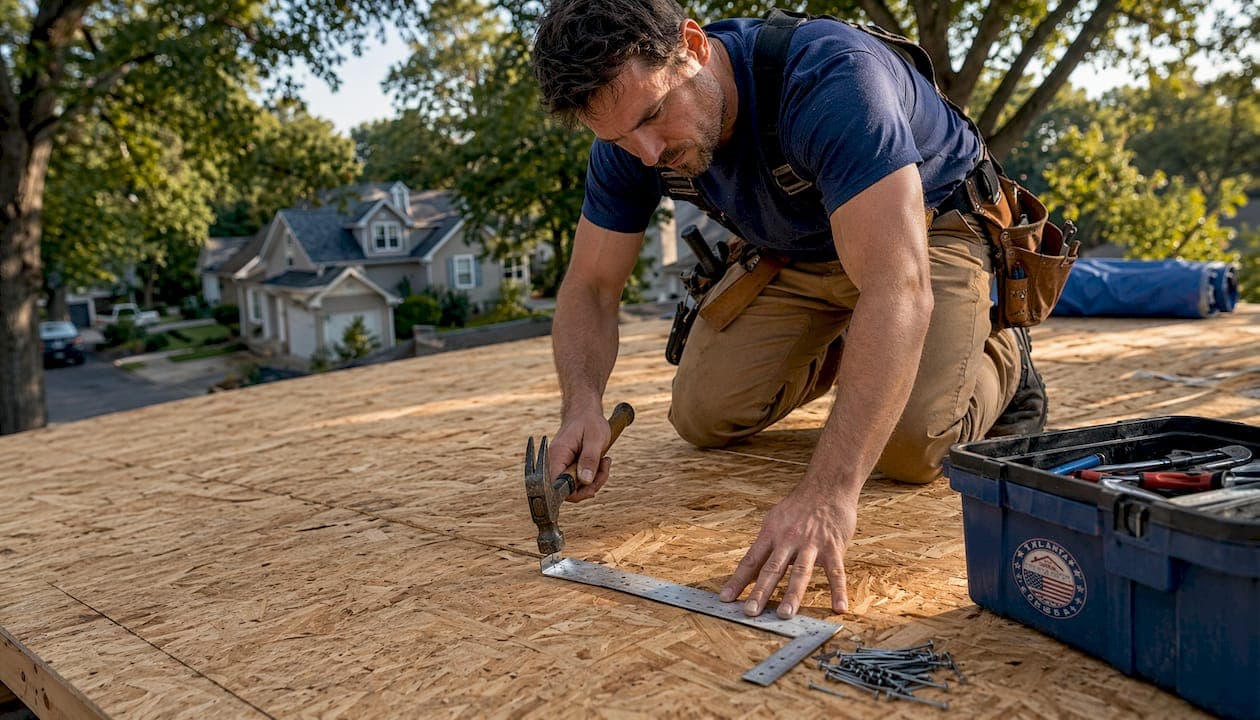
Roof decking, also called roof sheathing, is the structural panel layer fastened directly to your roof's framing that gives shingles, underlayment, and flashing a solid surface to attach to. Without it, your entire roofing system has nothing to grip. The 2026 International Residential Code (IRC) sets clear standards for decking materials, nail types, and spacing, and those standards matter even more in Georgia, where humidity, summer storms, and wind loads put roofs under constant stress. Whether you are planning a repair or just want to understand what sits beneath your shingles, this guide covers roof decking explained from materials to maintenance.
What is roof decking and why does it matter?
Roof decking is the foundation of your entire roof system. Shingles fail prematurely without a solid, stable decking layer to hold fasteners reliably. That single fact explains why decking quality drives overall roof durability more than almost any other variable.
The decking layer sits between your roof's structural rafters or trusses and the underlayment above. It transfers wind and snow loads down through the framing and into the walls. A compromised deck means the whole system above it is at risk, regardless of how new the shingles are.
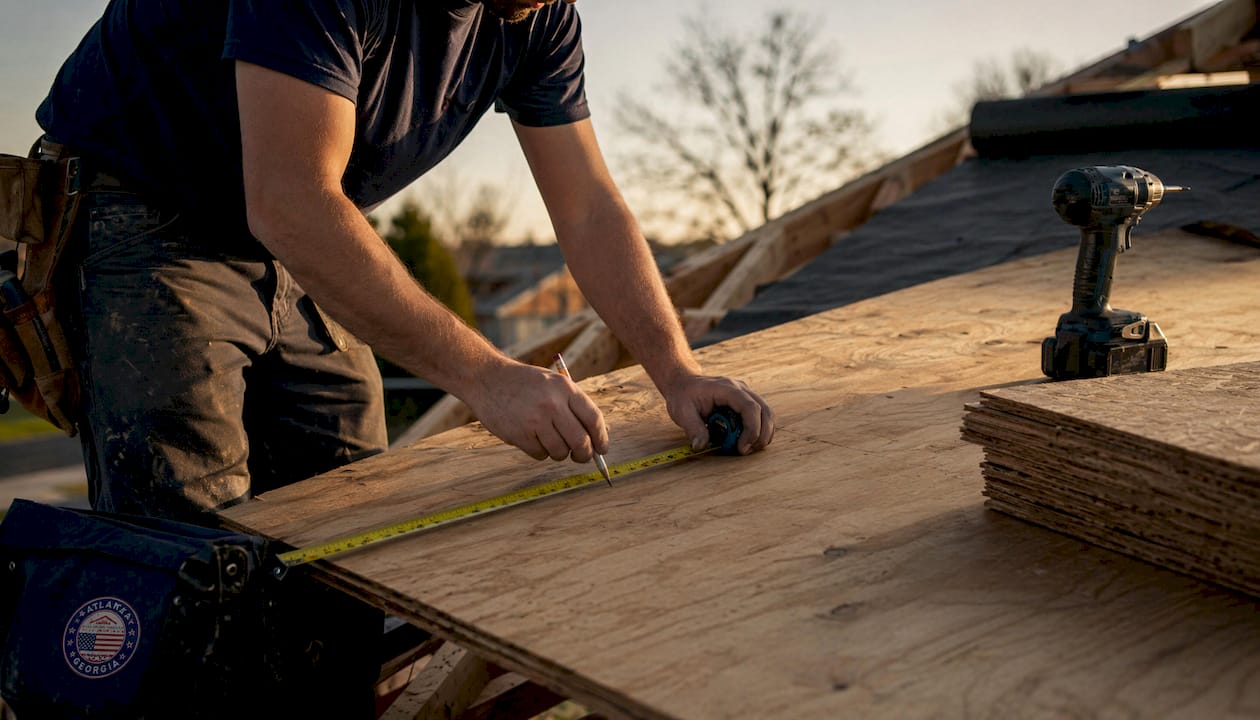
Georgia homeowners face a specific challenge. Atlanta's humid subtropical climate creates persistent moisture pressure from below through condensation, and from above through heavy rain and storm events. Choosing the right decking material and installing it correctly is not optional here. It is the difference between a roof that lasts 30 years and one that fails in 15.
What are the main roof decking materials?
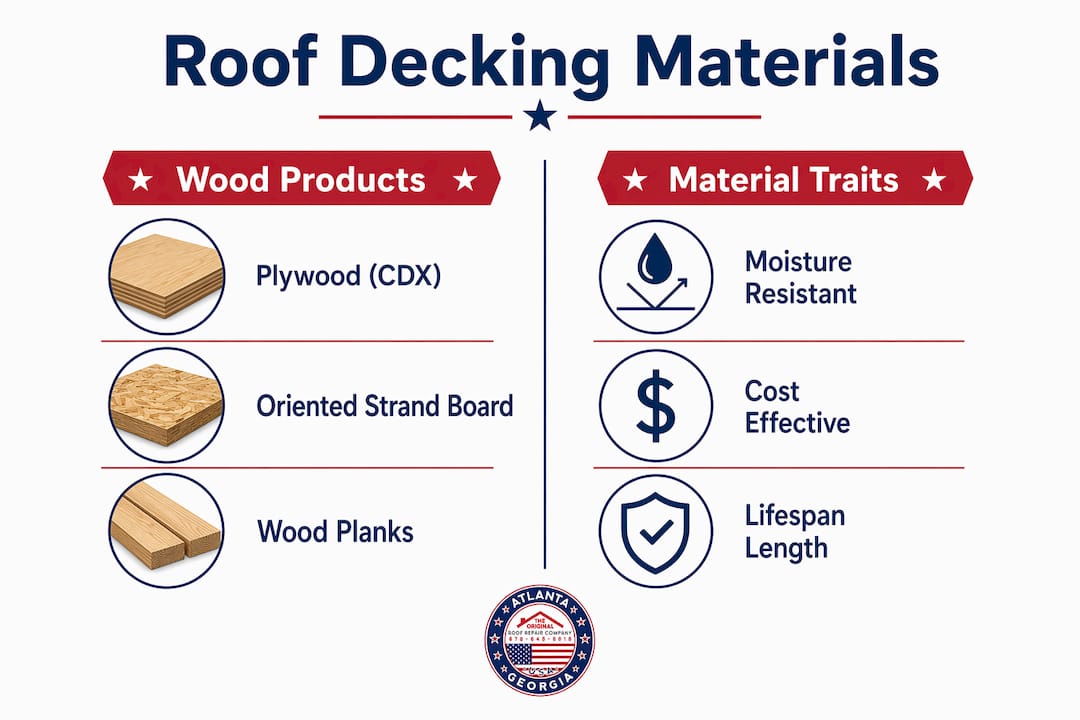
Residential roof decking materials most commonly include oriented strand board (OSB), plywood (typically CDX grade), and solid wood planks. Each has a distinct cost, lifespan, and moisture tolerance profile.
Plywood (CDX grade) is the preferred choice in humid regions like Atlanta. It handles moisture more forgivingly than OSB and carries a typical lifespan of 30–40+ years. A 4x8 sheet runs $35–$55. The cross-laminated veneer construction resists warping and holds fasteners well even after repeated wet-dry cycles.
OSB (oriented strand board) costs less at $18–$30 per sheet and carries a 20–30 year lifespan under normal conditions. OSB requires faster, more careful installation to avoid edge swelling from moisture exposure. In Georgia's climate, that margin for error is smaller than in drier regions.
Wood plank decking is found on older homes and costs $1.50–$3.00 per linear foot. It allows airflow between boards, which historically helped with ventilation, but the gaps create fastening challenges for modern underlayment systems. Plank decking is rarely installed new today.
| Material | Lifespan | Cost per unit | Moisture tolerance | Best for |
|---|---|---|---|---|
| Plywood (CDX) | 30–40+ years | $35–$55/sheet | High | Humid climates, Atlanta |
| OSB | 20–30 years | $18–$30/sheet | Moderate | Budget builds, dry climates |
| Wood planks | Varies | $1.50–$3.00/linear ft | Low | Older home restoration |
Pro Tip: In Atlanta and surrounding Cherokee County, specify CDX plywood when replacing decking. The extra cost per sheet is minor compared to the labor cost of replacing swollen OSB panels five years early.
How does roof decking installation work?
Correct installation follows the 2026 IRC nailing pattern: 6 inches on-center at panel edges and 12 inches on-center at intermediate supports, using 8d common nails for standard decking thicknesses. Thicker panels require 10d nails with adjusted lengths. In high-wind zones, including parts of Georgia, code requires tighter nail spacing to resist uplift forces.
Nail type is not interchangeable. 8d common nails are required for panel attachment because roofing nails have insufficient holding power and compromise the roof's structural diaphragm strength. Using the wrong fastener is one of the most common DIY errors inspectors find.
Panel sizing and span ratings also matter. The span rating embossed on decking panels (such as 32/16 or 48/24) directly informs suitable rafter spacing and panel thickness for load support. Never install a panel whose span rating does not match your rafter layout.
Unsupported long panel edges require H-clips, solid blocking, or tongue-and-groove edges to prevent deflection. Without edge support, panels flex under load and create visible ridges under shingles. Most homeowners never see this problem until shingles start buckling.
Common DIY installation mistakes to avoid:
- Skipping the 1/8 inch expansion gap at panel edges and ends, which causes buckling when panels swell.
- Driving nails too close to the panel edge (less than 3/8 inch), which splits the wood and weakens the connection.
- Overdriving nails so the head punches through the panel surface, reducing fastener holding strength.
- Using roofing nails instead of 8d common nails, which fails code and reduces structural integrity.
- Installing panels without checking the span rating against actual rafter spacing.
Pro Tip: Rent a pneumatic framing nailer with an adjustable depth setting for decking work. Set it so nail heads sit flush, not countersunk. Overdriven nails are the single most common installation defect found during Georgia roofing inspections.
How do you know when roof decking needs repair?
Roof decking damage is often hidden and best detected by attic inspection. Moisture from leaks, poor ventilation, or condensation causes rot on the deck's underside long before exterior signs appear. A flashlight and 20 minutes in your attic can reveal problems that would cost far more to fix if left undetected.
Watch for these six warning signs:
- Sagging or wavy rooflines visible from the ground, indicating panel deflection or rot
- Spongy spots when walking the roof or pressing on attic-side panels
- Water stains or discoloration on attic wood, showing active or past moisture intrusion
- Visible daylight through board gaps or seams, meaning panels have shifted or shrunk
- Nail pops pushing up through shingles, caused by decking movement or swelling
- Musty attic smells after rain, a reliable early indicator of mold or rot
Early detection via attic inspection prevents total roof failure. A problem caught at the rot-spot stage costs a fraction of what full redecking costs after widespread failure.
Spot repair is viable when damage affects less than 15–20% of the decking area and the surrounding panels are structurally sound. Full redecking is the right call when damage is widespread or when upgrading to a heavier roofing material that requires a thicker substrate.
Pro Tip: Use a roof inspection checklist to guide your attic walkthrough twice a year, once in spring after winter moisture and once in fall before storm season. Bring a flashlight and press gently on panels to test for softness.
For a detailed walkthrough of what to look for, the 2026 decking damage guide covers attic inspection steps and repair thresholds in depth.
What maintenance keeps roof decking in good condition?
Proper attic ventilation reduces condensation against roof decking, preventing moisture buildup that leads to wood damage, mold growth, and premature failure. In Atlanta's humid climate, ventilation is not a luxury. It is the primary defense against decking rot that starts from the inside out.
Underlayment and ice-and-water shield protect the deck from above. These layers sit between the decking and shingles, blocking wind-driven rain from reaching the wood surface. In Georgia, ice-and-water shield at eaves and valleys is standard practice, even though hard freezes are infrequent. The protection it provides against wind-driven rain is worth the cost year-round.
Practical maintenance habits that extend decking life:
- Inspect attic ventilation twice a year. Blocked soffit vents or a failed ridge vent trap humid air against the deck.
- Check flashing at penetrations (chimneys, vents, skylights) annually. Failed flashing is the most common entry point for water that reaches decking.
- Clear gutters and downspouts regularly. Backed-up water at the eaves saturates the fascia and works back under the first course of shingles.
- Avoid staple fasteners for underlayment. Staples back out over time and create small puncture points that allow moisture to reach the deck surface.
- Address small leaks immediately. A minor leak left for one season can rot a 4x8 panel section that requires full replacement.
Pro Tip: If your attic feels noticeably warmer than the outside air in winter, your ventilation is inadequate. That temperature differential drives condensation directly onto the underside of your decking every cold night.
What I've learned about roof decking after years of Georgia roofing
Most homeowners think of their roof as shingles. That is understandable. Shingles are what you see. But in my experience working on roofs across Cherokee County and the greater Atlanta area, the shingles are almost never the real problem when a roof fails early. The decking underneath is.
I have seen roofs with brand-new shingles installed over decking that was already soft in three or four spots. The previous contractor either did not check or did not want to add the cost of panel replacement to the estimate. Those roofs come back as a problem within a few years, and the homeowner ends up paying twice.
The other thing I see constantly is improper nailing. Contractors using roofing nails instead of 8d commons, or running a pneumatic nailer too hot and driving every fastener through the panel face. Improper nail choice and spacing are major reasons for decking failures discovered during inspections. The IRC guidelines exist for a reason, and skipping them always shows up eventually.
My honest advice: before any roofing project, have someone check the decking from the attic side. It takes 20 minutes and costs nothing. If you find soft spots or staining, address them before new shingles go on. Doing it in the right order saves money and avoids the frustration of tearing off a new roof to fix what should have been caught underneath.
— Eric
Roof decking repair and replacement in the Atlanta area
When decking damage goes beyond a simple spot repair, homeowners across Cherokee County and the Atlanta metro area need a contractor who will give them a straight answer about what actually needs to be done.
The Original Roof Repair Company specializes in honest, repair-first assessments. If a section of decking is soft or rotted, the team identifies the exact scope before any work begins, so you know what you are paying for and why. For localized damage, professional roof repair addresses the affected panels without unnecessary full replacement. When damage is widespread or a full system upgrade makes more financial sense, roof replacement services include proper decking evaluation and installation to current IRC standards. Contact The Original Roof Repair Company for a transparent assessment of your decking condition.
FAQ
What is roof decking made of?
Roof decking is most commonly made from OSB, CDX plywood, or solid wood planks. Plywood is preferred in humid climates like Atlanta because it handles moisture more forgivingly than OSB.
How thick should roof decking be?
Most residential applications use 7/16 inch or 1/2 inch panels. The correct thickness depends on rafter spacing and the span rating embossed on the panel, which must match your roof's framing layout per IRC code.
How long does roof decking last?
Plywood decking lasts 30–40+ years under normal conditions. OSB typically lasts 20–30 years. Both lifespans shorten significantly without adequate attic ventilation and proper underlayment protection.
Can roof decking be repaired without replacing the whole roof?
Spot repair is appropriate when damage covers less than 15–20% of the total decking area and surrounding panels are structurally sound. Widespread rot or structural compromise requires full redecking.
What nails does the IRC require for roof decking?
The 2026 IRC requires 8d common nails spaced 6 inches on-center at panel edges and 12 inches on-center at intermediate supports. Roofing nails are not an acceptable substitute because they lack the holding power required for structural diaphragm performance.
Key takeaways
Roof decking is the structural foundation of every residential roof system, and its material, installation, and condition determine how long the entire roof performs.
| Point | Details |
|---|---|
| Material choice matters | Plywood (CDX) outperforms OSB in humid climates like Atlanta, with a 30–40+ year lifespan. |
| IRC nailing standards are non-negotiable | Use 8d common nails at 6 inches on-center at edges; roofing nails fail code and reduce structural strength. |
| Attic inspection is the best early warning | Water damage and rot start on the deck's underside, often long before exterior signs appear. |
| Spot repair has a clear threshold | Repair when damage covers less than 15–20% of the deck; replace when damage is widespread. |
| Ventilation protects decking from inside | Proper attic airflow prevents condensation-driven rot, the leading cause of premature decking failure in Georgia. |