
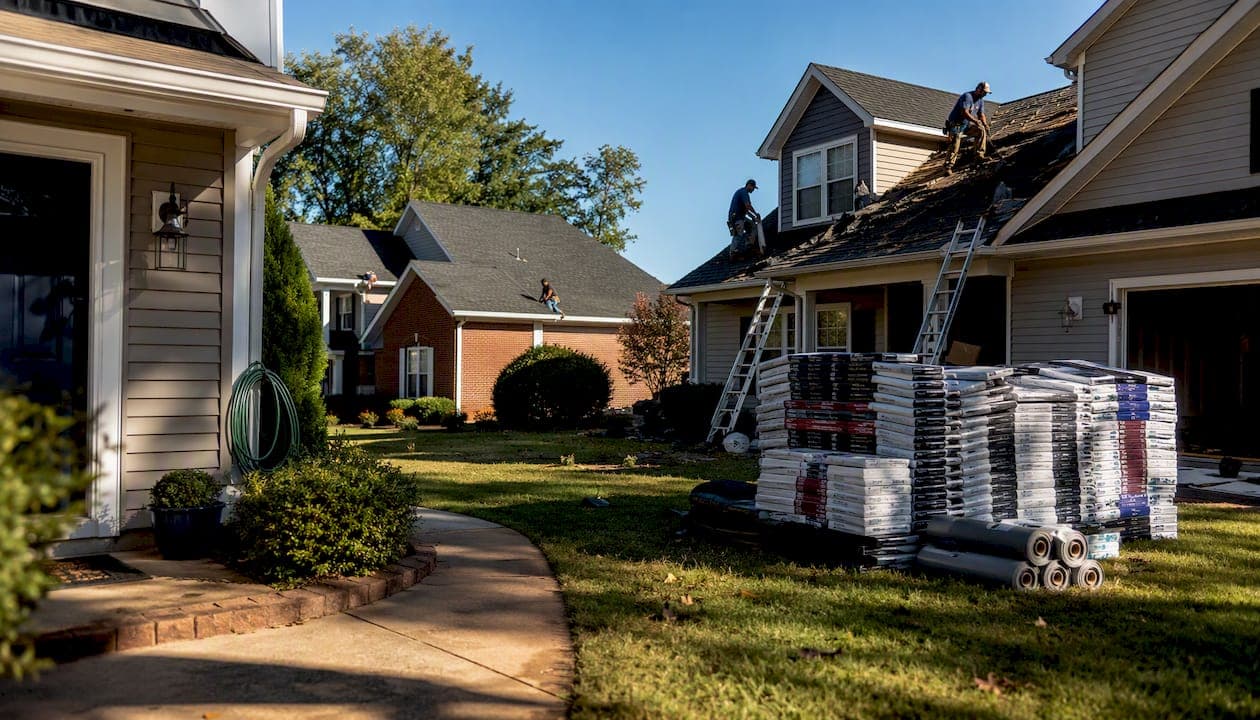
In 2026, most U.S. homeowners pay roughly $8,500–$16,000 to replace a typical 2,000 sq ft roof, with a national average near $9,607 according to Angi's 2026 data. The full national range runs from about $5,900 on the low end to $46,000 for complex, premium-material projects. NerdWallet's 2026 estimates put the installed cost at $4–$11 per square foot, and that spread exists for three reasons: material choice, labor and pitch complexity, and local permit or code requirements.
For Atlanta and Cherokee County homeowners, the Southeast's relatively moderate labor market keeps costs closer to the national midpoint than Northeast or West Coast markets. Local permit fees and Georgia's storm-season demand spikes, however, can push totals above that midpoint, especially after hail events when contractor schedules tighten.
Three fastest cost levers:
- Material: Asphalt shingles run $4–$7 per sq ft installed; metal, tile, and slate can triple that figure.
- Labor and pitch: Steep slopes and complex roof lines add 25–60% to base labor costs.
- Permits and hidden repairs: Decking rot, code-driven upgrades, and permit fees commonly add $1,000–$3,500 to a final bill.
Key Takeaways
Most Georgia homeowners budgeting a 2026 roof replacement should plan for a typical mid-range total for a standard 2,000 sq ft asphalt shingle project, with material choice and labor complexity as the two largest variables.
| Point | Details |
|---|---|
| 2026 national average | Angi reports $9,607 average; full range runs $5,900–$46,000 depending on size and material. |
| Cost per square foot | NerdWallet's 2026 data puts installed costs at $4–$11 per sq ft; use mid-range $7 for initial budgeting. |
| Material drives lifespan value | Architectural asphalt runs 25–30 years at $10,000–$15,000; metal runs 40–70 years at — |
| Budget for hidden costs | Add 10–20% contingency for decking, flashing, ventilation, and code-driven upgrades ($400–$1,200 typical). |
| The Original Roof Repair Company | Serves Canton and the Atlanta metro with free inspections, repair-first estimates, and insurance-claim advocacy. |
Table of Contents
- How much does roof replacement cost by house size in 2026?
- What does each roofing material cost installed in 2026?
- How do labor, pitch, and tear-off affect your final price?
- How does your location affect 2026 roofing prices?
- What extra costs do homeowners often miss?
- How can you reduce your roof replacement bill without cutting corners?
- Should you repair or replace? A decision framework
- When is the best time to schedule a roof replacement?
- What warranties and long-term value should you expect?
- How the 2026 estimates in this guide were calculated
- A repair-first perspective from The Original Roof Repair Company
- The Original Roof Repair Company serves Canton and the Atlanta metro
- Sources
- FAQ
How much does roof replacement cost by house size in 2026?
NerdWallet's 2026 figures support this approach and provide the size-to-total examples below.
One detail that trips up many homeowners: your roof's square footage is not the same as your home's living area. A 2,000 sq ft ranch with a 6/12 pitch has a larger roof surface than a two-story home of the same footprint, because the slope adds surface area. Contractors price by the "square," meaning 100 sq ft of roof surface. A 2,000 sq ft roof equals 20 squares.
Quick calculation example: A 1,800 sq ft roof at a mid-range $7.50 per sq ft comes to $13,500 before any add-ons.
Pro Tip: Multiply your home's footprint (length × width from outside walls) by your pitch factor. A 4/12 pitch uses a factor of 1.054; a 6/12 uses 1.118; a 9/12 uses 1.25. That gives you a close roof square footage without climbing up.
What does each roofing material cost installed in 2026?
Material is the single biggest variable in any roofing budget. RoofingCalculatorHQ's Q1 2026 data puts the midpoint for a 2,000 sq ft architectural-shingle roof near $11,200, while premium materials push well beyond that. SubcontractorHub's 2026 breakdown provides the per-material ranges that anchor the table below.
|---|---|---|---| | 3-tab asphalt | $4–$7 | — | 15–20 years | | Architectural asphalt | $4–$7 | $10,000–$15,000 | 25–30 years | | Metal (standing seam) | $10–$18 | — | 40–70 years | | Concrete tile | — | $18,000–$28,000 | 40–50 years | | Clay tile | — | — | 50–100 years | | Natural slate | — | — | 75–150 years | | Wood shake | $8–$14 | $16,000–$28,000 | 20–30 years | | Synthetic (composite) | $7–$12 | —–$24,000 | 30–50 years | | Stone-coated steel | $8–$14 | $16,000–$28,000 | 40–70 years |
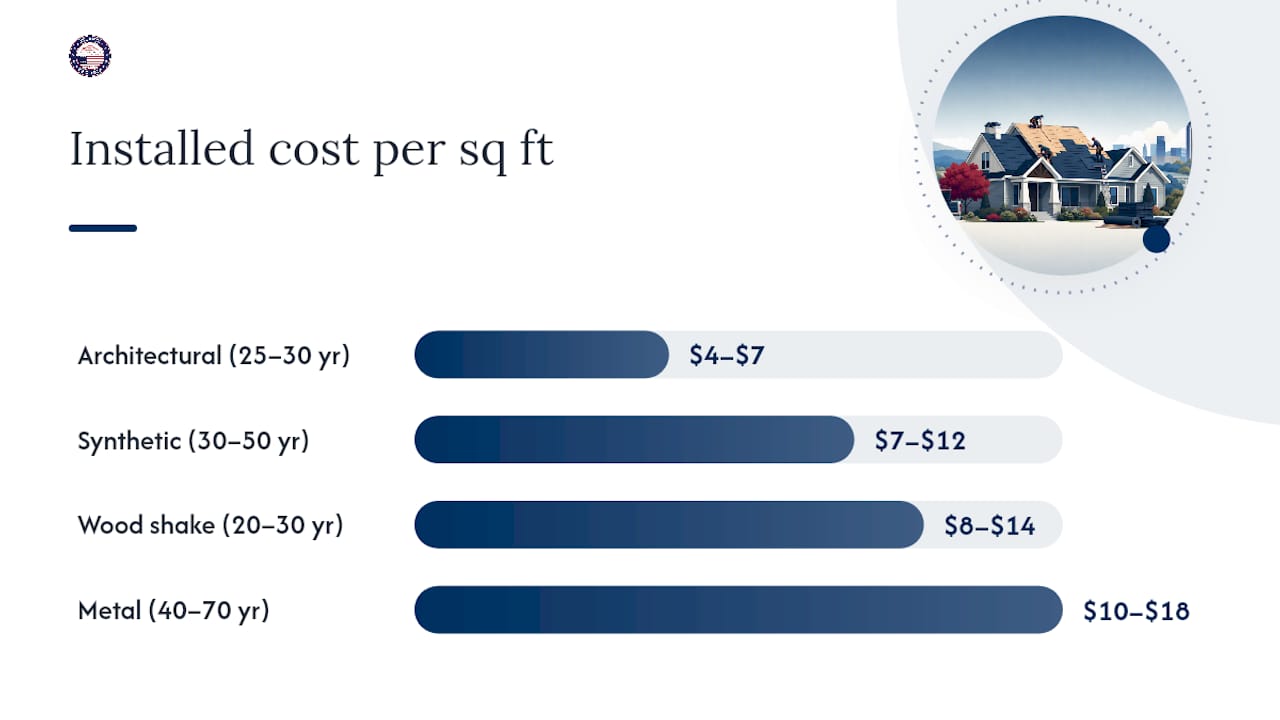
Installed cost includes more than the shingles themselves. Underlayment, ice-and-water shield at eaves and valleys, drip edge, starter strips, ridge cap, and fasteners all add to the material line. Roof deck repairs, if needed, are billed separately.
For most Georgia homeowners, architectural asphalt shingles offer the best balance of cost and durability. At 25–30 years of service on a $10,000–$15,000 investment, the cost-per-year runs roughly $400–$500. Metal roofing's 40–70 year lifespan can cut that annual figure significantly, but the higher upfront cost requires a longer ownership horizon to pay off.
How do labor, pitch, and tear-off affect your final price?
Angi's 2026 data confirms that labor typically accounts for more than half of a roof replacement's total cost, with contractor rates running $40–$95 per hour per worker depending on region. In the Atlanta metro, rates generally fall in the $50–$75 range. That labor share means a $12,000 project may carry $6,500 or more in pure installation cost before a single shingle is purchased.
Several installation factors push that labor number up:
- Pitch premium: A roof steeper than 6/12 requires safety equipment, slower work pace, and often additional crew. Expect a 25–60% labor surcharge on steep-slope projects.
- Tear-off vs. overlay: Overlaying a second layer of shingles over an existing layer costs less upfront but most building codes limit roofs to two layers, and the added weight can stress decking. A full tear-off adds $125–$400 per square (per 100 sq ft) to the project.
- Multi-layer removal: Removing two existing layers instead of one roughly doubles the tear-off labor cost and disposal fees.
- Staging and access: Homes with limited driveway access, steep driveways, or landscaping that complicates material delivery add $300–$800 in staging costs.
Complexity drivers that routinely appear in final invoices:
- Dormers (each adds framing, flashing, and additional cutting time)
- Skylights (require new flashing kits, typically $150–$400 each)
- Chimneys (step flashing and counter flashing, $300–$1,500 per chimney)
- Valleys (open vs. closed valley methods differ in labor and material cost)
- Roof penetrations such as plumbing vents and HVAC curbs (each requires a new boot or collar)
Pro Tip: Ask every contractor to itemize tear-off, disposal, and staging as separate line items. A bid that bundles everything into one number makes it impossible to compare quotes accurately.
How does your location affect 2026 roofing prices?
Geography shapes roofing costs in two ways: local labor market rates and code or zone requirements that mandate specific assemblies. WhatDoesARoofCost's 2026 report finds that 2026 national roofing costs are 15–25% higher than 2024 levels, driven by freight costs, persistent tariffs on metal components, and tight labor supply. That inflation is not uniform across regions.
Regional cost tendencies in 2026:
- Northeast: 20–35% above the national midpoint; dense labor markets and strict code requirements drive costs up.
- Southeast (including Georgia/Atlanta): Near or slightly below the national midpoint; moderate labor costs, though post-storm demand spikes can temporarily push prices 10–15% higher.
- Midwest: Generally at or slightly below the national midpoint; lower labor rates offset by longer material delivery distances in rural areas.
- West Coast: 25–40% above the national midpoint; high labor costs and fire-zone assembly requirements add significantly.
- Mountain West: Variable; rural areas can run 15–20% above midpoint due to material delivery costs.
- Texas/Southwest: Near the national midpoint; high storm frequency keeps contractor capacity active and pricing competitive.
For Cherokee County and Atlanta-area homeowners specifically, permit fees typically run $150–$500 for a standard residential replacement, though some municipalities charge based on project value. Georgia does not sit in a High Velocity Hurricane Zone (HVHZ), but local wind-load requirements and fire-code classifications in certain subdivisions can trigger code-driven upgrades. RoofingCalculatorHQ notes that code-driven upgrades after a tear-off commonly add $400–$1,200 to a project, covering items like enhanced nailing patterns, drip edge installation, and ice-and-water shield beyond the standard eave coverage.
What extra costs do homeowners often miss?
A contractor's initial estimate covers the roof surface. What it often does not cover are the conditions found after tear-off begins. Budgeting for these items upfront prevents the mid-project surprise that derails timelines and strains finances.
Common add-on costs and typical ranges:
- Decking replacement: Rotted or damaged OSB or plywood sheathing runs $70–$120 per sheet (4×8 panel). A moderately water-damaged roof may need 5–15 sheets replaced.
- Flashing replacement: Step flashing along walls and dormers, $200–$600; chimney counter flashing, $300–$1,500.
- Ventilation upgrades: Adding or replacing ridge vents, soffit vents, or powered attic fans, $300–$900.
- Ice-and-water shield beyond eaves: Extending membrane into valleys and around penetrations, $200–$600.
- Gutter replacement or rehang: Full gutter replacement runs $1,000–$2,500 for a typical home; rehang after fascia repair, $150–$400.
- Attic insulation improvements: Often triggered by code after a full tear-off, $1,000–$3,000 depending on attic size and current R-value.
- Structural repairs: Rafter sistering or ridge board repair, $500–$2,500 depending on extent of damage.
| Hidden Cost Item | Typical Range | Common Trigger |
|---|---|---|
| Decking replacement | $350–$1,800 | Water damage, rot found after tear-off |
| Flashing (all types) | $200–$1,500 | Age, improper original install |
| Ventilation upgrades | $300–$900 | Code trigger or moisture damage |
| Gutter work | $150–$2,500 | Fascia rot, full replacement |
| Structural repairs | $500–$2,500 | Rot, storm damage, long-deferred maintenance |
An honest contractor documents every hidden-cost item with photos before billing for it. If a contractor calls mid-job with a verbal add-on and no documentation, ask for photos and a written change order before approving the work. Georgia homeowners can review common roof replacement red flags to know what to watch for before signing any contract.
How can you reduce your roof replacement bill without cutting corners?
Timing, material selection, and competitive bidding are the three levers that reliably move the final number down. None of them require sacrificing quality.
Questions to include in every contractor quote:
- Is the permit fee included, or billed separately?
- What is the per-square tear-off and disposal charge?
- What is the decking replacement rate per sheet?
- What manufacturer warranty does the shingle carry, and what labor warranty do you provide?
- What is the payment schedule, and is a deposit required?
- Are there any code upgrades required in this jurisdiction that are not in this bid?
Savings tactics that work in 2026:
- Schedule in the shoulder season. Late October through February is typically slower for Georgia roofing contractors. Some offer 5–10% discounts to fill schedule gaps.
- Choose mid-grade architectural shingles. The jump from 3-tab to architectural shingles adds modest cost but extends lifespan by 10+ years. The jump from architectural to designer shingles adds 30–50% in cost for marginal performance gains.
- Get three bids minimum. Bid spreads of 20–30% on identical scopes are common. The lowest bid is not always the best, but three bids reveal the market rate.
- Ask about bundled discounts. Replacing gutters or adding attic insulation at the same time as a roof replacement often costs less than scheduling those projects separately.
- Check for utility rebates. Georgia Power and some local utilities offer rebates for qualifying cool-roof or insulation upgrades. Amounts vary by program year.
- Review your homeowner's insurance policy. Storm, hail, and wind damage may be covered. Insurance typically pays for damage-driven replacements, not wear-and-tear. Documenting damage thoroughly before filing is critical. The Original Roof Repair Company's insurance claim advocacy service handles that documentation process for Atlanta-area homeowners.
For financing, most Georgia contractors offer third-party financing through programs like GreenSky or Hearth, with terms ranging from 12-month same-as-cash to 10-year installment loans. Homeowners with sufficient equity may also use a home equity line of credit (HELOC), which typically carries lower interest rates than contractor-arranged financing. A guide to local roofing companies that finance covers the most common options available to Georgia homeowners.
That three-scenario range gives you a realistic floor, midpoint, and ceiling before the first contractor arrives.
Should you repair or replace? A decision framework
The repair-vs-replace question is where many homeowners overspend. Replacing a roof that had five good years left is expensive. Repairing a roof that is structurally compromised is a short-term fix that delays an inevitable larger bill.
Replace when any of these conditions apply:
- Repair estimates exceed $4,000 for a single event or accumulated damage
- The roof is within 3–5 years of its expected lifespan end
- Granular loss is widespread across multiple slopes, not isolated to one area
- Multiple active leaks exist in different roof sections
- Structural rot is present in decking, rafters, or the ridge board
- The insurance adjuster has documented storm or hail damage across the full roof surface
Repair when:
- Damage is isolated (one slope, one penetration, one section of flashing)
- The roof is less than 15 years old and otherwise in sound condition
- The repair estimate is well below $4,000 and addresses the root cause, not just the symptom
- No structural issues are present
The repair-first rule: At The Original Roof Repair Company, we recommend replacement only when documented repair costs exceed $4,000 or when the roof's condition makes repair a poor long-term investment. A free inspection and written estimate give homeowners the documented evidence they need to make that call clearly, without pressure.
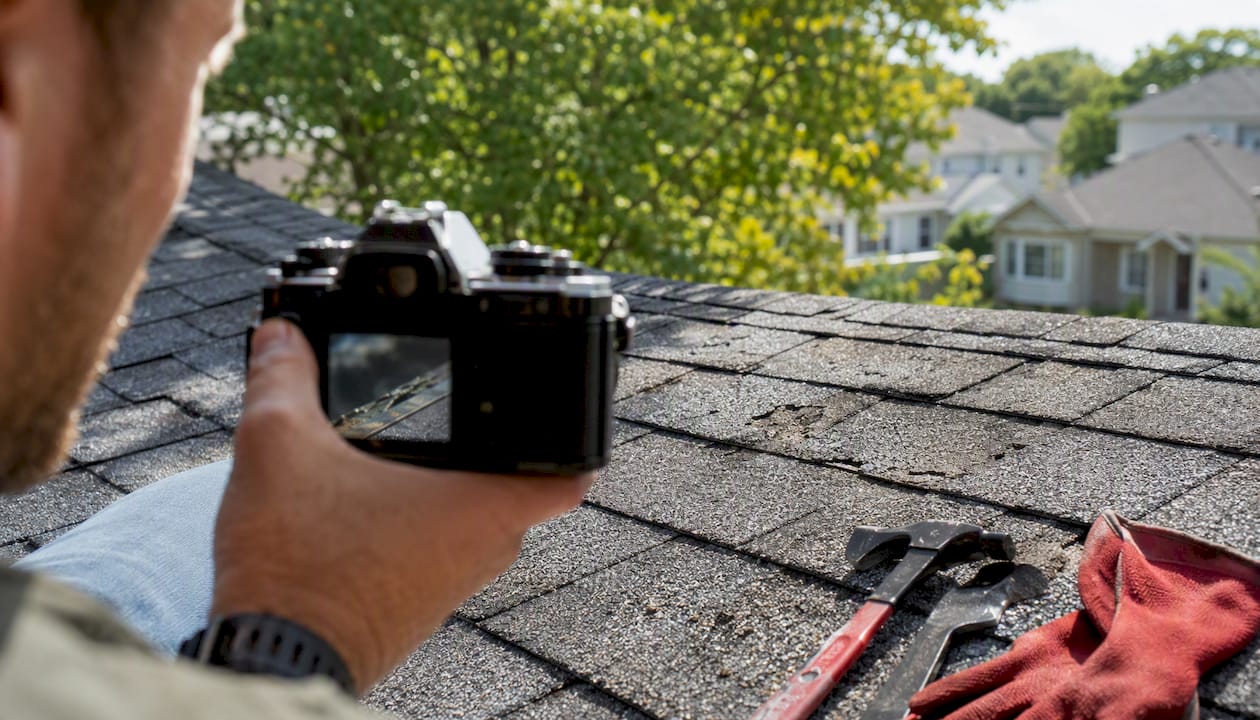
For storm and hail events, the decision often hinges on what the insurance carrier will cover. Thorough photo documentation of damage, taken immediately after a storm, is the single most important step a homeowner can take before calling a contractor or an adjuster. The Original Roof Repair Company provides that documentation as part of its roof replacement and insurance-advocacy services for Canton, Cherokee County, and surrounding Atlanta-area counties.
Pro Tip: Before any contractor visit after a storm, photograph every slope from ground level, every interior ceiling stain, and any visible granule accumulation in gutters or downspout splash blocks. Date-stamped photos are the foundation of a successful insurance claim.
For guidance on when to move from monitoring to calling a professional, the 2026 guide on when to call a roofing professional covers the clearest signals.
When is the best time to schedule a roof replacement?
A typical roof replacement follows a predictable sequence, and understanding each step helps homeowners avoid delays that push projects into peak-season pricing.
- Initial inspection and estimate: 1–3 days to schedule; same-day or next-day for urgent situations.
- Insurance claim filing (if applicable): Adjuster visit typically scheduled within 5–14 days of filing.
- Permit application: 3–10 business days in most Georgia jurisdictions; some counties offer same-day over-the-counter permits for residential work.
- Material order and lead time: Standard architectural shingles are typically available within 3–7 days. Metal roofing panels and specialty materials can run 2–6 weeks.
- Tear-off and installation: A standard 2,000 sq ft asphalt shingle roof takes 1–2 days for an experienced crew. Complex roofs or large homes may run 3–4 days.
- Final inspection: Scheduled within 3–7 business days of completion in most Georgia counties.
Total elapsed time from first call to completed inspection: typically 3–6 weeks for a planned replacement, assuming no insurance delays or specialty material back-orders.
Seasonal pricing patterns follow contractor demand. In Georgia and the broader Southeast, peak season runs April through September, when storm activity and homeowner project starts are highest. WhatDoesARoofCost's 2026 report notes that structural labor shortages are keeping prices elevated year-round in 2026, but shoulder-season scheduling (October through February) still offers the best chance of faster contractor availability and occasional off-peak pricing.
Scheduling checklist to reduce delays:
- Confirm permit requirements with your county before signing a contract
- Ask the contractor to lock in material pricing at signing, not at order time
- Build 2–3 weather contingency days into your timeline
- Avoid scheduling final inspection during holiday weeks when county offices may be closed
What warranties and long-term value should you expect?
Warranties on a new roof come from two separate sources, and understanding the difference protects homeowners from gaps in coverage.
Manufacturer warranties cover the shingles or panels themselves against defects and premature failure. Standard architectural shingle warranties run 25–30 years, often prorated after the first 10 years. Premium shingle lines carry 50-year or lifetime designations, though "lifetime" is typically defined as the life of the original structure, not the homeowner. Metal roofing manufacturer warranties commonly run 40–50 years on finish and 30–40 years on perforation.
Contractor workmanship warranties cover installation errors: improper nailing, flashing failures, and similar defects. Standard workmanship warranties run 1–5 years. Some contractors offer extended workmanship coverage of 10–25 years, often tied to manufacturer-certified installer programs. Extended coverage typically adds $300–$800 to a project.
Cost-per-year comparison using lifespan data:
- Architectural asphalt at $12,000 over 27 years: roughly $444/year
- Standing seam metal at $28,000 over 55 years: roughly $509/year
- Synthetic composite at $18,000 over 40 years: roughly $450/year
The per-year figures are surprisingly close across materials, which means the real differentiator is often upfront cash availability and how long the homeowner plans to stay in the home.
Regarding resale value, Angi's data supports the general industry finding that a new roof is one of the highest-ROI exterior improvements a homeowner can make, particularly when the existing roof is visibly aged. Premium materials like metal or slate can increase curb appeal and appraisal value, but the payback horizon on the premium over asphalt typically exceeds 10–15 years.
Warranty questions to ask before signing:
- Is the manufacturer warranty transferable to a future buyer?
- What voids the manufacturer warranty (improper ventilation, walking damage, satellite dish installation)?
- Is the workmanship warranty in writing and does it cover flashing and penetrations specifically?
- Does the contractor carry the manufacturer's certified installer designation, which often unlocks enhanced warranty tiers?
How the 2026 estimates in this guide were calculated
The cost figures in this guide draw from four primary sources: Angi's 2026 homeowner cost data, NerdWallet's 2026 installed cost ranges, WhatDoesARoofCost's 2026 annual price report, and RoofingCalculatorHQ's Q1 2026 material-by-material survey. SubcontractorHub's 2026 breakdown provided cross-validation for per-size and per-material totals.
Source methodology notes:
- Angi's figures reflect aggregated homeowner-reported project costs from completed jobs, weighted toward the most common project type (architectural asphalt, 1,500–2,500 sq ft).
- NerdWallet's per-square-foot ranges reflect contractor bid samples and distributor catalog pricing across multiple U.S. regions.
- WhatDoesARoofCost's 2026 report draws from distributor pricing data and contractor surveys conducted in Q1–Q2 2026.
- RoofingCalculatorHQ's midpoints reflect regional survey pulls with material-specific breakdowns.
Limits and variability to keep in mind:
- All figures reflect national averages or ranges. Local labor markets, permit fee structures, and material availability shift totals meaningfully.
- Single-layer removal costs less than multi-layer; rare or imported premium materials carry freight premiums not reflected in standard ranges.
- Georgia-specific costs generally track near or slightly below the national midpoint, with storm-season demand as the primary upward variable.
Use the ranges in this guide to build a pre-bid budget. Get at least three written quotes from licensed Georgia contractors before committing to a final number. The ranges here are a planning tool, not a substitute for a site-specific estimate.
A repair-first perspective from The Original Roof Repair Company
The most common mistake Atlanta-area homeowners make is accepting a replacement recommendation without a documented repair estimate first. A contractor whose revenue depends on replacement jobs has an incentive to recommend replacement. That is not an accusation; it is a structural reality of the business.
At The Original Roof Repair Company, the approach is different by design. Every inspection starts with a repair-first diagnosis. If the documented repair cost is below $4,000 and the roof has meaningful life remaining, repair is the recommendation. Replacement is recommended only when repair costs exceed that threshold or when the roof's condition makes repair a poor long-term investment.
For Cherokee County and Atlanta-metro homeowners who have experienced storm or hail damage, the insurance-claim process adds another layer of complexity. Carriers and adjusters respond to documented evidence, not verbal descriptions. The company photographs every affected surface, catalogs damage by slope and penetration, and works directly with adjusters to support the homeowner's claim. That advocacy has helped many local homeowners recover costs they would otherwise have absorbed out of pocket.
Free inspections, written estimates with itemized line items, and no-pressure recommendations are the operating standard. BBB accreditation and four years of local service back that commitment.
The Original Roof Repair Company serves Canton and the Atlanta metro
When a repair estimate exceeds $4,000 or a storm has compromised your roof's integrity, the next step is a documented inspection from a contractor who will give you an honest answer either way.
The Original Roof Repair Company provides free roof inspections and written estimates for homeowners across Cherokee County and 11 surrounding counties in the Atlanta, Georgia metro area. Services include repair-first roof repair, full roof replacement when replacement is the smarter financial choice, emergency roof repair for active leaks and storm damage, and insurance-claim advocacy from initial documentation through adjuster negotiations. Most inspection appointments are available within 1–3 business days. To schedule, contact The Original Roof Repair Company directly through the website and have your last replacement date, any HOA roofing guidelines, and recent storm dates ready for the appointment.
Sources
The figures in this guide reflect Q1–Q2 2026 data pulls. Local quotes remain the only way to confirm exact pricing for your specific home and county.
- How Much Does Roof Replacement Cost? 2026 | Angi
- Roof Replacement Cost in 2026 - NerdWallet
- Roofing Costs 2026: Annual Price Report | What Does a Roof Cost?
- How Much Does a New Roof Cost in 2026? US Pricing Guide
- How Much Does It Cost to Replace a Roof in 2026? (Full Breakdown) | SubcontractorHub
FAQ
Will roofing prices go down in 2026?
Prices are unlikely to drop meaningfully in 2026.
How much does a shingle roof cost on a 2,000 sq ft house?
A 2,000 sq ft architectural shingle roof typically runs $10,000–$15,000 installed in 2026, with RoofingCalculatorHQ placing the Q1 2026 midpoint near $11,200 for that size and material.
Is $30,000 too much for a roof replacement?
Not necessarily. A $30,000 quote is within range for a 2,500–3,000 sq ft home with a steep pitch, premium materials such as metal or tile, or significant hidden repairs. For a standard 2,000 sq ft asphalt shingle project, $30,000 would be above market and warrants a second or third bid.
What time of year is cheapest to replace a roof?
Late October through February is typically the slowest period for Georgia roofing contractors. Scheduling during those months offers the best chance of faster availability and occasional off-peak pricing, though 2026's tight labor market has compressed seasonal discounts compared to prior years.