
Yes, many local roofing companies that offer financing are available in Florida, and the process is more straightforward than most homeowners expect. Contractors typically arrange financing through third-party lenders like Hearth rather than lending money themselves. Your immediate next step: get a written, itemized estimate, then ask the contractor which lender partners they use and whether the quoted price changes depending on how you pay. Before signing anything, the Georgia Attorney General's Consumer Protection Division and Florida's equivalent agencies both recommend verifying contractor licensing and written loan terms upfront. The Original Roof Repair Company, based in Canton, Georgia, follows this same standard for every estimate.
Key points to confirm before you proceed:
- Ask the contractor to name their financing partner and provide a sample loan disclosure.
- Request the cash price and the financed price separately to check for markup.
- Confirm the contractor is licensed, insured, and willing to provide a written lien-waiver.
Table of Contents
- What financing options do local roofing companies offer?
- How does contractor financing work, step by step?
- Which lenders do roofing contractors commonly use?
- What credit score and APR should you expect?
- How do you vet a roofing company that offers financing?
- What are your options if you can't qualify or can't afford a full replacement?
- Concrete next steps for Florida homeowners
- Key Takeaways
- The real value of financing transparency
- Roof repair and replacement in the Atlanta metro area
- Useful sources
- FAQ
What financing options do local roofing companies offer?
Roofing companies with financing almost always work through a third-party lender rather than carrying the debt themselves. Understanding the differences between the main options helps you choose the one that fits your situation.
- Contractor-arranged third-party loans. The contractor connects you to a lender like Hearth. Approvals can be fast, sometimes same-day, but project pricing occasionally runs higher when financing is involved. Always ask for the cash price to compare.
- Unsecured personal loans. You apply directly through a bank or online lender. Personal loans carry no home collateral and offer fixed monthly payments, though APRs vary based on your credit profile.
- Home equity loans and HELOCs. These use your home as collateral, which typically means lower rates. The trade-off is real: missed payments put your home at risk.
- Credit cards. Fast access, but interest rates can reach 15–25% if you carry a balance. Best used for small repairs you can pay off quickly.
- Government-backed programs. HUD Title I loans and FHA 203(k) rehabilitation loans exist for qualifying homeowners, though they involve more paperwork and longer timelines.
| Financing Type | Collateral Required | Typical Speed | Best For |
|---|---|---|---|
| Contractor-arranged loan | None | Same day to 7 days | Full replacements with quick start |
| Personal loan | None | 1–7 days | Homeowners who want lender choice |
| Home equity / HELOC | Yes (your home) | 2–6 weeks | Large projects, lower rate priority |
| Credit card | None | Immediate | Small repairs, short payoff window |
| Government programs (Title I, 203k) | Varies | Weeks to months | Lower-income or qualifying homeowners |
How does contractor financing work, step by step?
The process follows a predictable path once you know what to expect.
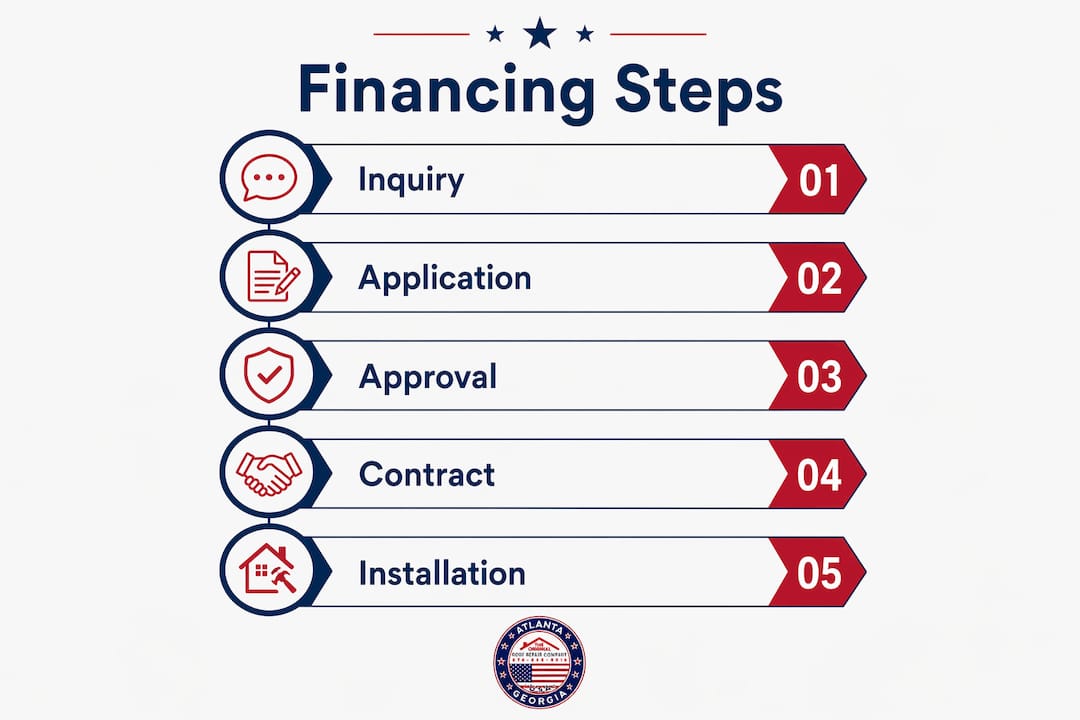
- Get a written inspection and itemized estimate. A reputable contractor will document the problem, not just quote a number. Use a roof inspection checklist before the appointment so you know what to ask.
- Ask about financing partners. The contractor either provides a direct link to their lender's application or submits on your behalf. Ask who the lender is and request a sample loan disclosure before you apply.
- Submit your application. Most lender applications require basic income verification, a Social Security number, and a soft or hard credit pull. Approval timelines can range from within a day to up to one or two weeks depending on lender and loan type.
- Review and sign the loan agreement. Read the APR, total repayment amount, payment schedule, and prepayment penalty terms before signing. Attach the lender's promissory note to your contractor agreement.
- Sign the roofing contract and schedule work. Work typically begins after both the loan and the contract are executed. Confirm the lien-waiver process before the crew starts.
- Final payment and lien waiver. At project completion, the contractor should provide a signed lien waiver before or at the time of final payment. This protects you from subcontractor claims against your property.
Pro Tip: Compare the total repayment amount across loan options, not just the monthly payment. A lower monthly payment stretched over a longer term often costs significantly more in total interest.
Approval timelines vary: contractor-arranged platforms like Hearth often return decisions within minutes to 24 hours, while personal loans from banks typically take 1–7 days, and home equity products can take 2–6 weeks.
Which lenders do roofing contractors commonly use?
Hearth is one of the most widely used home-improvement financing platforms among roofing contractors. It connects homeowners to multiple lenders through a single application and commonly offers fixed-term loans, no-interest promotional periods, and deferred-interest options. Contractors who use Hearth typically display the logo on their estimate paperwork or website.
What to request from any contractor about their financing partner:
- The lender's full legal name and contact information.
- Written loan terms showing APR, total repayment amount, and payment schedule.
- Whether the project price is the same for cash and financed customers.
- Lien policy: who files it, when it is released, and what triggers it.
- Prepayment penalty terms, if any.
Solid disclosure looks like this: the lender's logo appears on the contract, a written payment schedule is attached, and the financing partner's contact information is listed separately from the contractor's. If a contractor cannot produce these details in writing, that is a reason to pause.
What credit score and APR should you expect?
Many lenders use a credit score near the mid 600s as a common benchmark for better rate tiers, though options exist for scores below that threshold. A higher score generally unlocks lower APRs and longer repayment terms.
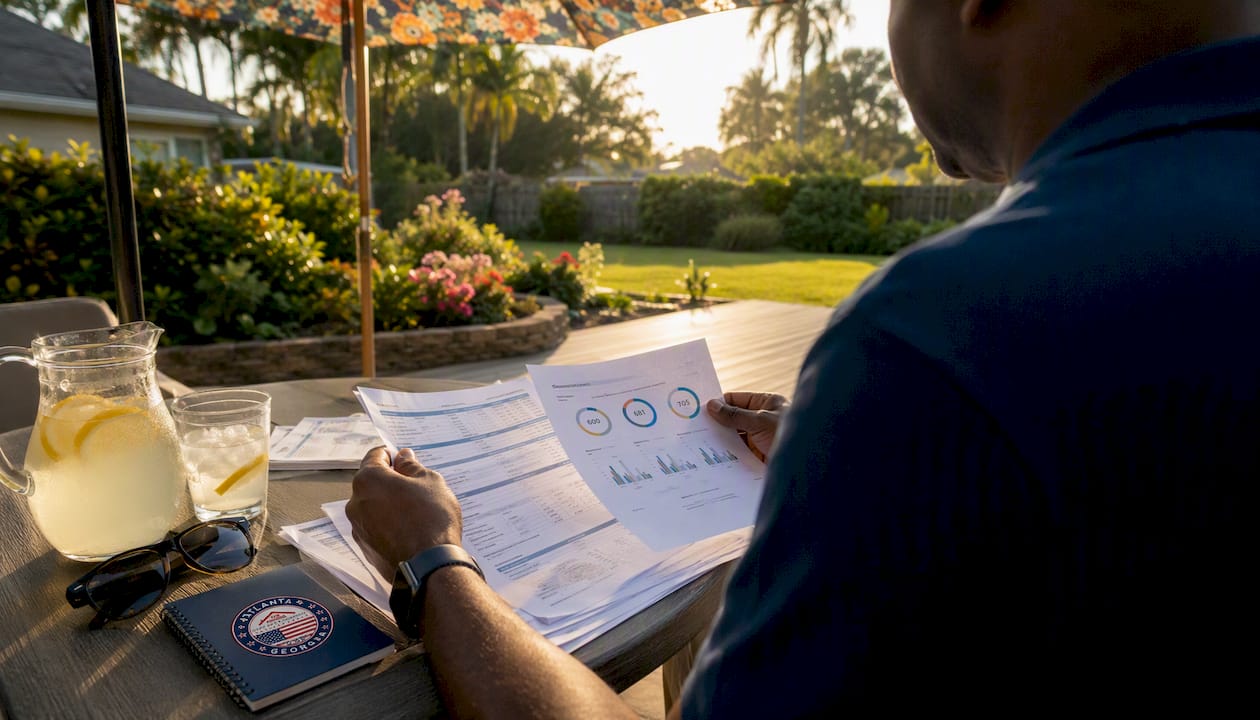
Roof projects often cost around ten thousand dollars or more, and home improvement personal loans typically run two to seven years in term length. APRs vary widely depending on credit profile, lender, and loan type.
Roof projects often cost around ten thousand dollars or more. Loans for roof replacement are typically offered at APRs ranging from around 8% to 15% over terms of two to seven years. Monthly payment and total interest will depend on project size, loan term, and your credit profile; always compare the total repayment amount across loan types.
How do you vet a roofing company that offers financing?
Financing adds a layer of complexity to contractor selection. The vetting process should cover both the contractor's credentials and the loan terms they are presenting.
Trust signals to verify:
- Florida DBPR (Department of Business and Professional Regulation) license number, confirmed on the state's online portal.
- Proof of general liability insurance and workers' compensation coverage.
- BBB accreditation and recent reviews.
- A physical local address, not just a phone number.
- References from recent jobs in your area.
Contract-level checks:
- Written loan terms attached to or referenced in the roofing contract.
- Lien-waiver language specifying when and how the waiver is delivered.
- Warranty terms in writing, covering both materials and labor.
- Itemized invoice showing labor, materials, and any financing-related fees separately.
- Payment schedule tied to project milestones, not arbitrary dates.
Red flags to watch for:
- Pressure to sign the same day, especially after a storm.
- Requests for large upfront cash payments not tied to documented emergency services.
- Refusal to name the financing partner or provide written loan terms.
- A project price that jumps when you ask about paying cash.
Georgia homeowners should also know that Georgia Code Title 10 gives you a five-day cancellation window for contracts tied to insurance proceeds, and contractors cannot demand payment during that period except for pre-authorized emergency services. For more on spotting contractor warning signs, the roof replacement red flags guide covers the most common issues in detail.
What are your options if you can't qualify or can't afford a full replacement?
A full replacement is not always the only path forward. Several alternatives can protect your home while you work on financing.
- Emergency tarping and localized repairs. A licensed contractor can tarp damaged sections or patch isolated failures to stop water intrusion. This buys time without committing to a full project.
- Staged repairs. Address the most critical failures first and plan the remainder over one to two seasons. This spreads cost without requiring a single large loan.
- Home equity loan or HELOC. If you have equity, these products typically carry lower rates than contractor-arranged financing. The application takes longer, but the total interest cost is often lower.
- Government programs. HUD Title I loans and FHA 203(k) rehabilitation loans are available to qualifying homeowners. Contact a HUD-approved housing counselor to check eligibility.
- Co-signer or joint application. Adding a creditworthy co-signer to a personal loan application can improve approval odds and rate tiers.
- Insurance claim advocacy. If the damage was caused by a storm, hail, or wind event, your homeowner's insurance may cover most of the cost. A roofing insurance advocate can document the damage and work directly with your carrier.
This article is general information, not financial or legal advice. Confirm current rates, licensing requirements, and program eligibility with the relevant lender, state agency, or a qualified professional for your specific situation.
Concrete next steps for Florida homeowners
Florida homeowners can move from uncertainty to a signed contract in a week or less if they follow a clear sequence.
- Get 2–3 written estimates that include financing options. Ask each contractor to name their lender partner and provide a sample loan disclosure alongside the project quote.
- Verify each contractor's license on the Florida DBPR portal. Request proof of general liability insurance and workers' compensation before any work begins.
- Check BBB accreditation and read recent reviews. A contractor with a physical local address and verifiable references is a stronger choice than one with only a phone number.
- Ask for written lien-waiver language, warranty details covering both materials and labor, and confirmation of whether the contractor assists with insurance claims.
- If the damage may be storm-related, get a storm damage assessment before committing to a financed repair. Insurance proceeds can reduce or eliminate the amount you need to finance.
- Homeowners near the Georgia or Atlanta area should also check Georgia's consumer-protection resources and note the five-day cancellation window that applies to insurance-tied contracts under Georgia law.
Key Takeaways
Florida homeowners who find local roofing companies that finance should compare total repayment cost, verify contractor credentials, and insist on written lien-waiver language before any work begins.
| Point | Details |
|---|---|
| Financing is widely available | Most local roofers arrange loans through third-party partners like Hearth; always ask for written loan terms. |
| Compare total cost, not monthly payment | Loans offered at typical roof project APRs can add several thousand dollars in interest over multi-year terms. Compare the total repayment amount for your selected financing option. |
| Verify credentials before signing | Confirm Florida DBPR license, insurance, BBB status, and lien-waiver language in the contract. |
| Alternatives exist for bad credit | Emergency repairs, HELOCs, government programs, and insurance claims can reduce or replace financing needs. |
| The Original Roof Repair Company | Serves Canton, Cherokee County, and the Atlanta metro with transparent pricing, repair-first estimates, and insurance claim advocacy. |
The real value of financing transparency
Most homeowners assume financing is a last resort. That framing leads to rushed decisions and signed contracts with terms they did not fully read.
Financing is a liquidity tool, not a sign of financial trouble. Keeping cash available for emergencies while spreading a $12,000 roof project over 36 months is a reasonable financial decision for many households. The problem is not financing itself. The problem is contractors who obscure the terms, inflate the project price for financed customers, or present a monthly payment without disclosing the APR or total repayment amount.
Transparent contractors explain the trade-offs between paying cash, using third-party financing, and pursuing an insurance claim. That conversation should happen before you sign anything, not after. If a contractor cannot or will not have it, that tells you something important about how the rest of the project will go.
The repair-first approach matters here too. A contractor who recommends a $15,000 replacement when a $900 flashing repair solves the problem is not serving your interests, financed or otherwise. Get the honest diagnosis first. Then decide how to pay for it.
Roof repair and replacement in the Atlanta metro area
When a roof problem needs a real answer, not a sales pitch, The Original Roof Repair Company is the contractor Georgia and Atlanta-area homeowners call first. The company serves Canton, Cherokee County, and 11 surrounding counties within a 35-mile radius of the Atlanta metro, handling everything from emergency leak repairs to full replacements when repair costs exceed $4,000.
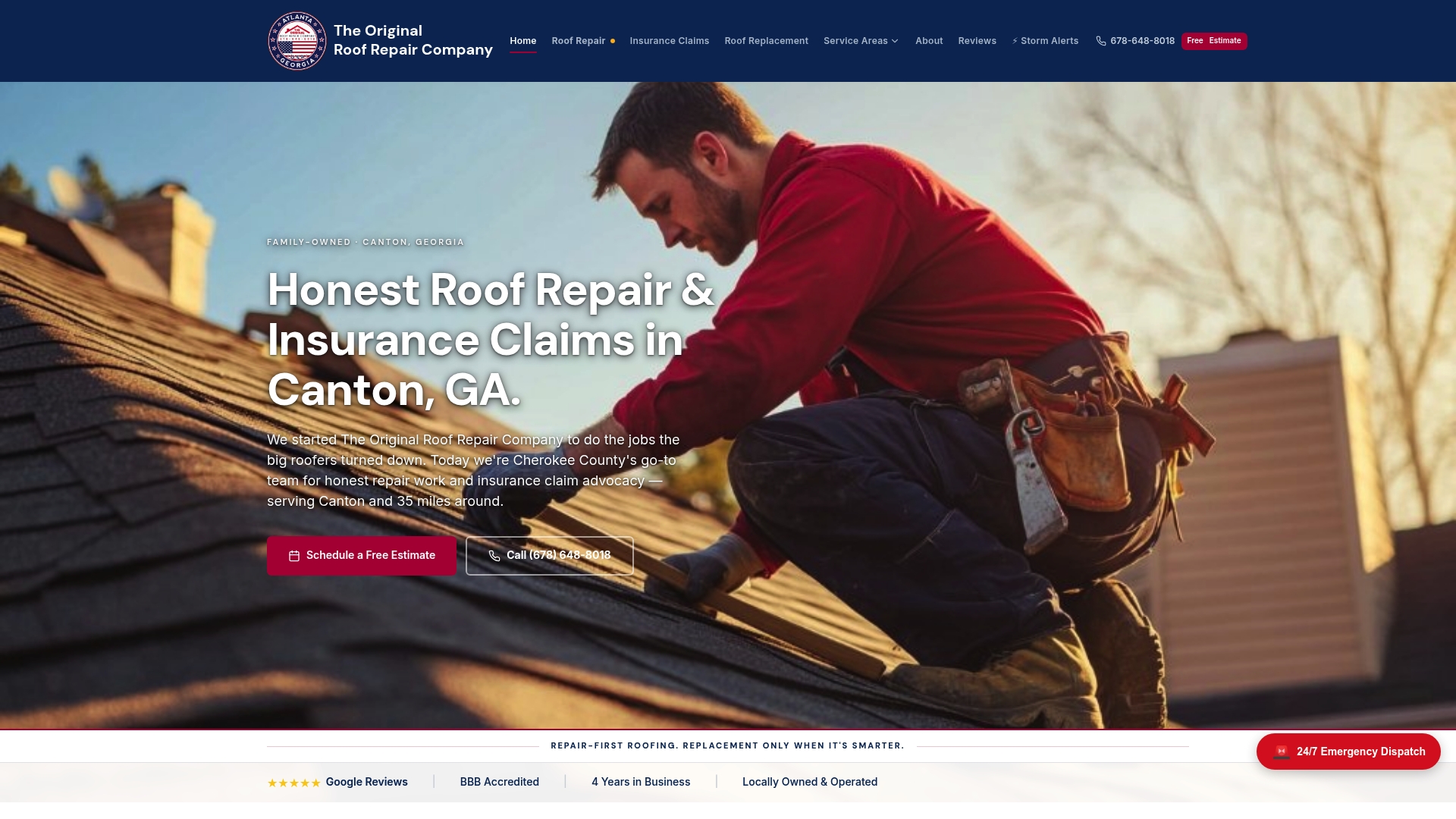
The team provides free inspections and itemized estimates, explains financing trade-offs without pressure, and assists homeowners with insurance claims from documentation through adjuster negotiations. Every estimate includes written lien-waiver language and warranty terms. If your roof needs attention now, request a free roof repair estimate or learn more about full roof replacement options to get a clear picture of your costs and options before committing to anything.
Useful sources
Verify contractor credentials, lender terms, and program eligibility directly through these resources.
- Florida DBPR (contractor licensing and complaints): myfloridalicense.com
- Georgia Attorney General's Consumer Protection Division: consumer.georgia.gov
- Georgia Code Title 10 (insurance-tied contract cancellation rights): FindLaw — GA Code § 10-1-393.12
- Hearth (contractor financing platform): gethearth.com/roof-financing
- HUD Title I and 203(k) programs: hud.gov
- BBB contractor profiles and accreditation: bbb.org
- Roof financing overview and loan terms: Finder
- Personal loan vs. home equity trade-offs: SoFi Learn
| Resource | Purpose |
|---|---|
| Florida DBPR | Verify contractor license and complaint history |
| Georgia AG Consumer Protection | Verify licensing; Georgia/Atlanta homeowners |
| Hearth | Review lender terms and contractor financing platform |
| HUD.gov | Check Title I and 203(k) program eligibility |
| BBB | Review contractor accreditation and customer complaints |
| Finder (roof financing) | Compare loan types, terms, and APR ranges |
FAQ
Do roofing companies allow financing?
Yes. Most local roofing companies arrange financing through third-party lenders like Hearth rather than lending money themselves. Always ask the contractor to name the lender and provide written loan terms before you apply.
What credit score do you need for roof financing?
Many lenders use a credit score near the mid 600s as a common benchmark for better rate tiers, though options exist for scores below that threshold. A higher score generally unlocks lower APRs and longer repayment terms.
How can you get a new roof if you can't afford one right now?
Start with emergency repairs or tarping to protect the home, then explore home equity loans, HELOCs, HUD Title I loans, or insurance claim advocacy if storm damage is involved. These options can reduce or replace the amount you need to finance.
How do you get a roof financed with bad credit?
Look for lenders that accept lower credit scores, consider adding a creditworthy co-signer to a personal loan application, or ask contractors about programs designed for lower-credit applicants. Compare APRs carefully, since rates are higher for lower credit profiles and the total repayment cost adds up quickly.
How does The Original Roof Repair Company help with financing?
The Original Roof Repair Company provides free inspections and itemized estimates, explains financing and insurance claim options without pressure, and assists Georgia and Atlanta-area homeowners with lender applications, lien-waiver language, and warranty documentation before any work begins.