
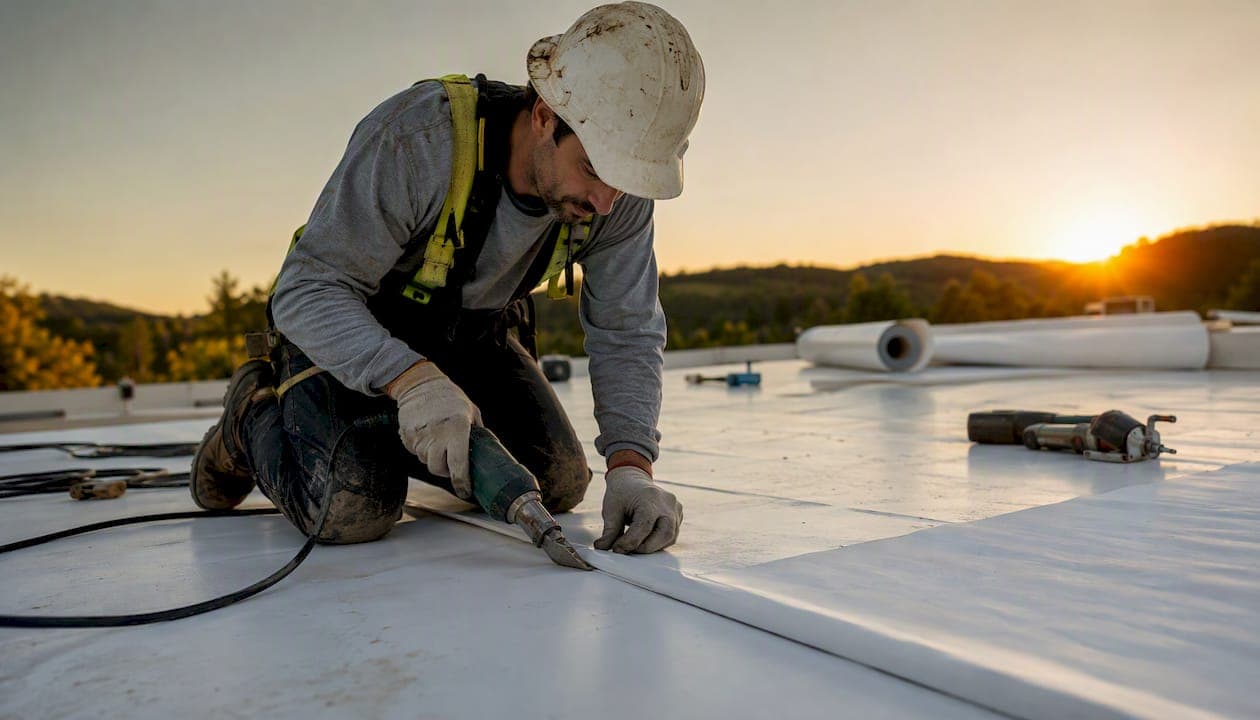
TPO roofing is a single-ply thermoplastic polyolefin membrane with heat-welded seams, installed on low-slope commercial roofs across warehouses, retail centers, and office buildings. For most commercial property owners, it delivers a solid balance of energy efficiency, seam reliability, and installed cost. The one honest caveat: the system performs only as well as the contractor who installs it, and maintenance is not optional.
ASTM D6878 is the governing specification, and SPRI publishes industry-average product data through its Environmental Product Declaration program. Georgia property owners in the Atlanta metro area will find TPO on the majority of commercial re-roofing bids, which makes understanding the material worth your time before you sign anything.
Table of Contents
- What TPO roofing is made of and how it's built
- How TPO roofing installation works
- Why property owners choose TPO: the real advantages
- What TPO roofing costs and how long it lasts
- How TPO compares with EPDM and PVC
- Standards and quality checks to require on every bid
- How to evaluate a TPO roofing contractor
- Key Takeaways
- A roofer's honest take on TPO in Georgia
- Useful sources
- FAQ
What TPO roofing is made of and how it's built
TPO is manufactured as a three-layer sheet: a weathering cap on top, a polyester or fiberglass reinforcement scrim in the middle, and a base ply underneath. That scrim layer is what gives the membrane its dimensional stability and tear resistance. The cap layer carries the UV stabilizers, antioxidants, and flame retardants that determine long-term weathering performance.
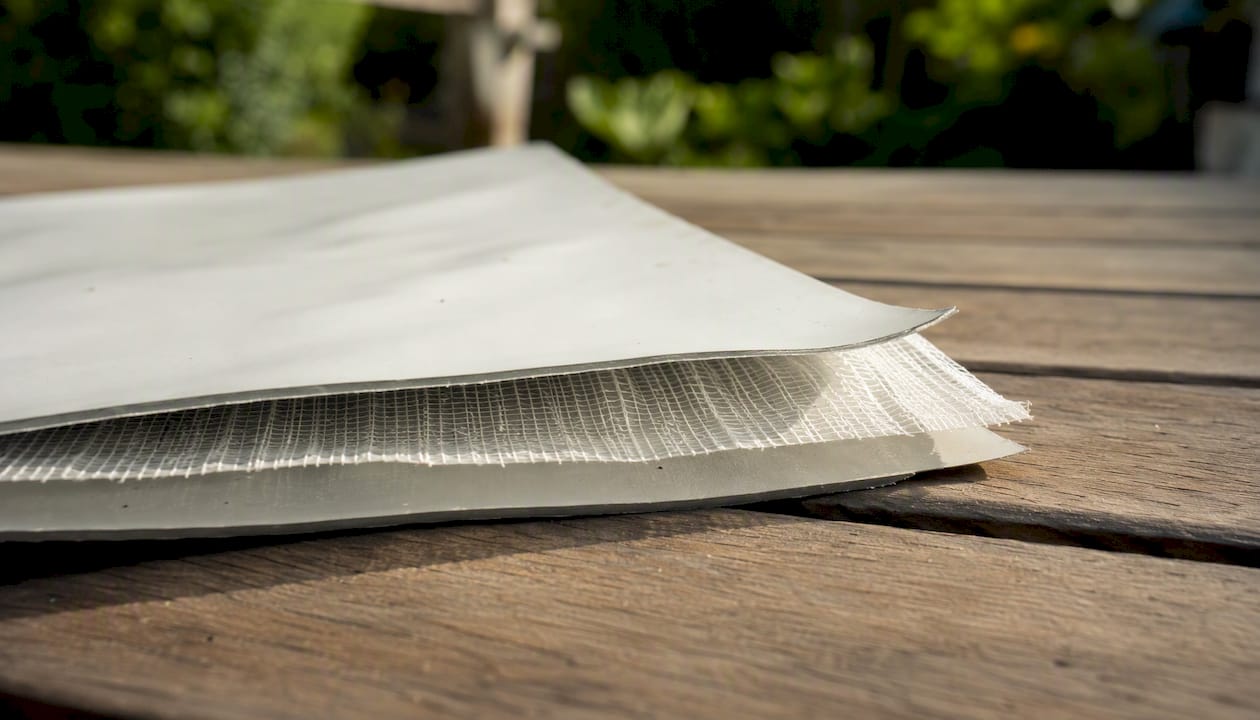
Membrane thickness is the first spec to check on any quote. Thicker membranes resist punctures better and carry longer warranties.
| Membrane thickness varies, with lighter options suitable for light commercial or recover projects, mid-range thicknesses typical for standard commercial new construction, and heavier membranes recommended for high-traffic roofs and premium installations.
Source: SPRI TPO EPD
White is the default color because it delivers the highest solar reflectance. Light gray is available for owners who prefer a less stark appearance. Darker colors are possible on request but sacrifice the cool-roof energy benefit. TPO differs from EPDM (a rubber membrane) in that its seams are heat-welded rather than taped or adhesive-bonded. Compared with PVC, another thermoplastic, TPO costs less and performs similarly on reflectivity, but PVC holds an edge in chemical resistance.
How TPO roofing installation works
The three primary attachment methods are mechanically attached, fully adhered, and ballasted. Mechanically attached is the most common: fasteners and plates secure the membrane through the insulation into the deck. Fully adhered bonds the membrane directly to the substrate with adhesive, which reduces flutter and is preferred on roofs with high wind-uplift requirements. Ballasted systems use river stone or pavers to hold the membrane down without fasteners, though they add significant dead load.
A typical installation follows this sequence:
- Roll layout and positioning — TPO rolls are available up to 12 feet wide, which reduces the number of field seams and speeds installation.
- Hot-air seam welding — overlapping membrane edges are fused with an automated or hand-held hot-air welder at 900–1,100°F, creating a bond that can exceed the membrane's own tensile strength when done correctly.
Welder calibration is the single biggest variable on a commercial job. Temperature, wind speed, and humidity all shift the optimal welding parameters, so the equipment must be recalibrated at the start of each workday.
Pro Tip: Require the contractor to provide daily welder calibration logs and at least one destructive seam test cut per day. A contractor who resists this request is a contractor worth walking away from.
Why property owners choose TPO: the real advantages
White TPO membranes carry Solar Reflectance Index (SRI) values often reported in the 95–110 range, which qualifies them as cool roofs under ENERGY STAR and many local utility incentive programs. On a Georgia summer afternoon, that reflectivity translates directly into lower cooling loads. Buildings in the Atlanta metro area with dark legacy roofs frequently see measurable HVAC savings after a TPO re-roof.
The welded seam is the other major advantage. Adhesive-bonded systems can peel under thermal cycling; a properly welded TPO seam becomes monolithic. Repairability is also straightforward: a puncture or seam void can be patched with a TPO cover strip and a hand welder, often in under an hour. Installed cost sits below PVC and most metal panel systems, and manufacturer warranties on 60 and 80 mil membranes typically run 15–20 years.
What TPO roofing costs and how long it lasts
Installed cost for TPO varies significantly depending on thickness, attachment method, insulation depth, tear-off requirements, and local labor rates, with mid-range pricing typical in the Atlanta area. A roof overlay rather than a full tear-off can reduce cost when the existing substrate is sound and local code permits it.
Design life for a 60 mil system is typically considered to be multiple decades under normal conditions. Warranty terms vary and may include membrane-only coverage for material defects, total system warranties including workmanship with manufacturer-certified contractors, and some premium options that cover repair costs without a cap.
To keep any warranty valid, owners must document semi-annual inspections, maintain a repair log, and avoid unauthorized rooftop work. Energy savings from cool-roof reflectivity and potential utility rebates for ENERGY STAR-qualified membranes can meaningfully offset lifecycle cost over a 20-year period.
How TPO compares with EPDM and PVC
| Feature | TPO | EPDM | PVC |
|---|---|---|---|
| Seam method | Hot-air welded | Tape or adhesive | Hot-air welded |
| Reflectivity / energy | High (white SRI 95–110) | Low (black standard) | High (similar to TPO) |
| Chemical resistance | Moderate | Moderate | Excellent |
| Installed cost | Moderate | Lower | Higher |
| Typical warranty | 15–20 years | 10–20 years | 15–20 years |
| Best climate fit | Warm / hot | Cold / mixed | Chemical-exposure zones |
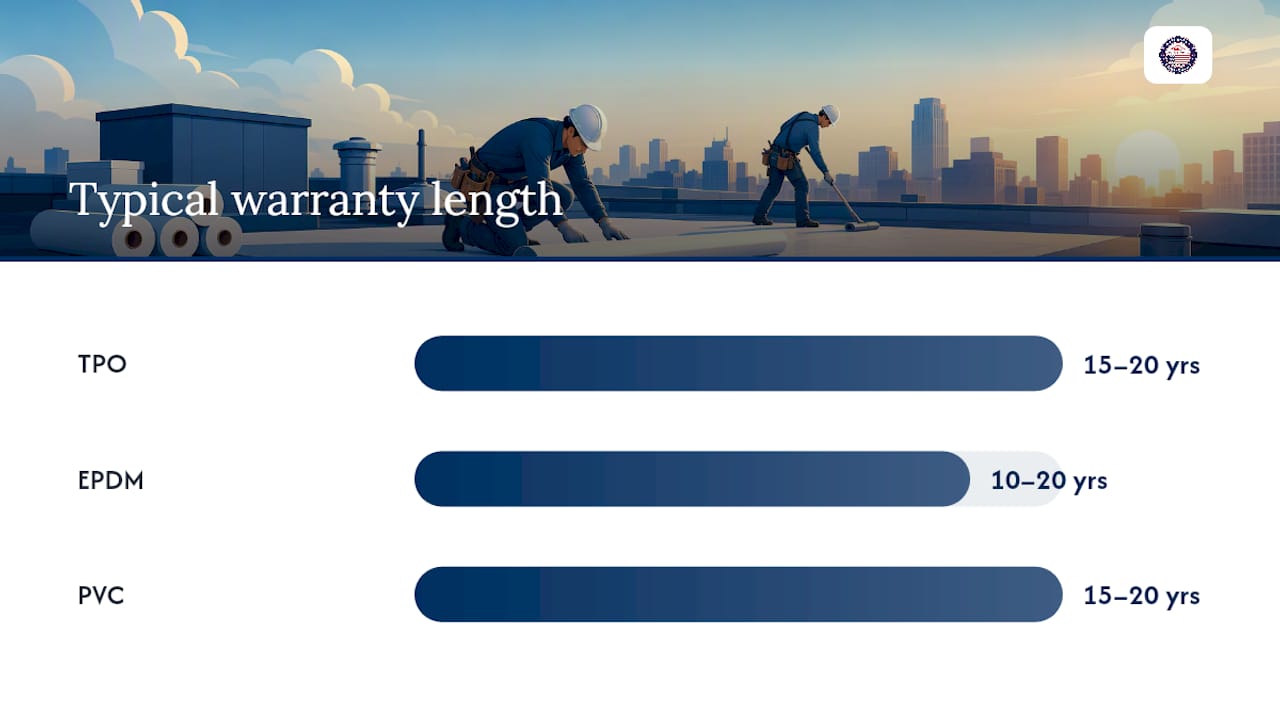
EPDM is the better choice in cold climates where low-temperature flexibility matters more than reflectivity. PVC is preferable when rooftop chemical discharge (oils, grease, solvents) is a regular concern, such as restaurant exhaust zones. TPO is the default for warm-climate commercial roofs where cool-roof performance and cost efficiency are the priorities, which covers most of Georgia.
Standards and quality checks to require on every bid
ASTM D6878/D6878M-21 defines the minimum property requirements for TPO sheet roofing: breaking strength, elongation, seam strength, and weather resistance. Any product submitted on a bid should carry factory test data confirming compliance with this standard.
The SPRI TPO Environmental Product Declaration provides industry-average data for 45, 60, and 80 mil membranes, including nominal weights and environmental impact data. Requesting the EPD from a manufacturer confirms the product has been independently evaluated.
Owner quality checklist — require these before signing a contract: Confirm the product data sheet states the nominal mil thickness and reinforcement type. Verify ASTM D6878 compliance on factory test reports. Request the manufacturer's EPD or equivalent third-party product documentation. Confirm the installer holds current manufacturer certification for the specific product. Ask for the daily welder calibration procedure in writing. Require a signed scope of work that specifies attachment method, insulation R-value, and warranty type.
How to evaluate a TPO roofing contractor
A credible contractor answers specific questions without hesitation. Here is what to ask and what to watch for:
- Ask for TPO-specific project references — request two or three local commercial jobs completed in the past three years, with contact names.
- Confirm manufacturer certification — total system warranties require certified installers; ask for the certification number.
- Request the seam testing protocol — destructive cuts and nondestructive probing should both be standard practice.
- Review warranty language in detail — confirm whether the warranty is membrane-only or includes workmanship, and check the exclusion list.
- Verify insurance and licensing — general liability and workers' compensation certificates should name your property.
Red flags that warrant a second opinion:
- A quote with no line-item breakdown of insulation, membrane thickness, or attachment method.
- Refusal to perform destructive seam tests ("it damages the roof" is not a valid reason).
- No installer certification for the specific membrane brand being proposed.
- Warranty language that is vague about what triggers a claim or who performs repairs.
For Atlanta and North Georgia property owners, local contractor familiarity with Georgia's wind and storm exposure requirements matters. A contractor who has handled storm damage documentation and insurance claims in this market understands the specific failure modes that Georgia weather produces.
Key Takeaways
TPO roofing is the dominant commercial single-ply membrane in North America because it pairs cool-roof reflectivity with welded seam strength at a moderate installed cost, but performance depends entirely on verified installation quality and consistent maintenance.
| Point | Details |
|---|---|
| Verify membrane thickness | Specify 60 or 80 mil for standard commercial use; 45 mil is undersized for high-traffic roofs. |
| Demand seam test documentation | Daily welder calibration logs and destructive test cuts are non-negotiable quality controls. |
| Inspect semi-annually | Check seams, flashings, boots, and drains twice a year to keep warranty coverage intact. |
| Confirm ASTM D6878 compliance | Require factory test data showing the product meets the governing TPO sheet specification. |
| Get local quotes in person | Atlanta-area owners should have a contractor walk the roof before accepting any estimate. |
A roofer's honest take on TPO in Georgia
TPO is a genuinely good product when it is installed correctly and maintained. The problems seen most often in the Atlanta area are not material failures — they are workmanship failures. Seams that were welded too fast, flashings that were not fully adhered, and roofs that went uninspected for three or four years until a leak showed up on a ceiling tile.
The repair-first approach matters here. A seam void caught at year two is a $300 repair. The same void at year five, after water has saturated two layers of polyiso insulation, can push past $4,000 and make replacement the smarter financial call. That threshold is exactly where The Original Roof Repair Company draws the line: repair when it makes sense, recommend replacement honestly when it does not.
For commercial and residential property owners in Canton, Cherokee County, and across the Atlanta metro area, The Original Roof Repair Company offers free on-site inspections and transparent estimates. Storm damage documentation and insurance claim advocacy are part of the service when hail or wind is involved. No pressure, no inflated scopes.
Need a TPO inspection or repair in the Atlanta area? The Original Roof Repair Company serves Cherokee County and 11 surrounding counties. Schedule a free roof inspection or call for a same-day estimate. If storm damage is involved, the team handles insurance claim documentation directly with your carrier.
Useful sources
- TPO Roofing Guide (2026) | Commercial Roof Guide
- TPO Roofing Guide for Building Owners | Flat Roof Report
- TPO SINGLE PLY ROOFING MEMBRANE — SPRI EPD
- ASTM D6878/D6878M-21: Standard Specification for Thermoplastic Polyolefin (TPO)-Based Sheet Roofing
- TPO Roofing: Advantages And Disadvantages For Commercial Flat Roofs
- TPO Roofing Pros and Cons for Commercial Buildings
FAQ
What does TPO stand for in roofing?
TPO stands for thermoplastic polyolefin. It refers to a single-ply roofing membrane made from a blend of polypropylene and ethylene-propylene rubber, manufactured in three layers and installed on low-slope commercial roofs.
How long does a TPO roof last?
A 60 mil TPO roof is typically expected to last multiple decades under normal conditions. Manufacturer warranties typically run 15–20 years, depending on membrane thickness and whether the installer is manufacturer-certified.
Is TPO roofing energy efficient?
White TPO membranes carry SRI values often reported in the 95–110 range, qualifying them as cool roofs under ENERGY STAR criteria. That high reflectivity reduces rooftop heat gain and can lower cooling costs in warm climates like Georgia.
What is the difference between TPO and EPDM roofing?
TPO uses heat-welded seams and reflects solar heat; EPDM is a rubber membrane with adhesive or tape seams and is typically black. TPO is preferred in warm climates for energy performance; EPDM is favored in cold climates for low-temperature flexibility.
How much does TPO roofing cost to install?
Installed TPO typically costs roughly $5 to $12 per square foot, depending on membrane thickness, attachment method, insulation requirements, and whether tear-off is needed. Atlanta-area projects generally fall in the mid-range of that band.