
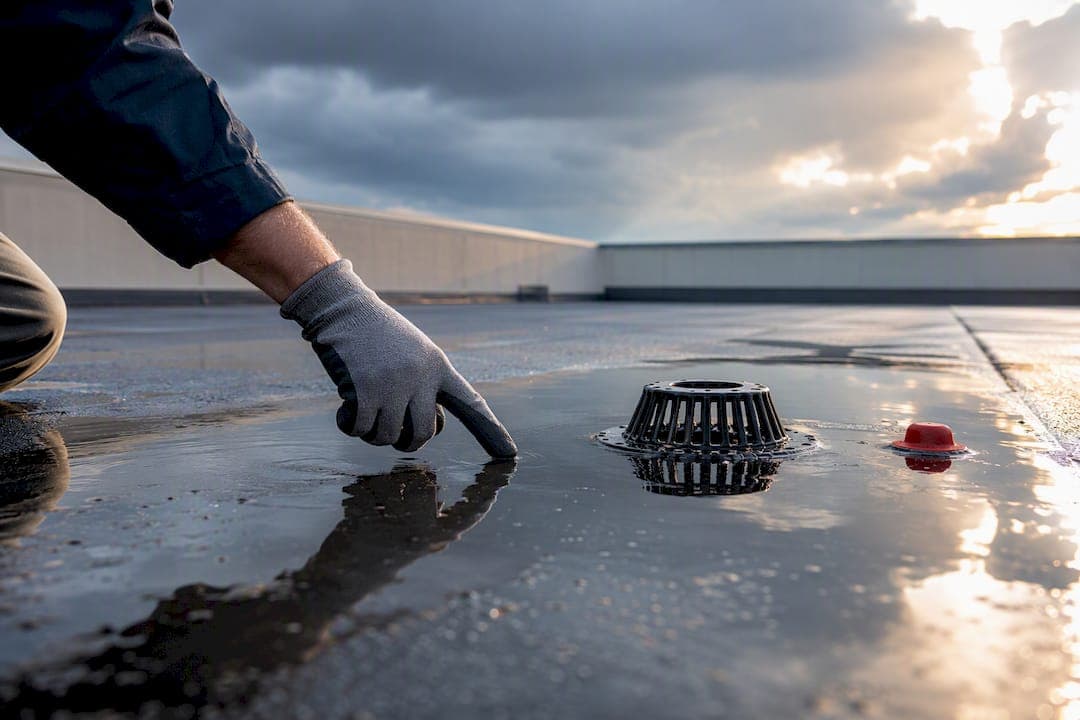
A commercial roof leak is any point where water penetrates the roof membrane, flashing, or penetrations and enters the building envelope. The moment you spot one, contain the water, photograph the damage with a timestamp, and call a qualified commercial roofer or inspector before you touch anything else. Acting within hours, not days, is what keeps your insurance claim and any manufacturer warranty intact.
TL;DR:
- Most roof leaks originate at flashing and penetration points, especially around rooftop equipment, and require prompt inspection and documentation within 48 hours.
- Major leak causes include membrane damage from foot traffic or hail, ponding water, uplift from high winds, and poor installation, with ponding over 48 hours accelerating deterioration.
- Leak detection relies on a combination of visual checks, infrared thermography, and moisture mapping, which must be verified with core sampling to avoid unnecessary repairs.
- Repair costs vary from small fixes like resealing flashings to extensive replacements, with most minor repairs completed in one day and larger repairs potentially taking several, depending on scope.
- Routine biannual inspections, quarterly drain cleaning, and detailed record-keeping help prevent costly emergency repairs and support insurance claims.
Table of Contents
- What Are the Warning Signs of a Commercial Roof Leak?
- What Causes Most Commercial Roof Leaks?
- How Do Professionals Detect a Hidden Roof Leak?
- What Does Commercial Roof Leak Repair Cost?
- How Often Should a Commercial Roof Be Inspected?
- Should You Repair or Replace a Leaking Commercial Roof?
- What Do Insurance Companies Require After a Roof Leak?
- How Do Climate and Roof Type Affect Leak Risk?
- An Owner's Take: Why Repair-First Beats Replace-First Thinking
- Get Help With a Commercial Roof Leak in Atlanta
- Sources
- FAQ
What Are the Warning Signs of a Commercial Roof Leak?
Interior clues usually show up before anyone climbs onto the roof. Ceiling tile stains, bulging drywall, a musty odor near HVAC returns, or a tripped breaker near a wet spot all point to active water intrusion. On the roof itself, look for ponding water that lingers, lifted flashings at parapets and curbs, and visible tears or open seams in the membrane.
Once you spot any of these signs, move through triage in order:
- Contain the leak with buckets or plastic sheeting and move equipment or inventory out of the drip path.
- Cut power to any fixture near standing water and flag the area for staff safety.
- Arrange temporary tarping over the source if the roof is accessible and weather allows it.
- Notify tenants or affected departments so nobody is surprised by contractors on site.
- Photograph and video the damage with a timestamp, note the date and weather event, and log who you called and when.
That log becomes the backbone of your insurance claim documentation later, so start it the same day.
What Causes Most Commercial Roof Leaks?
Flashing and penetration failures cause the largest share of commercial roof leaks, more than membrane tears or age alone; for detailed guidance on rooftop units and curb penetrations, refer to this commercial rooftop unit repair guide. Parapet copings, pipe boots, and curb flashings around rooftop units are where sealants dry out, metal shifts, and gaps open just enough to let water track sideways into the deck. A JSheld engineering analysis notes that the most severe losses originate at these predictable weak points, which is exactly why inspectors check them first.
Beyond flashings, the recurring culprits are:
- Membrane damage from foot traffic, hail, or UV breakdown, especially on aging single-ply systems
- Ponding water caused by clogged drains, insufficient slope, or deck deflection over time
- Edge and corner uplift during high wind events, where fasteners loosen before the membrane visibly tears
- Installation defects like poorly lapped seams that only fail years after the crew leaves
Ponding that sits longer than 48 hours accelerates membrane breakdown and adds real weight to the deck, which is why persistent ponding deserves a drainage evaluation, not just a patch. The GSA's overview of flat roofing types breaks down how built-up, modified bitumen, and single-ply systems each deteriorate differently, which matters when you're deciding what to inspect first.
How Do Professionals Detect a Hidden Roof Leak?
Walking the roof and looking for obvious damage catches maybe half the problem. Water travels sideways under a membrane before it ever shows up as a ceiling stain, so a visual check alone misses trapped moisture that's already saturating insulation.
Infrared thermography reads temperature differences between wet and dry insulation, but it only works under specific conditions: a clear night sky, minimal wind, and enough temperature swing between day and night to create a thermal signature. Reflective roof membranes can throw off readings, which is one reason Professional Roofing's coverage of moisture surveys stresses pairing thermography with a second method rather than trusting it alone.
| Method | Best used for | Key limitation |
|---|---|---|
| Visual inspection | Obvious flashing gaps, ponding, tears | Misses subsurface moisture |
| Infrared thermography | Scanning large membrane areas at night | Needs specific weather, struggles on reflective roofs |
| Electronic leak detection (ELD) | Pinpointing single-ply membrane breaches | Best on exposed membranes, not under ballast |
| Nuclear/capacitance moisture mapping | Mapping wet insulation across a roof section | Prone to false positives without verification |
| Core sampling / gravimetric testing | Confirming actual moisture content | Destructive, used to verify scan results |
Moisture mapping technology is genuinely useful, but standards call for combining it with core sampling and gravimetric analysis before anyone authorizes a tear-off. Skipping that verification step is how buildings end up paying for insulation replacement they didn't need. For anything beyond a straightforward flashing leak, bring in a certified inspector who combines methods rather than relying on a single scan.
What Does Commercial Roof Leak Repair Cost?
Repair scope drives cost more than roof size does. A single failed pipe boot or a short run of open flashing seam is a same-day fix in most cases. Multiple penetrations or a stretch of separated seams take longer and cost more, and a section of saturated insulation under a membrane tear can turn a patch job into a re-covering project.
- Minor repairs (flashing reseal, single boot replacement, small patch): typically the fastest and least expensive category, often finished in one visit
- Moderate repairs (multiple penetrations, seam repairs across a section, localized re-cover): span one to several days depending on access and material lead time
- Major repairs or partial replacement (saturated insulation, extensive membrane damage): may require emergency tarping first, then a scheduled crew for the permanent fix
- Emergency response premiums apply when a crew has to mobilize after hours or in active weather, which is standard across the industry, not unique to any one contractor
A flashing-specific repair guide walks through what a typical reseal or boot replacement involves, and it's worth reading before you get a quote so you know what questions to ask.
How Often Should a Commercial Roof Be Inspected?
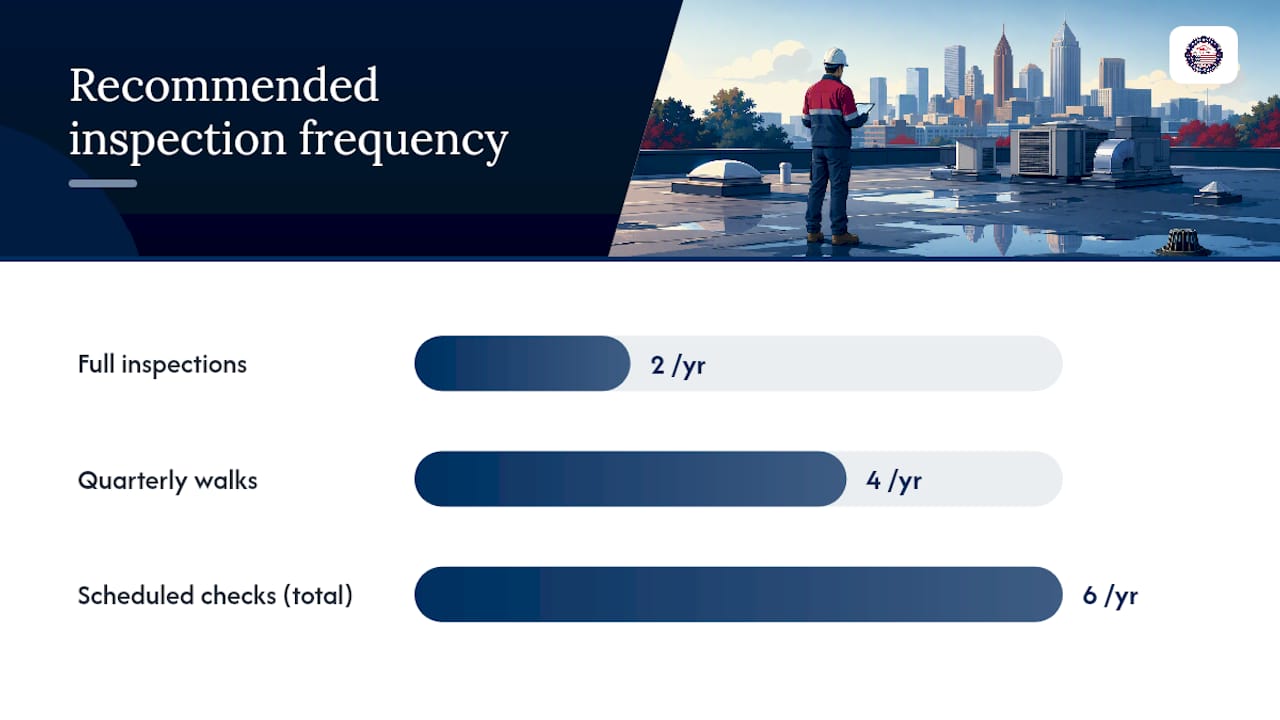
The most cost-effective maintenance rhythm is a full inspection every spring and fall, with a quarterly walk in between and an added check after any major storm. Rimkus's maintenance guidance recommends this biannual structure specifically because it catches drain clogs and flashing wear before they become active leaks.
Between full inspections, a maintenance crew should:
- Clear debris from drains and scuppers every quarter
- Reseal pitch pockets and check edge metal for lifting
- Maintain walk pads near HVAC units to prevent foot-traffic punctures
- Log every finding with dated photos, even when nothing looks wrong
Reactive repairs after a leak already happened cost noticeably more than scheduled maintenance, and a documented program is what makes an insurance adjuster take your claim seriously.
Pro Tip: Keep a single digital folder per roof with every inspection photo, repair receipt, and drain-clearing log in date order. When a leak happens, you'll hand your adjuster a paper trail instead of scrambling to reconstruct one.
Should You Repair or Replace a Leaking Commercial Roof?
Most leaks are fixable without a full tear-off, and a repair-first approach protects your budget as long as the underlying deck and insulation are sound. The math tends to shift toward replacement when:
- The repair estimate exceeds roughly $4,000 or approaches the cost of a full system
- Insulation is saturated across a wide area rather than one isolated spot
- The membrane is past 80% of its expected service life with recurring failures in different spots
- Structural deck damage shows up during a core inspection
A roof coating or restoration can be a smart interim step for a membrane that's aging but structurally sound, though persistent ponding can rule out certain coating chemistries entirely. Walk into any scope review with those thresholds in hand and you'll spend less time arguing with a contractor's estimate.
What Do Insurance Companies Require After a Roof Leak?
Insurers expect documentation that proves the damage happened when you say it did and that you weren't neglecting the roof beforehand. Get an inspection done within 48 to 72 hours of any storm and notify your carrier immediately. Waiting past that window is one of the fastest ways to get a claim denied.
Carriers typically want:
- Timestamped photos and video from before repairs begin
- A professional inspection report identifying the specific failure point
- Maintenance history showing the roof wasn't neglected
- Proof of the weather event itself, like local storm data
The most common denial reasons are evidence of deferred maintenance, reporting the damage too late, and skipping inspections required to keep a manufacturer warranty active. A step-by-step photo guide can help you package a claim-ready record before an adjuster even shows up.
How Do Climate and Roof Type Affect Leak Risk?
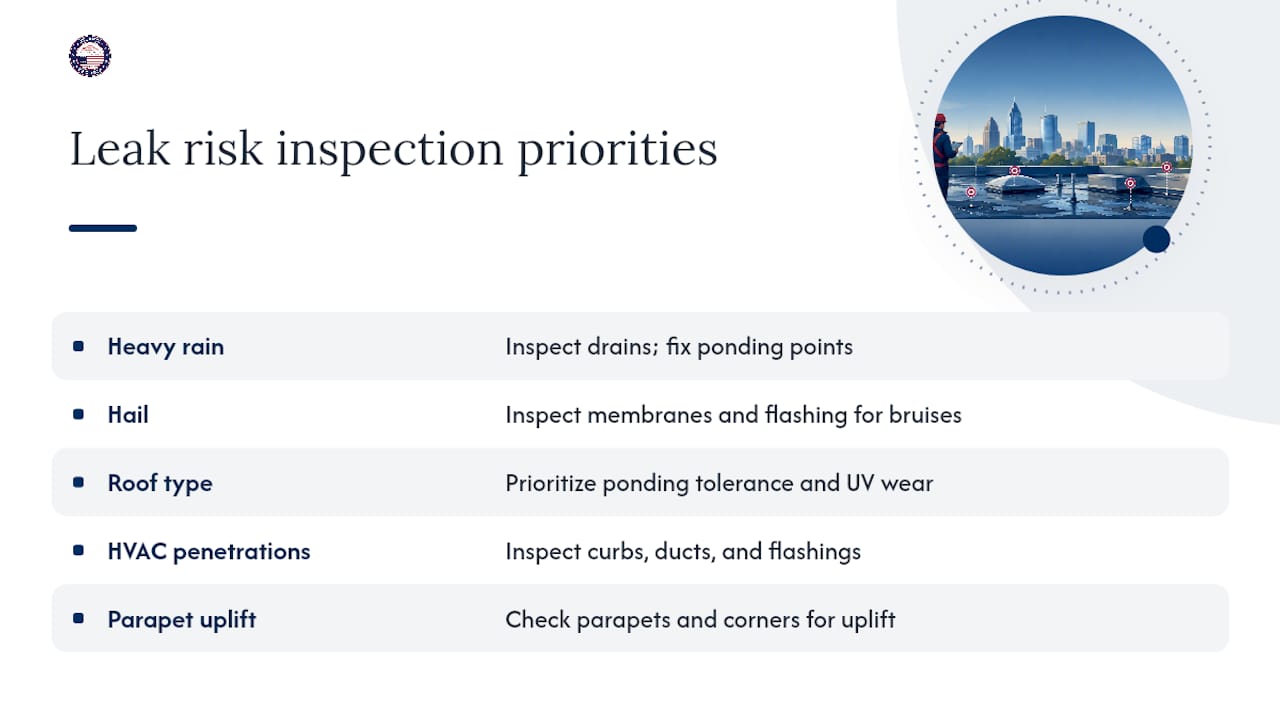
Where your building sits and what kind of roof it has changes the leak math significantly. In the Atlanta, Georgia metro area, summer thunderstorms drop heavy rain fast, which overwhelms undersized drains and exposes ponding problems that a slow drizzle would never reveal. Hail during spring storm season bruises membranes and dents flashing, and that damage often doesn't leak immediately, it shows up weeks later once the material fatigues.
Roof type matters just as much as climate. A single-ply membrane on a low-slope commercial building handles ponding differently than a built-up or modified bitumen system, and the GSA's technical breakdown of flat roofing types explains why UV exposure, thermal cycling, and ponding tolerance vary by material. A building with dense rooftop HVAC equipment adds another variable entirely, since every curb and duct penetration is a potential failure point that a bare membrane simply doesn't have.
Buildings near tree cover deal with debris clogging drains after every storm, while taller buildings in open areas face higher uplift forces at parapets and corners. None of these factors are things a property team can change, but they do determine where to focus inspection attention. A roof in a hail-prone Georgia county with a dozen HVAC penetrations needs a different inspection priority than a low-traffic warehouse roof with simple drainage. Matching your maintenance plan to your building's specific exposure, rather than applying a generic checklist, is what actually reduces leak frequency over time.
An Owner's Take: Why Repair-First Beats Replace-First Thinking
The roofing industry has a bias toward replacement, and it's not always in the building owner's interest. A full tear-off is the bigger invoice, so it's the easier sell. What gets lost is that most leaks, even ones that look alarming from inside a ceiling tile, trace back to a single flashing failure or a boot that dried out. That's a repair, not a rebuild.
Eric Manly founded The Original Roof Repair Company on the idea that a roofer should diagnose the actual problem before recommending the expensive fix. We only point toward full replacement when a repair estimate climbs past $4,000 or the system itself is no longer salvageable, and we say so plainly rather than padding a quote to get there. Serving Canton and Cherokee County along with the surrounding Georgia counties, we handle everything from a single boot replacement to emergency response and full insurance claim advocacy. For readers who want procedural detail beyond what fits here, our blog covers flashing repair and claim documentation step by step.
— Eric
Get Help With a Commercial Roof Leak in Atlanta
If your building is actively leaking right now, waiting for a callback isn't a plan. The Original Roof Repair Company runs a repair-first process built specifically for situations like this: a free inspection to diagnose the actual failure point, transparent pricing before any work starts, and full insurance claim advocacy if a storm caused the damage. We only recommend replacement when the repair estimate crosses $4,000 or the roof system genuinely can't be saved, so you're never paying for more roof than the problem calls for.

Before your inspection, pull together whatever photos you already took, note the date water first appeared, and have your last roof inspection record on hand if one exists. That paperwork speeds up both the diagnosis and any insurance claim that follows. If you're dealing with active water intrusion anywhere in the Atlanta, Georgia metro area, request emergency roof repair today, or if the leak is manageable and you'd rather schedule a standard visit, book a roof repair inspection and get a straight answer on what it will actually take to fix it.
Sources
- Commercial roofing systems, materials lifespan and engineering strategies for low-slope roof performance — JSheld (2026)
- Commercial roofing maintenance — Rimkus (2026-07-13)
- Surveying roof moisture — Professional Roofing (2025-12-01)
FAQ
Does Commercial Insurance Cover Roof Leaks?
Most commercial property policies cover sudden, storm-related leaks, but they typically deny claims tied to gradual deterioration or deferred maintenance, which is why timestamped inspection records matter so much.
Are Commercial Landlords Responsible for Roof Leaks?
In most commercial lease structures, the landlord or building owner is responsible for roof and structural repairs, though the exact split depends on the lease terms, so property managers should confirm responsibility in the lease itself before assuming coverage.
What Is the Average Lifespan of a Commercial Roof?
Lifespan varies by material and maintenance, with single-ply and built-up systems generally lasting decades under a consistent biannual inspection program, while neglected roofs fail well ahead of their expected service life.
What Is the Number One Cause of Roof Leaks?
Flashing and penetration failures around parapets, pipe boots, and rooftop equipment curbs are the leading cause of commercial roof leaks, ahead of membrane tears or age alone.
How Quickly Should I Report a Commercial Roof Leak to My Insurer?
Report the leak and get a professional inspection within 48 to 72 hours of discovering it or after a storm event, since delayed reporting is one of the most common reasons carriers deny claims.