
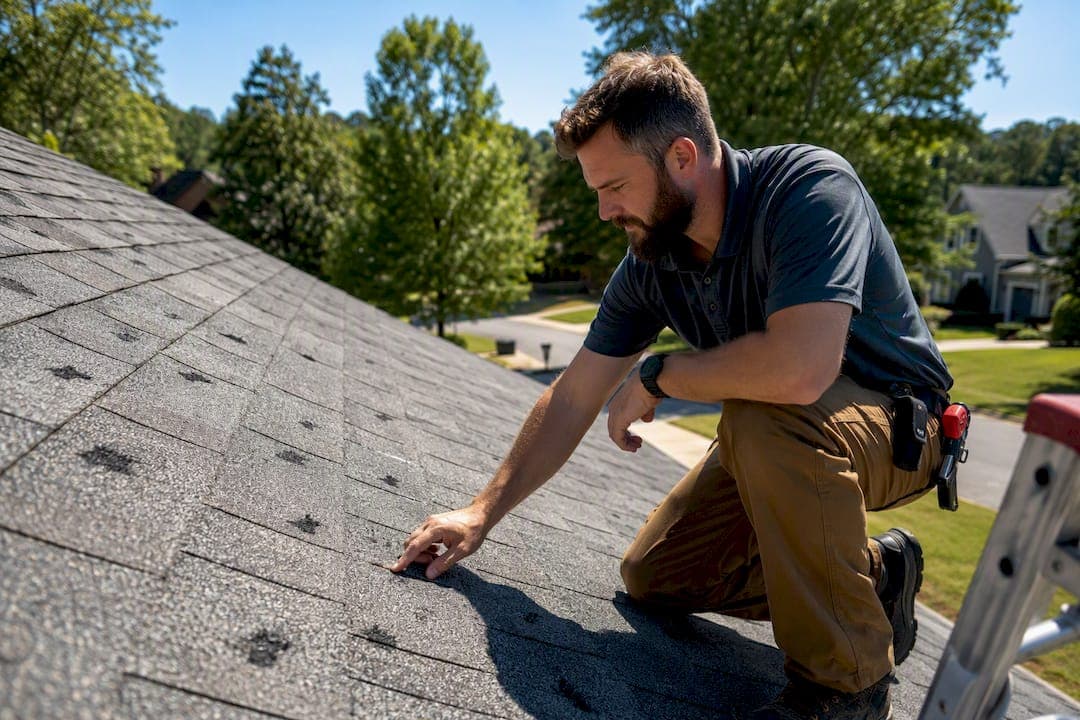
If you see granule loss in your gutters, dented soft metals, or missing shingles after a storm, hire a claim-experienced roofer before you call your insurance company. Get a written inspection with photos and measurements first. That document tells you whether the damage is real, whether it's worth filing a claim, and what your carrier should be covering.
A roofer who has worked storm claims for years in Georgia can tell you something a generic contractor can't: whether your damage is likely to clear your deductible and whether filing is worth the risk of a premium increase later.
- Request a written, photo-backed inspection report before you contact your insurer.
- Ask the roofer to walk you through the repair cost versus your deductible before you decide to file.
Key Takeaways
A claim-experienced roofer who documents damage before you file, attends your adjuster inspection, and recommends repair over replacement unless the numbers say otherwise gives you the strongest position in a storm claim.
| Point | Details |
|---|---|
| Document before you file | Get a written, photo-backed inspection with measurements before contacting your insurer. |
| Weigh the deductible math | Compare repair cost against your deductible and premium risk before deciding to file a claim. |
| Vet contractors on experience | Ask how many adjuster inspections the contractor attended in the last 12 months. |
| Know the legal boundary | A roofer documents and estimates; only a licensed public adjuster negotiates your settlement. |
| Choose a repair-first local option | The Original Roof Repair Company offers free, photo-backed inspections and recommends replacement only above $4,000 in repair cost. |
Table of Contents
- Why Choose a Claim-Experienced Roofer Over a General Contractor
- What Should You Check Before Hiring a Claims Roofer?
- What Happens After You File a Storm Damage Claim?
- Warning Signs and Legal Guardrails to Know
- How The Original Roof Repair Company Handles Storm Claims
- What Georgia Homeowners Get Wrong About Storm Claims
- Get a Free Storm Damage Inspection From a Local Crew
- Sources
- FAQ
Why Choose a Claim-Experienced Roofer Over a General Contractor
A roofer who regularly works storm and hail claims changes what shows up in your insurance settlement. Adjusters miss things. They rush through inspections, especially after a widescale storm event when they're handling dozens of homes a week. A contractor standing on the roof beside them, pointing at cracked pipe boots and hail-bruised shingles, closes that gap.
Contractor presence during adjuster inspections helps ensure every legitimate damage indicator gets documented, and industry data shows claims settle more completely when a contractor attends. That's not a minor detail. Missed accessory items, code-required upgrades like ice and water shield, and even full slope replacements often depend on whether someone flagged them in person.
An experienced claims roofer also speaks the adjuster's language. Xactimate is the estimating software most carriers use to build their scope, and a contractor who prepares line items in that same format, backed by clear photos, gives the adjuster less reason to argue over pricing.
It helps to know where a roofer's role ends. A contractor documents damage and provides repair or replacement estimates. A public adjuster negotiates the settlement and represents you against the carrier, a distinct legal role that most roofers are not licensed to perform.
- Roofer: inspects, documents, estimates, attends the adjuster meeting.
- Public adjuster: negotiates value, represents you formally, charges a fee for that service.
Know which one you're hiring for which job.
What Should You Check Before Hiring a Claims Roofer?
Vetting a roofer for storm claim work takes fifteen minutes on the phone if you ask the right questions. Here's the order that matters most.
- Confirm licensing and insurance. Ask for proof of general liability coverage and workers' compensation, and confirm any state or local licensing that applies. A roofer who hesitates here is a roofer to avoid.
- Request a sample inspection report. A competent claims roofer should be able to show you a report with dated photos, roof measurements, and a written scope of work, not a verbal walk-through and a handshake.
- Ask about adjuster inspection experience. How many adjuster meetings has this contractor attended in the last 12 months? That single question is one of the clearest proxies for real claims experience in a storm-affected market like Georgia.
- Verify local presence and reputation. Check BBB accreditation, manufacturer certifications, and reviews that go back multiple years, not just the last storm season. Ask for local references you can actually call.
- Watch for the red flags. Pressure to sign a contract on the spot, promises to "waive your deductible," requests to sign an assignment of benefits form, or a truck with out-of-state plates showing up right after a hailstorm are all reasons to walk away.
Georgia sees its share of storm-chasing crews after major hail events, and choosing local, documented contractors over transient sales teams protects you long after the crew has left town.
Pro Tip: Call the contractor's office number, not just a cell phone, before you agree to anything. A real local business answers a landline during business hours.
What Happens After You File a Storm Damage Claim?
The process runs in a predictable order once you've hired the right contractor, though the timeline varies by carrier and storm volume.
Initial inspection. Your roofer climbs the roof first, before the adjuster ever shows up, and produces a written report with photos, measurements, and a scope of damage. This document becomes your reference point for everything that follows.
Decide whether to file. Not every roof issue justifies a claim. If repair costs land near or below your deductible, filing can raise your premium for a small net gain. A good roofer will walk you through that math honestly instead of pushing you toward a claim by default.
Adjuster meeting. Your contractor attends, points out damage the adjuster might otherwise miss, and provides supporting documentation. The contractor does not negotiate settlement value. That's the boundary between contractor and public adjuster again, and it matters.
Supplements. If the carrier's initial scope comes back short, missing items like drip edge, decking replacement, or proper ventilation, your roofer documents the gap and files a supplement request with additional photos and line items.
Permits, materials, and timing. Once the scope is approved, your contractor pulls permits, orders materials, and schedules the work. This is also where a repair-first approach earns its keep. At The Original Roof Repair Company, replacement only gets recommended when a repair estimate exceeds the typical threshold for repair viability, not automatically because a storm rolled through the neighborhood.
- Photo-backed report before the adjuster arrives
- File-or-repair decision weighed against your deductible
- Adjuster meeting with contractor documentation, not negotiation
- Supplement requests for missed scope items
- Permits, ordering, and scheduled repair or replacement
Warning Signs and Legal Guardrails to Know
Some of the worst outcomes in storm claims happen at the signing table, not on the roof. Know these guardrails before anyone hands you a clipboard.
Never sign an assignment of benefits (AOB) or a direction-to-pay form during the adjuster meeting. These documents can transfer your insurance rights to the contractor, and once signed, you lose control over how the claim gets negotiated and paid.
You may be able to cancel certain contracts signed in your home within three business days under the FTC's Cooling-Off Rule, though exceptions apply depending on the transaction. Delay signing anything until you have a written scope in hand.
A contractor who documents damage is not the same as a public adjuster who negotiates your settlement. If your claim gets denied or the carrier's number feels far off from reality, that's the point to bring in a licensed public adjuster or an attorney who handles insurance disputes, not to keep arguing with the same contractor who inspected your roof.
- Don't sign an AOB or direction-to-pay form on the spot.
- Use the cooling-off window if the contract was signed at your home.
- Escalate to a public adjuster or attorney if the claim is denied or disputed.
How The Original Roof Repair Company Handles Storm Claims
Founded by Eric Manly, The Original Roof Repair Company is a family-owned, BBB-accredited roofing business serving Canton, Cherokee County, and 11 surrounding counties, including the greater Atlanta, Georgia metro area. The approach is repair-first by design: full replacement only gets recommended when a repair estimate exceeds $4,000 or repair isn't a realistic option, not as the default answer after every storm.
Claim advocacy is built into the service, not billed as an add-on. That means:
- Free roof inspections with photo-backed written reports before you file anything
- Attendance at your adjuster inspection to document missed damage
- Supplement support when the carrier's initial scope comes up short
- No-pressure estimates, so you decide on your own timeline
For homeowners weighing whether their roof needs a repair or full replacement after a storm, that free inspection is the logical first call. If you're dealing with active leaks right now, emergency roof repair is available to stop the damage before the claims process even starts.
What Georgia Homeowners Get Wrong About Storm Claims
The conventional advice on storm claims treats filing as automatic: damage happens, you call your insurer, a contractor shows up to collect a check. That framing skips the one decision that actually protects a homeowner's finances long term, whether the repair cost clears the deductible by enough to justify the premium risk.
I'd argue the industry has trained homeowners to think bigger is always better when it comes to claims. It isn't. A roof with isolated hail bruising on one slope doesn't need a full tear-off, and a contractor pushing for one anyway is optimizing for their invoice, not your outcome.
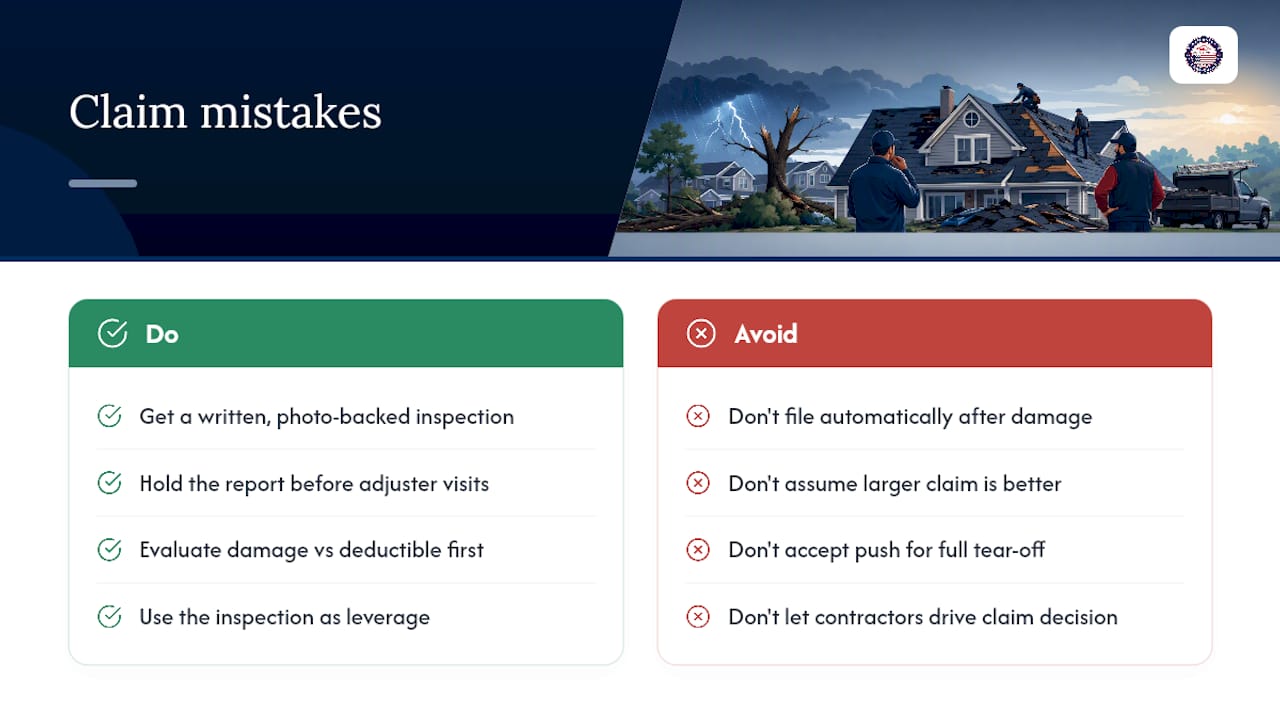
What the evidence actually supports is a documentation-first posture. The homeowners who come out ahead are the ones who had a written, photo-backed inspection in hand before the adjuster ever climbed a ladder. That report is leverage. Everything else, the adjuster meeting, the supplement requests, the repair-versus-replace call, flows from how solid that first document is.
Prioritize the inspection. The rest follows.
— Eric
Get a Free Storm Damage Inspection From a Local Crew
Storm-chasers and out-of-state crews can inspect your roof too, but they won't be around for the supplement request six weeks later or the warranty call two years from now. The Original Roof Repair Company operates out of Canton, Georgia, and stays local across Cherokee County and 11 surrounding counties, including the Atlanta metro area, which means the crew that inspects your roof is the same crew that shows up for the repair.
That local presence backs a repair-first promise: replacement gets recommended only when repair costs exceed $4,000 or repair genuinely isn't viable, never as an upsell after a storm rolls through. Every inspection comes with a written, photo-backed report you can hand to your adjuster, and Eric Manly's team will attend that adjuster meeting to make sure nothing gets missed.
If you've spotted damage after a recent storm, schedule a free roof inspection and get a written scope before you file anything with your carrier.
Sources
For homeowners who want to verify the guidance above, these resources cover contractor roles, adjuster inspections, and consumer protections in more depth.
- Insurance Adjuster Roof Inspection: 2026 Homeowner Guide | The Roofing Brief
- How Do Roofing Companies Work With Insurance? - LegalClarity
- Insurance Claim Roof Contractor: 7 Essential Tips for Success
FAQ
How Do I Know if My Roof Damage Is Worth an Insurance Claim?
Get a written inspection first. If the estimated repair cost is well above your deductible and reflects real storm damage, filing usually makes sense; if it's close to your deductible, weigh the premium risk before you file.
What Does a Claim-Experienced Roofer Do at the Adjuster Meeting?
The contractor walks the roof with the adjuster and points out damage that might otherwise be missed, backed by the photo report prepared beforehand. They document; they do not negotiate the settlement value.
Should I Hire a Roofer or a Public Adjuster?
A roofer inspects, documents, and estimates repair or replacement costs. A public adjuster negotiates your settlement and represents you formally, a role you need only if the claim is denied or contested.
Can I Cancel a Roofing Contract I Signed at Home?
In many cases, yes, within three business days under the FTC's Cooling-Off Rule, though exceptions exist depending on the circumstances of the sale.
Does The Original Roof Repair Company Handle Storm Claim Paperwork?
Yes. The Original Roof Repair Company provides free, photo-backed inspections, attends adjuster meetings, and supports supplement requests for homeowners across Cherokee County and the greater Atlanta, Georgia area.